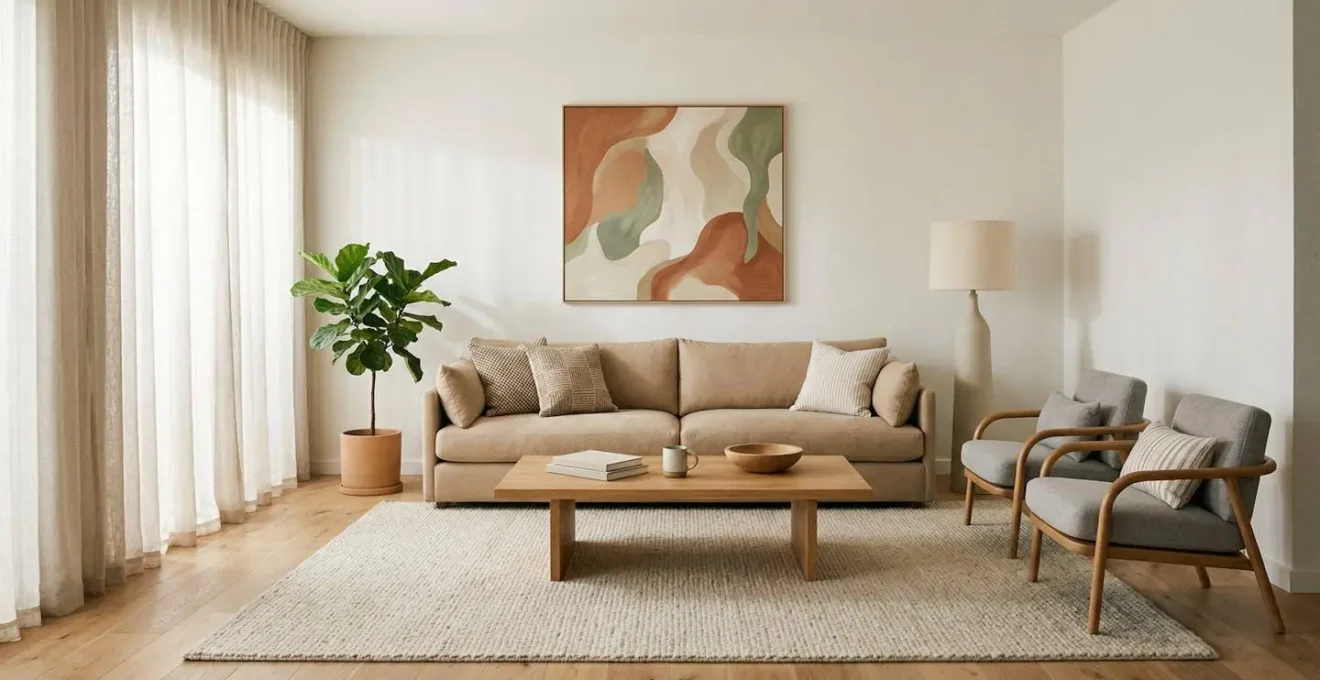
Creating a calm home is about much more than just decluttering or choosing soothing colors. It’s a scientific process of intentionally curating your environment to reduce your brain’s cognitive load. By understanding and applying core principles of perceptual fluency, biophilic design, and negative space, you can actively shape your surroundings to lower stress hormones, enhance focus, and foster a genuine sense of mental tranquility in your personal sanctuary.
For many urban homeowners, the promise of home as a sanctuary feels increasingly distant. You return from a demanding day, hoping to decompress, only to be met by a subtle but persistent sense of unease. The space that should be a refuge feels more like another source of stimulation, contributing to the very stress you’re trying to escape. This feeling is a common struggle for those of us living in dense, fast-paced environments, where the line between work and rest has become irrevocably blurred.
Conventional wisdom offers simple solutions: declutter your shelves, add a fresh coat of paint, or buy a few new plants. While these actions can provide temporary relief, they often fail to address the root cause of the issue. They treat the symptoms of environmental stress, not the underlying psychological and neurological mechanisms at play. But what if the true key to a restorative home wasn’t just about *what* is in your room, but about *how* your brain processes the visual information it receives?
As an environmental psychologist specializing in interior design, I can assure you the connection between our living spaces and our mental state is profound and scientifically validated. It’s governed by principles like cognitive load, perceptual fluency, and our innate biophilic responses. This article moves beyond surface-level decorating tips to explore the science of visual harmony. We will uncover why certain environments feel chaotic while others feel calming, and how you can intentionally design your home to be a true partner in your mental well-being, actively reducing your stress levels on a physiological basis.
Throughout this guide, we will explore the tangible ways you can transform your home from a source of sensory overload into a haven of psychological restoration. We’ll delve into the science behind visual noise, the power of symmetry and natural patterns, and the critical role of light in shaping your perception and mood.
Summary: A Scientific Approach to a Stress-Free Home Environment
- Why Does Visual Clutter Increase Anxiety in 70% of Remote Workers?
- How to Audit Your Living Room for Visual Noise in 30 Minutes?
- Symmetry vs Asymmetry: Which Layout Promotes Better Focus?
- The Over-Styling Mistake That Makes Rooms Feel Claustrophobic
- How to Use Natural Light to Soften Hard Architectural Lines?
- Why Do Fractal Patterns in Decor Lower Cortisol Levels?
- Why is 2700K Lighting Essential for Scandinavian Winter Evenings?
- Why Does Biophilic Design Improve Sleep Quality in Urban Apartments?
Why Does Visual Clutter Increase Anxiety in 70% of Remote Workers?
Visual clutter significantly increases anxiety because it bombards our brains with excessive stimuli, creating what neuroscientists call “visual noise.” This sensory overload forces our brain to work harder to filter out irrelevant information, increasing our cognitive load and triggering a constant, low-level stress response. For the growing population of remote workers, this effect is amplified, as the home must serve as both a productive office and a restful sanctuary, a dichotomy that can heighten feelings of anxiety.
This isn’t just a feeling; it’s a measurable neurological process. Research from the Princeton University Neuroscience Institute revealed that a cluttered environment directly competes for neural representation in the visual cortex. Using fMRI scans, scientists observed that when participants were in disorganized spaces, their brains’ ability to focus and process information was severely limited. This constant battle for attention drains mental energy, impairs working memory, and keeps our nervous system in a state of heightened alert, which manifests as anxiety and an inability to truly relax.
The context of remote work adds another layer of psychological strain. When your workspace is also your living space, the visual cues of unfinished tasks, disorganized papers, and general clutter prevent the mental disengagement necessary for recovery. In fact, an analysis by the Integrated Benefits Institute shows that remote and hybrid work are associated with higher rates of anxiety and depression. A cluttered home office ensures that your brain never truly “clocks out,” contributing to the chronic stress that so many urban professionals experience.
How to Audit Your Living Room for Visual Noise in 30 Minutes?
Auditing your living room for visual noise isn’t about stark minimalism; it’s about becoming aware of the “cognitive cost” of each item in the room. A simple 30-minute audit can reveal the hidden sources of sensory overload. Start by standing at the entrance of your living room and taking a photograph. The detachment of viewing it on a screen often makes patterns of clutter more obvious. Then, put the phone away and assess the space through a different lens.
Instead of seeing individual objects, try to see “visual weight.” Squint your eyes slightly. What shapes, colors, and textures jump out? Are they concentrated in one area, creating an unbalanced feeling? A stack of magazines, a tangle of electronic cords, or a shelf crowded with mismatched trinkets all carry significant visual weight. These are the primary sources of visual noise. The goal is not to eliminate personality, but to create balance. An asymmetrically balanced room, for instance, might pair a large sofa on one side with two smaller chairs and a tall lamp on the other, creating equilibrium without rigid mirroring.
This concept of balancing visual weight is crucial for creating harmony. It involves considering not just the objects themselves, but the interplay of their textures, colors, and forms. A successful composition allows the eye to rest and move gracefully through the space, rather than being constantly snagged by distracting focal points.
As you can see in this detailed view, balancing visual weight often involves contrasting textures. The rough, visible weave of a natural fabric provides a tactile counterpoint to the smooth grain of light wood. This thoughtful combination feels harmonious because it provides sensory interest without creating sensory conflict. During your audit, ask yourself: do the textures in my room complement each other, or do they fight for attention? A room filled with only hard, shiny surfaces can feel as jarring as one filled with too much pattern.
Symmetry vs Asymmetry: Which Layout Promotes Better Focus?
The choice between symmetrical and asymmetrical layouts directly influences your psychological state, and each serves a distinct purpose. For promoting passive rest and a sense of calm stability, symmetry is unparalleled. Our brains are neurologically programmed to find symmetry appealing because it’s easy to process. This effortlessness is a concept known as “perceptual fluency.” When a space is symmetrical, the brain doesn’t have to work hard to understand it, which conserves cognitive energy and induces a state of relaxation.
This innate preference is deeply rooted in our evolutionary drive to identify safe and predictable environments. As luxury interior designer Anita Lang notes, this principle is foundational to creating serene spaces.
Symmetrical arrangements are easier for the brain to process (‘perceptual fluency’), requiring less cognitive energy and thus promoting a state of passive rest.
– Anita Lang, IMI Design Studio
However, for tasks requiring active focus and creativity, a well-executed asymmetrical layout can be more effective. While symmetry fosters rest, asymmetry creates a sense of dynamism, energy, and visual interest. It forces the eye to move through the space, engaging the brain in a more active way. A home office, for example, might benefit from an asymmetrical layout where the desk is offset, and visual weight is balanced with shelving and artwork. This creates a more stimulating environment conducive to thought and problem-solving, without feeling chaotic.
The key is balance. An asymmetrical room shouldn’t feel lopsided. It requires a more sophisticated eye to arrange furniture and decor of varying sizes, shapes, and colors so that they achieve a sense of equilibrium. As research on interior architecture principles shows, the human brain instinctively seeks this equilibrium. Whether through the predictable calm of symmetry or the dynamic balance of asymmetry, the ultimate goal is to create a layout that supports the intended function of the room.
The Over-Styling Mistake That Makes Rooms Feel Claustrophobic
One of the most common design mistakes that inadvertently increases stress is over-styling. In an effort to inject personality and follow trends, many people fill every available surface with decorative objects, creating a space that feels busy, cramped, and ultimately claustrophobic. This “horror vacui,” or fear of empty spaces, works directly against our psychological need for visual breathing room. When the eye has no place to rest, the brain remains in a state of high alert, constantly processing information.
The antidote to over-styling is the intentional use of negative space. In design, negative space refers to the empty areas around and between objects. It is not “wasted” space; it is an active and essential element that defines the composition of a room. A room with adequate negative space feels open, airy, and calm. It allows the objects that you truly love to stand out and be appreciated, rather than getting lost in a sea of visual clutter.
The Japanese aesthetic principle of “Ma” (間) perfectly encapsulates the power of negative space. Ma is often translated as “gap” or “pause,” but it signifies an interval in time and space. It is the conscious appreciation of emptiness. In interior design, Ma is the powerful silence between notes, the empty wall that makes a single piece of art more impactful, the unfilled corner that makes a room feel expansive.
Embracing this philosophy means making deliberate choices. It requires curating your possessions and resisting the urge to fill every nook and cranny. Instead of ten small decorative items on a console table, choose one or two that have significant meaning. This not only reduces visual noise but also elevates the perceived value of the items you choose to display. By consciously incorporating negative space, you give your mind the permission and the physical room to relax and decompress.
How to Use Natural Light to Soften Hard Architectural Lines?
Natural light is one of the most powerful and cost-effective tools for transforming the feel of a room and reducing stress. Its primary psychological function is to connect us to the outdoor environment and the natural rhythm of the day, which helps regulate our circadian system. Aesthetically, it has the unique ability to soften hard architectural lines, making a space feel more gentle and organic. Harsh corners, sharp angles, and flat, imposing walls can be rendered soft and dynamic through the strategic manipulation of daylight.
The quality of light is just as important as the quantity. Direct, harsh sunlight can be just as jarring as a cluttered room, causing glare and discomfort. The goal is to diffuse and manage the light, turning it into a soft wash that bathes the room in a gentle glow. This can be achieved through a variety of techniques, from window treatments to the strategic placement of reflective surfaces. For instance, a sheer linen curtain doesn’t block light; it transforms it from a sharp beam into a soft, ambient luminescence that blurs the hard edges of window frames and walls.
Furthermore, light is not static. It moves and changes throughout the day, and learning to work with its temporal dimension is key to creating a dynamic, living space. Morning light has a different color and angle than afternoon light. By observing how light travels through your home, you can place objects—like a metallic vase or a large-leafed plant—to catch and manipulate it in beautiful ways, creating shifting patterns of light and shadow that add a layer of serene complexity to the room.
Your Action Plan: Mastering Light for a Softer Space
- Map light movement: Track how natural light moves through your room during different times of day to understand its temporal dimension.
- Use sheer window treatments: Install translucent fabrics like linen or cotton voile to diffuse harsh direct sunlight into a soft, even ‘light wash’ across walls.
- Position reflective surfaces strategically: Place a mirror or a polished metallic object to bounce and redirect soft morning or late afternoon light into darker corners of the room.
- Incorporate plants as natural diffusers: Place large-leafed plants, like a Fiddle Leaf Fig, in or near windows to break up harsh light into dappled, moving patterns that mimic a forest canopy.
- Balance light grazing and washing: Use sharp-angle lighting (grazing) from a floor lamp to accentuate the texture on a brick or stone feature wall, while washing other surfaces with diffuse light for overall softness.
Why Do Fractal Patterns in Decor Lower Cortisol Levels?
Fractal patterns, the repeating, self-similar patterns found everywhere in nature, lower cortisol levels because our brains are uniquely adapted to process them with remarkable efficiency. From the branching of a tree to the intricate structure of a snowflake or the veins of a leaf, these patterns represent the fundamental building blocks of the natural world. Our visual system evolved over millennia to recognize and decode them effortlessly. This phenomenon, known as “fractal fluency,” means viewing them requires very little cognitive energy, which in turn triggers an automated physiological relaxation response.
This stress-reduction effect is not just subjective; it’s a measurable biological event. Research led by physicist Richard Taylor at the University of Oregon used biometric sensors to track participants’ responses while viewing fractal and non-fractal images. The results were striking, revealing a 60% improvement in stress recovery for those viewing nature-based fractal images. The brain perceives these patterns as familiar and non-threatening, signaling the nervous system to shift from a “fight-or-flight” state to a “rest-and-digest” state, leading to a tangible decrease in stress hormones like cortisol.
Interestingly, not all fractals are created equal. The same research discovered that the most calming and restorative fractals are those with a mid-range complexity, similar to what we typically see in natural landscapes. Fractals that are too simple or too complex can fail to engage our visual system in this optimal, stress-reducing way. This explains why a Jackson Pollock painting, which contains these mid-range fractals, can feel so mesmerizing, while a simple checkerboard or a chaotic, overly intricate pattern does not have the same effect. Incorporating these patterns into your home decor—through artwork, textiles like a fern-patterned cushion, or a rug with a branching design—is a powerful way to tap into this innate relaxation mechanism.
Why is 2700K Lighting Essential for Scandinavian Winter Evenings?
In regions with long, dark winters like Scandinavia, artificial lighting is not just a utility; it is a critical tool for psychological well-being. The specification of 2700K lighting is essential for winter evenings because this color temperature perfectly mimics the warm, amber glow of a setting sun or a candle’s flame. This specific wavelength of light sends a powerful signal to our brains to begin winding down for the day, which is crucial for regulating our internal body clock, or circadian rhythm.
From a biological perspective, exposure to the blue-spectrum light common in standard office lighting (4000K-5000K) suppresses the production of melatonin, the hormone that governs sleep. Conversely, the warm, yellow-red hues of 2700K light have a minimal impact on melatonin, allowing our bodies to naturally prepare for rest. In the depths of a Scandinavian winter, where daylight is scarce, creating a distinct “evening” environment with warm lighting is vital to combat seasonal affective disorder (SAD) and maintain healthy sleep patterns.
Beyond the biology, this choice is deeply embedded in the cultural concept of “hygge”—a Danish term that encapsulates a feeling of coziness, contentment, and well-being. Hygge is about creating a warm, intimate atmosphere, and lighting is its most important ingredient. A pool of 2700K light from a low-hanging pendant over a dining table, or the soft glow from a floor lamp in a reading nook, creates a sense of sanctuary and safety. It defines a space as a haven from the cold, dark world outside. This use of layered, warm lighting transforms a house into a home, fostering a feeling of comfort and security that is psychologically restorative.
Key Takeaways
- Visual harmony’s primary benefit is reducing the brain’s cognitive load, which directly lowers physiological stress and anxiety.
- Natural elements—including specific light temperatures, fractal patterns, and biophilic features—are not just decorative but trigger innate relaxation responses.
- The intentional use of space, through balanced layouts (symmetry/asymmetry) and negative space, is more critical for creating calm than the quantity of objects in a room.
Why Does Biophilic Design Improve Sleep Quality in Urban Apartments?
Biophilic design, the practice of incorporating nature and natural elements into the built environment, significantly improves sleep quality in urban apartments by addressing the root causes of stress-related insomnia. Urban living constantly exposes us to artificial stimuli and disconnects us from the natural world, keeping our nervous systems in a chronically activated state. Biophilic design works as a powerful countermeasure, re-establishing this lost connection and promoting the physiological conditions necessary for restful sleep.
The mechanisms are twofold. First, exposure to natural elements—even just viewing them—has a direct, measurable impact on our bodies. As research shows, simply looking at natural elements or trees through a window can reduce blood pressure, lower the production of the stress hormone cortisol, and positively influence mood. When cortisol levels are high in the evening, they interfere with melatonin production and disrupt the sleep-wake cycle. By creating a home environment rich with plants, natural materials like wood and stone, and views of nature, you actively lower your daytime and evening stress levels, paving the way for your body to naturally prepare for sleep.
Second, biophilic design helps to recalibrate our circadian rhythms. Natural light, as discussed, is the primary driver of our internal clock. Additionally, elements like indoor plants that engage in photosynthesis and transpiration can subtly improve air quality and humidity, contributing to a more comfortable sleeping environment. The presence of these natural, living elements provides a gentle, non-jarring sensory input that is inherently calming to our primal brain. In an urban apartment, where exterior nature may be lacking, creating an interior “natural” ecosystem is a profound investment in your mental health and, consequently, your ability to achieve deep, restorative sleep.
To begin creating your own sanctuary, you don’t need a complete overhaul. Start by consciously auditing a single room for sources of visual noise and identify one small change you can make today—whether it’s clearing a surface, adding a plant, or changing a lightbulb—to begin reducing your brain’s cognitive load.