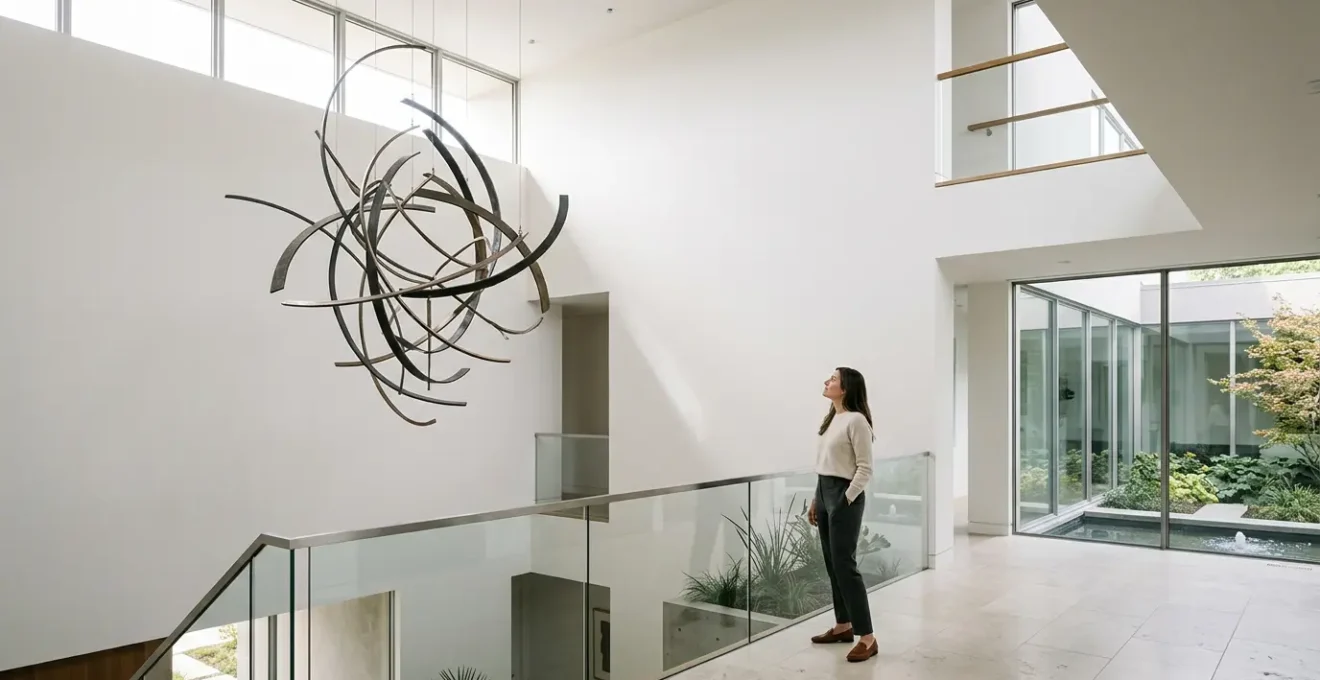
The greatest challenge in placing large-scale art is not filling the void, but sculpting it; success lies in treating the installation as an architectural intervention, not mere decoration.
- Structural integrity is non-negotiable and requires engineering expertise to manage both static and dynamic loads, far exceeding standard construction limits.
- The artwork’s “visual load” is as important as its physical weight; transparent or linear forms preserve openness and prevent psychological claustrophobia.
Recommendation: Prioritize a structural assessment and a spatial plan that considers traffic flow, acoustics, and the psychological footprint of the piece before ever selecting the art itself.
The owner of a property with a double-height atrium faces a unique and magnificent challenge. That vast vertical space is a canvas of immense potential, promising grandeur and architectural drama. Yet, it is often a space of quiet intimidation. The default solutions—leaving it empty, or filling it with oversized but conventional furniture—feel like a surrender. The ambition to place a truly significant, large-scale work of art is the correct instinct, but it is fraught with peril. The fear is not just of aesthetic missteps, but of a catastrophic, expensive failure.
Common advice often revolves around matching colors or finding a “focal point,” but this trivializes the undertaking. We are not hanging a painting; we are altering the very fabric of the architecture. The conversation must shift from decoration to logistics, from aesthetics to engineering. This is an act of spatial strategy where the physical weight of a sculpture must be balanced against its visual weight, and where the pathways of human movement—the very flow of the home—must be protected and even enhanced.
But what if the key was not simply to find art that “fits,” but to use the art to redefine the space itself? The true mastery of installing large-scale art in an atrium is to understand that you are not adding an object to a room; you are intervening in its architecture. It’s about sculpting the negative space, managing acoustic signatures, and respecting the psychological need for openness. This guide abandons decorative platitudes to provide a logistical and safety-conscious framework for this ambitious project.
We will dissect the process from the ground up, starting with the immense structural challenges, moving through the nuanced management of visual and psychological space, and finally exploring the functional and financial value of getting it right. This is your strategic manual for transforming a voluminous void into a statement of unparalleled sophistication.
Summary: A Strategic Framework for Monumental Art in Residential Spaces
- How to Rig a 200kg Sculpture in a Finished Ceiling?
- Why Do Standard Drywall Studs Fail With Museum-Grade Art?
- The Visual Claustrophobia of Over-Filling High Ceilings
- Suspended Mobile vs Floor Statue: Which Maintains Floor Traffic?
- How to Manage Acoustics When Installing Large Metal Artworks?
- Open Plan vs Broken Plan: Which Fits a Family of Four Better?
- How to Maintain a Vertical Living Wall in Low-Light Apartments?
- Why Does Oversized Art Signal Higher Luxury Than Furniture?
How to Rig a 200kg Sculpture in a Finished Ceiling?
Suspending a 200kg object—the weight of two adults—from a finished residential ceiling is not a DIY task; it is a serious structural engineering problem. The primary concern is moving beyond the concept of “hanging” and into the professional discipline of “rigging.” Your ceiling’s joists were likely designed to support the static load of the ceiling material itself, plus some tolerance for live loads like snow on the roof, not a massive, concentrated point load. A failure here is not a damaged frame; it is a catastrophe.
The first step is a structural assessment by a qualified engineer. They will not simply “find a joist.” They will calculate the total load (the art’s weight plus the rigging hardware) and determine how to distribute it. This often involves installing new blocking between joists or, more robustly, a steel plate or “sub-frame” in the attic space above the ceiling. This hardware spreads the point load across multiple structural members, preventing any single joist from being over-stressed. It’s an intervention that remains completely invisible after the ceiling is patched and finished.
Furthermore, safety is paramount. Professional engineering standards dictate significant safety margins. While typical building components often use a safety factor of 2.0, critical components whose failure could result in injury or death may require a factor of four to ten. This means a 200kg sculpture must be supported by a system rated to hold at least 800kg, and often more. This accounts for unforeseen stresses, material degradation over time, and dynamic forces (e.g., minor seismic activity, building vibration). This level of diligence transforms the installation from a risk into a permanent, secure architectural feature.
Case Study: The Engineering of Art at MIT
To understand the level of coordination required, consider the professional approach taken for public art. When engineers installed a sculpture at MIT’s Kendall Pavilion, they faced complex challenges, including placing it above an active metro station. The project demanded collaboration between multiple structural engineers and registered design professionals. This ensured that the overall structural system could handle the load and, crucially, that communication gaps were closed between the designers and installers. For a residential project of this scale, adopting this mindset—treating it as a formal project with clear professional oversight—is the only path to a safe and successful outcome.
Why Do Standard Drywall Studs Fail With Museum-Grade Art?
The question of why standard drywall and studs are insufficient for museum-grade art comes down to a fundamental misunderstanding of forces. A typical wall stud is designed to handle compressive loads (the weight of the roof and floors above pushing down). It is not designed to handle significant tensile or shear loads—the pulling and tearing forces exerted by a heavy, cantilevered object. A 100kg piece of art does not just exert 100kg of downward force; its mounting hardware acts like a lever, multiplying the stress on the fasteners and the stud itself.
Standard fasteners, like screws driven into a wood stud, have a limited pull-out strength. When a heavy object is hung, the top fastener is under immense tensile stress (it’s being pulled straight out), while the bottom of the mount creates a compression point against the drywall. The drywall, made of soft gypsum, will invariably crush and fail over time, causing the art to sag and eventually tear the fasteners from the stud. This is a slow, inevitable failure.
This is where engineering specifications provide crucial clarity. Structural standards, such as ANSI/AISC 360-10, define specific safety factors for different types of stress. While flexure and tension yielding might have a typical safety factor of 1.67, connections are held to a higher standard, often 1.75 to 2.0. Standard residential construction is simply not built with these art-specific load cases in mind. For “museum-grade” security, the solution is to bypass the drywall entirely and anchor directly to reinforced blocking installed horizontally between the studs, creating a structural plane designed specifically to handle these unique forces.
As this macro view of material stress illustrates, the intersection of hardware and building material is the critical point of failure. The physics of load distribution cannot be ignored. The integrity of a multi-million dollar property and priceless art depends on respecting these forces, not just finding the center of a stud.
The Visual Claustrophobia of Over-Filling High Ceilings
Once structural safety is guaranteed, the next great challenge emerges: managing the visual load. An atrium’s luxury is its volume, its feeling of light and air. The gravest error is to fill this volume with an object so massive and opaque that it creates a sense of visual claustrophobia, effectively putting a lid on the room and destroying the very openness that makes it special. The goal is not to fill the space, but to activate it.
This is where the concept of negative space transitions from an abstract design term to a crucial strategic tool. An artwork with high transparency—such as a wireframe sculpture, a mobile of delicate glass elements, or a form made of mesh—can command a huge physical footprint while maintaining a low visual load. It occupies the volume without blocking sightlines or light. Light from high windows can pass through it, casting dynamic shadows that become a secondary, evolving artwork on the walls and floor. The space breathes.
Negative space is not nothing. It only sounds like emptiness, but in practice, is very much something: a pause, a pocket of air, a moment of visual restraint that spotlights the pieces you love most.
– Interior design expert, Homes & Gardens Design Editorial
This principle of restraint is a hallmark of sophisticated design. Choosing a sculpture that is 70% empty space can have a far more powerful and luxurious impact than a solid, monolithic block. The void around the art becomes as important as the art itself. It allows the form, the material, and the interplay with light to be the focus, rather than sheer, oppressive mass.
This installation exemplifies the principle. The sculpture has presence and scale, yet the room’s volume remains unobstructed. It is a dialogue with the space, not a monologue that dominates it. This balance is the key to avoiding the feeling of a crowded, over-filled environment.
Suspended Mobile vs Floor Statue: Which Maintains Floor Traffic?
The choice between suspending an artwork or placing it on the floor is a fundamental strategic decision that directly dictates the flow of a space. While both can be effective, they serve different functions and create profoundly different psychological footprints. The physical footprint is obvious—a floor statue occupies tangible square footage. But the psychological footprint is the invisible zone of influence an object projects, guiding how people move and feel within a space.
A suspended mobile or sculpture has a zero-floor footprint, which seems ideal for maintaining open traffic paths. However, it creates an “overhead avoidance zone.” People subconsciously tend not to linger directly beneath a large, heavy object, even if it is perfectly secure. This can create an invisible barrier, a dead zone in the middle of a room. In contrast, a floor statue has a clearly defined boundary. Its footprint is unambiguous, allowing people to navigate around it with confidence and predictability.
Therefore, a floor statue can be a more effective tool for actively directing traffic. Placed strategically, it can function as a ‘flow director,’ creating intentional pathways, subtly separating a large open area into two distinct zones, or acting as a grand, central pivot point for circulation. The key is analyzing the desired movement patterns in the atrium. Is the goal an uninterrupted path from A to B, or is it to create areas for pause and congregation? The following comparison breaks down these considerations.
This table, based on an analysis of spatial dynamics, highlights the trade-offs between suspended and floor-based art.
| Aspect | Suspended Mobile | Floor Statue |
|---|---|---|
| Physical Footprint | Zero floor space occupied | Direct floor area required (typically 2-4 sq ft minimum) |
| Psychological Footprint | Creates overhead ‘avoidance zone’ – people may subconsciously avoid walking directly beneath heavy objects | Clearly defined boundary allows confident navigation around object |
| Traffic Flow Function | Leaves floor paths open but may not actively guide movement | Can function as ‘flow director’ – strategically placed to create intentional pathways or define functional zones |
| Visual Impact | Commands attention at eye level and above; maximizes use of vertical volume | Anchors space at ground level; provides tactile, approachable presence |
| Hybrid Option | Floor-to-ceiling installation using tensioned cables: minimal floor footprint while vertically emphasizing height | |
How to Manage Acoustics When Installing Large Metal Artworks?
An atrium, with its large volume and hard surfaces (glass, stone, wood floors), is an acoustic amplifier. It’s an echo chamber waiting to happen. Introducing a large-scale metal sculpture—a highly reflective surface for sound waves—can exacerbate this problem, turning a conversation into a cacophony and filling the space with unpleasant flutter echo and reverberation. However, a strategic approach can transform the artwork from an acoustic liability into a functional asset. The key is to manage the artwork’s acoustic signature from the outset.
Instead of a flat, polished sheet of metal, consider a sculpture with an irregular, faceted, or deeply textured surface. These complex geometries act as acoustic diffusers, scattering sound waves in multiple directions rather than reflecting them uniformly. This breaks up standing waves and prevents echo, improving speech clarity and creating a more comfortable, serene auditory environment. The art becomes a functional acoustic treatment disguised as a beautiful object.
Beyond diffusion, absorption is the other critical tool. Large, hollow metal forms can be discreetly filled with sound-dampening foam. Large, flat metal panels can be backed with high-density acoustic felt before installation. These interventions are completely invisible but can dramatically reduce the reverberation time of the room. The final strategy is acoustic pairing: balancing the reflective nature of the metal by placing sound-absorbing materials elsewhere. A plush, thick-pile rug placed directly beneath a suspended sculpture, or heavy velvet drapes on an opposing wall, will work in concert with the art to create a balanced and pleasing soundscape.
Action Plan: Mitigating the Acoustic Impact of Metal Sculptures
- Design for Diffusion: Commission or select a metal sculpture with irregular, faceted, or curved surfaces. Your primary goal is to use the art itself to break up sound waves and prevent flutter echo.
- Integrate Invisible Absorption: Plan for the integration of sound-dampening materials. Discuss with the artist or fabricator the possibility of backing large panels with acoustic felt or filling hollow sections with sound-absorbing foam.
- Deploy Strategic Pairing: Identify locations for complementary absorptive materials. Map out where to place thick area rugs, heavy drapery, or fabric acoustic panels to counterbalance the reflective properties of the metal.
- Conduct a Pre-Installation Test: If possible, bring a large, hard object (like a sheet of plywood) into the space to simulate the acoustic effect. Clap your hands and listen for the echo to understand the baseline problem you need to solve.
- Consult an Acoustician: For high-stakes projects or particularly challenging spaces, engage an acoustic consultant. They can model the room’s performance with the proposed artwork and recommend precise, data-driven solutions.
Open Plan vs Broken Plan: Which Fits a Family of Four Better?
The debate between open-plan and broken-plan living is central to modern family life. Open plans foster togetherness and a sense of space, but they can lack privacy and become chaotic with the competing activities of four individuals. Broken plans offer designated zones for quiet, work, and play, but can feel cellular and disconnected. Large-scale art, particularly transparent or sculptural forms, offers a third way: creating the benefits of a broken plan within an open-plan footprint without building a single wall.
Imagine a vast living/dining area. For a family of four, this can become a noisy, single-function space. Now, introduce a large, transparent sculptural installation—a series of suspended glass panels, or a tall, ethereal acrylic form—at the natural boundary between the living and dining zones. This piece acts as a “soft wall” or a spatial delineator. It doesn’t block light or sightlines; a parent in the kitchen can still see the children in the living area. Yet, it creates a powerful psychological separation.
This “art as architecture” approach provides distinct zones. The area on one side of the sculpture becomes the designated “quiet zone” for reading or conversation, while the other side remains the active “social zone.” The artwork breaks the plan visually and psychologically without sacrificing the light and volume that make the open plan desirable. It’s a sophisticated solution that adds aesthetic value while solving a fundamental functional problem for a family, providing both connection and separation simultaneously.
As demonstrated here, the sculptural element clearly defines the transition from one functional area to another while maintaining the home’s cohesive, light-filled atmosphere. It’s a functional intervention that feels purely artistic, making it the ideal solution for a family seeking both community and individuality in their shared space.
How to Maintain a Vertical Living Wall in Low-Light Apartments?
A vertical living wall is the ultimate large-scale installation: a living, breathing, evolving work of art. In a low-light environment like an urban apartment or a north-facing atrium, however, it presents a significant logistical challenge. Success depends on treating it not as a collection of potted plants, but as an integrated biomechanical system. The three pillars of success are light, water, and failure mitigation.
First, light must be engineered. Natural low light is insufficient. The solution is full-spectrum LED grow lights. The key is to integrate them architecturally, recessing them into the ceiling or concealing them behind soffits so they appear as deliberate, high-end interior lighting rather than a clunky agricultural add-on. The goal is to provide the necessary photosynthetically active radiation (PAR) without compromising the aesthetic flow of the space.
Second, water must be automated and invisible. A concealed drip irrigation system, running on a precise timer and connected directly to the building’s plumbing, is essential. Equally important is an integrated drainage system that routes excess water away discreetly. Visible collection trays or manual watering cans are signs of an amateur setup; a truly luxurious installation manages its own life support invisibly. The plant species themselves must be carefully selected for shade tolerance—ferns, pothos, philodendrons, and certain mosses can thrive with a combination of low ambient light and targeted supplementation.
Interior environments tend to be less stressful to artwork than exterior environments. Vandalism is generally minimal and the environmental concerns of temperature and relative humidity are usually well controlled.
– ArtsWA Conservation Guidelines, Materials and Fabrication Handbook for Public Art
Finally, one must plan for failure. This means using modular plant panels that allow for a single declining plant to be easily swapped out without dismantling the entire wall. Automated moisture sensors can prevent the number one cause of failure: over- or under-watering. And a scheduled professional maintenance contract is not an indulgence, but a necessary insurance policy to preemptively address pests, disease, or system malfunctions.
Key Takeaways
- Prioritize Engineering Over Aesthetics: A structural engineer’s assessment is the non-negotiable first step. The physical load must be safely managed before any artistic decisions are made.
- Sculpt with Negative Space: Avoid visual claustrophobia by choosing art with high transparency or a linear form. The goal is to activate the volume, not just fill it.
- Design for Flow and Psychology: Consider the artwork’s “psychological footprint.” Use floor pieces to direct traffic and suspended pieces to preserve open paths, but be mindful of the subconscious “avoidance zone” they create.
- Treat Acoustics as a Material: In a voluminous atrium, a large artwork’s acoustic signature is critical. Use faceted or irregular forms for diffusion and integrate absorption to prevent echo and create a serene environment.
Why Does Oversized Art Signal Higher Luxury Than Furniture?
The ultimate signal of luxury is not utility, but a confident command of space. While high-end furniture is functional and beautiful, it remains tethered to a human-scale purpose: a place to sit, a surface to work on. Oversized, site-specific art transcends this. Its primary function is not to serve a physical need, but to master and define the architectural volume it inhabits. This commitment of space to a non-utilitarian object is the ultimate expression of affluence—it declares that the owner can afford to dedicate significant, prime real estate purely to the provocation of thought and emotion.
Furthermore, a monumental sculpture or installation is a statement of permanence and commitment. Unlike a sofa that can be replaced with changing trends, a 200kg sculpture rigged into the ceiling is an architectural intervention. It is integrated into the home’s very identity. This signals a level of confidence and long-term vision that disposable decor cannot match. It suggests the home is not just a collection of objects, but a curated environment, a private gallery.
Finally, it has a unique investment quality. While furniture depreciates, significant art has the potential to appreciate. More importantly, it enhances the value of the architecture itself. As noted by art investment specialists, while owning a large installation can be challenging, it can significantly increase the investment value of the building it’s placed in. The artwork and the architecture become a single, more valuable asset. It is a purchase that is both an emotional indulgence and a strategic financial decision, a combination that defines the pinnacle of modern luxury.
To embark on this journey is to move beyond conventional decoration and into the realm of architectural strategy. The next logical step is to commission a formal structural assessment and spatial analysis for your property, ensuring that this powerful statement of luxury is built on a foundation of unshakeable safety and strategic foresight.