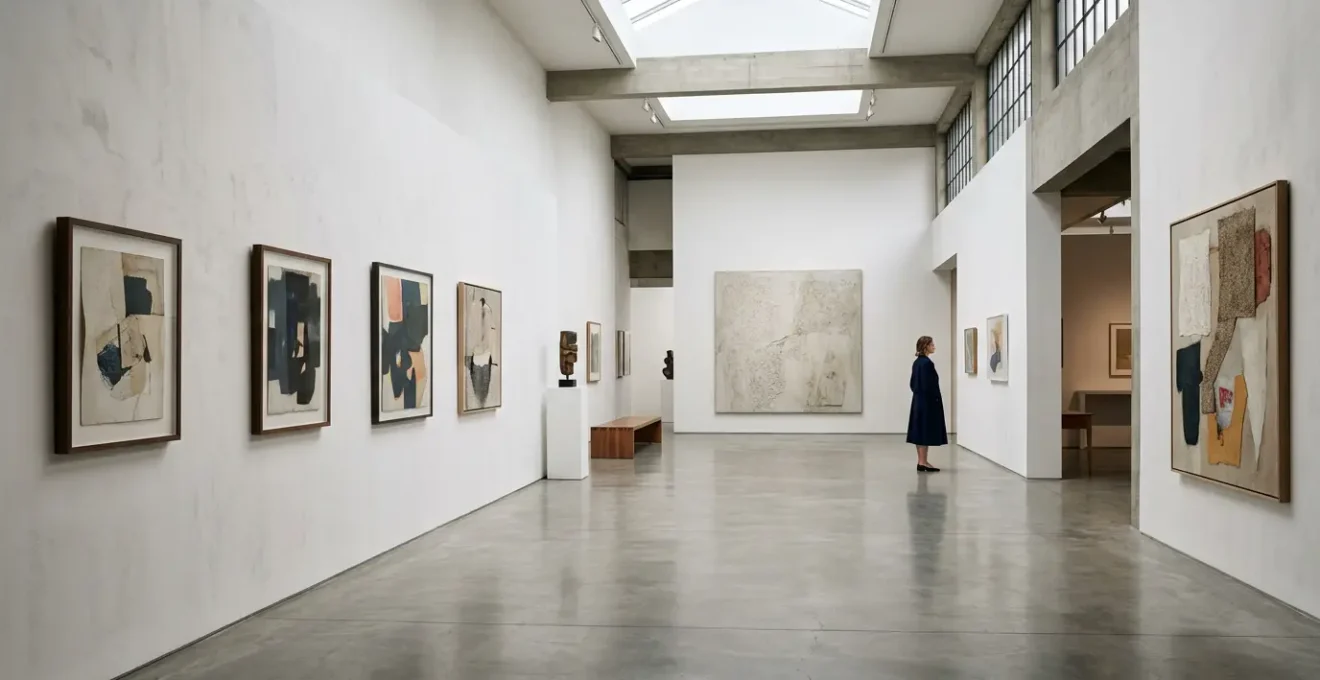
Building a valuable art collection is less about luck and more about a disciplined, infrastructure-focused investment strategy.
- Success hinges on identifying pre-market indicators of an artist’s career trajectory, not just chasing current aesthetic trends.
- The financial upside is locked in by actively building “value infrastructure”—provenance, exhibition history, and critical recognition—from the moment of acquisition.
Recommendation: Your first step is to shift your mindset from a passive collector to an active art portfolio manager.
For the aspiring collector with a discerning eye and a moderate budget, the art market presents a tantalizing yet perilous landscape. The desire to own something beautiful is often coupled with the quiet hope that it might one day be worth more than its purchase price. This is where the journey begins for many, armed with the well-intentioned but financially naive advice to simply “buy what you love.” While passion is a valid entry point, it is an insufficient strategy for long-term financial appreciation. The market is littered with beautiful objects that will never accrue value.
The common path involves visiting galleries, perhaps acquiring a limited-edition print, and securing a certificate of authenticity. These are the basic mechanics of buying, not the strategic mechanics of investing. They fail to address the fundamental question: what separates a decorative piece from a strategic asset? This distinction is crucial for anyone looking to build a collection that matures financially over a decade, rather than merely adorning a wall. The key is not to have a bigger budget, but to have a sharper framework for evaluating potential.
This is where we move beyond the platitudes. What if the most critical factor for an artwork’s appreciation isn’t its immediate aesthetic appeal, but the underlying “value infrastructure” that supports it? This guide proposes a shift in perspective: from viewing art as a static object to understanding it as a dynamic asset with a career trajectory. We will deconstruct the mechanisms that drive value, offering a systematic approach to identifying, acquiring, and managing art for long-term growth within a $5,000 to $20,000 budget.
This article provides a strategic roadmap for the art investor. We will dissect the signals that predict an artist’s ascent, navigate the nuanced ROI of prints versus originals, and identify the market traps that snare novice collectors. You will learn to manage your collection like a portfolio, building the very provenance that will one day define its worth. The following sections break down this methodology into actionable intelligence.
Summary: A Strategic Framework for Art Investment and Value Creation
- How to Spot Future Blue-Chip Artists at Graduate Shows?
- Originals vs Limited Prints: Which Offers Better ROI for Beginners?
- The “Trend Trap” That Devalues Collections Within 5 Years
- How to Insure a Growing Art Collection Without Overpaying Premiums?
- Why Is Provenance the Single Most Critical Factor for Resale?
- When to Sell Designer Furniture to Maximize Resale Profit?
- How to Identify Which Brand Collaborations Will Become Classics?
- How to Invest in Limited Edition Homeware That Retains Value?
How to Spot Future Blue-Chip Artists at Graduate Shows?
The hunt for the next art market star begins not in the glossy pages of auction catalogues, but in the raw, energetic environments of MFA exhibitions and graduate shows. This is the frontline of aesthetic innovation, where financial investment requires foresight, not just capital. For the astute collector, these shows are not social events; they are opportunities for aesthetic arbitrage, identifying talent before the market applies its premium. The key is to look beyond the immediate visual appeal and analyze the structural indicators of a promising career.
First, observe who else is looking. Gallerists, curators, and seasoned collectors attend these shows with a specific agenda. Pay attention to the artists who are generating quiet, serious conversations. More important than a single prize is early institutional validation. Has a graduating artist been included in a group show by a respected independent curator? Has a tastemaker with a proven track record acquired a piece? These are the pre-market indicators of future success. The quality of an artist’s first gallery representation is a powerful predictor; market research on emerging artist trajectories shows this to be a critical factor in their long-term career success. A gallery with a history of nurturing talent is a significant asset.
Finally, analyze the artist’s progression pattern. A successful trajectory typically moves from group exhibitions to solo shows, and from regional to international representation. An artist who secures a solo show with a credible gallery within a year or two of graduating is demonstrating significant momentum. Your role as an early investor is to spot this pattern at its inception, acquiring works when the artist is demonstrating professional discipline and a clear vision for their career path. This is how you invest in a career, not just a canvas.
Originals vs Limited Prints: Which Offers Better ROI for Beginners?
For collectors operating within a moderate budget, the “original vs. print” dilemma is a constant strategic consideration. The allure of a unique original work is powerful, but its price point can often limit a new collector to less-established artists. Conversely, a limited edition print by a well-known name offers a share in their brand equity, but is it a genuine investment vehicle? The answer lies in understanding the mechanics of scarcity and market demand for each format.
A unique original painting or sculpture holds the highest potential for massive appreciation, but also carries the highest risk. Its value is entirely tied to the single artist’s career trajectory. If the artist fails to gain recognition, the original work has little to no secondary market. It is a high-risk, high-reward bet. For a beginner, allocating an entire $5,000-$20,000 budget to one or two unique works from unproven artists can be a precarious strategy. Diversification is key.
Limited edition prints offer a more accessible entry point into an established artist’s market. However, not all prints are created equal. The key drivers of ROI are the edition size, the artist’s signature, and the print’s specific designation. A small, numbered edition (e.g., under 50) will always be more valuable than a large or open edition. The most coveted are often the Artist’s Proofs (APs). These are a small number of prints, typically 10-20, pulled during the printing process for the artist’s approval. Because of their rarity and direct connection to the artist’s process, investment-grade print experts note that APs often command a significant premium over the main edition on the secondary market. For a beginner, securing an AP from a rising artist can offer a superior risk-adjusted return compared to a minor original from a complete unknown.
The “Trend Trap” That Devalues Collections Within 5 Years
One of the most significant risks for any collector is the “Trend Trap”—the speculative vortex that forms around a new, fashionable aesthetic, driving prices to irrational highs before an inevitable crash. These trends are often purely aesthetic, lacking the deeper art-historical or conceptual underpinnings that create lasting value. Falling for them is the quickest way to see a collection’s value evaporate within five years.
The defining characteristic of a trend, as opposed to a durable movement, is its lack of “value infrastructure.” Trends are often driven by social media hype, a handful of speculative collectors, and an aesthetic that is easily replicable. Enduring movements, by contrast, are supported by critical writing, museum acquisitions, and a dialogue with art history. Before acquiring a piece that feels very “of the moment,” ask critical questions: Is there serious academic discourse around this style? Are museums showing interest? Or is the excitement primarily confined to Instagram and the auction block?
As the image metaphorically suggests, lasting value is often rooted in materials and concepts that possess timeless qualities, while fleeting trends have a shiny but ultimately fragile surface. This distinction is crucial for long-term investment. Consider the cautionary tale of “Zombie Formalism,” a movement of process-based abstract painting that exploded in the early 2010s.
Case Study: The Zombie Formalism Market Bubble
From 2011 to 2014, the market for “Zombie Formalism” was frenzied. A painting by Lucien Smith, initially sold for $10,000 after his graduate thesis show, was flipped at auction for a staggering $389,000 in 2013. Collectors chased the hot trend, paying six-figure sums for works that were aesthetically pleasing but conceptually thin. However, as market saturation occurred and critical support waned, the bubble burst. By 2022, works that once commanded $100,000 were selling for as little as $12,000. This case vividly illustrates how a market driven by aesthetic speculation without deep art-historical relevance can collapse, wiping out value for those who bought at the peak.
How to Insure a Growing Art Collection Without Overpaying Premiums?
As your collection grows in size and value, insurance shifts from an afterthought to a critical component of your portfolio management. However, many collectors inadvertently overpay for premiums or, worse, find themselves underinsured when a claim is needed. The key to cost-effective coverage is to present your collection—and yourself—as a low-risk client to specialist art insurers.
Standard homeowner’s policies are woefully inadequate for a growing art collection. They often have low per-item limits and settle claims based on “actual cash value” (purchase price minus depreciation), which is the opposite of how fine art appreciates. You need a dedicated fine art policy. The most crucial feature to seek is an “agreed value” clause. This means you and the insurer agree on the artwork’s value when the policy begins. In the event of a total loss, you receive that full amount, regardless of market fluctuations. This is particularly advantageous for emerging art, where values can be volatile.
Insurers price risk. The more professional and organized you are, the lower your perceived risk. Using professional collection management software (like Artlogic or Collector Systems) is a game-changer. These platforms allow you to maintain a complete digital dossier for each piece: invoices, certificates of authenticity, provenance documents, and condition reports. Presenting this to an insurer demonstrates a level of seriousness that can lead to better rates. Furthermore, bundling your entire collection under a single, comprehensive policy with a specialist art insurer is almost always more cost-effective than insuring pieces individually. These insurers understand the nuances of a well-curated collection and may offer better terms for a portfolio that shows thematic coherence and discerning taste.
Why Is Provenance the Single Most Critical Factor for Resale?
In the art market, you are not just buying an object; you are buying its story. That story is its provenance—the documented history of ownership, exhibition, and publication for a work of art. While aesthetics, artist reputation, and condition are all vital, provenance is the bedrock upon which long-term value is built. It is the single most critical factor in guaranteeing authenticity, establishing historical significance, and ultimately, maximizing resale value. An artwork with a weak or broken provenance is a high-risk asset, whereas a piece with a stellar provenance is a blue-chip in the making.
At its most basic level, provenance serves as a guarantee against forgery or misattribution. An unbroken chain of ownership back to the artist’s studio provides the confidence necessary for a high-value transaction. But its role extends far beyond simple authentication. A distinguished provenance can dramatically increase an artwork’s value. Has the piece been owned by a famous collector? Exhibited at a major museum? Published in a scholarly book or the artist’s catalogue raisonné? Each of these events adds a layer of cultural validation and historical importance to the work, making it more desirable. As art market valuation research consistently shows, works from well-documented collections command significantly higher prices precisely because this history adds a narrative and credibility that the market pays a premium for.
For the strategic collector, this means provenance should not be viewed as a static document received at purchase. It should be treated as an active asset to be built and enhanced over time. This is a core tenet of transforming a collection from a group of objects into a portfolio of appreciating assets. By actively managing and building the provenance of your collection, you are directly manufacturing the value that future buyers will seek.
Action Plan: How to Build Strong Provenance for Your Collection
- Loan works to university galleries and other cultural institutions to create a public exhibition history.
- Proactively contact academics or foundations managing an artist’s catalogue raisonné to have your pieces documented.
- Maintain meticulous digital and physical records, including original invoices, purchase agreements, and certificates of authenticity.
- Commission professional photography and create a formal condition report at the time of acquisition, and periodically thereafter.
- Ensure any conservation or restoration work is done by a reputable professional and is fully documented, as this becomes part of the work’s history.
When to Sell Designer Furniture to Maximize Resale Profit?
The principles of value appreciation are not confined to paintings and sculpture. Collectible designer furniture follows similar, if not more predictable, market cycles. For the investor-collector, the question is not just *what* to buy, but *when* to sell. Selling a piece of designer furniture at the wrong time can mean realizing a fraction of its potential value. Understanding the “20-Year Design Appreciation Cycle” is crucial to maximizing resale profit.
Unlike fine art, which can appreciate from the moment it leaves the studio, designer furniture often experiences an initial period of depreciation. For the first 10-15 years, a piece can look merely “dated” or “second-hand.” This is the trough of its value cycle, and it is the worst possible time to sell. Many novice collectors panic during this phase and offload pieces for a loss. The strategic investor, however, recognizes this as a predictable part of the asset’s lifecycle and holds through it.
The turning point typically occurs around the 20-25 year mark. At this stage, the piece sheds its “dated” label and acquires the coveted “vintage” status. A new generation of collectors, who did not grow up with the style, begins to appreciate it with fresh eyes. This is when the appreciation phase begins in earnest. The key is patience. Market research on collectible assets confirms this pattern, showing a predictable trough before a growth phase as items gain historical status. For example, analysis of certain design markets shows that holding through the initial depreciation period is essential, as the most significant returns are realized after the piece crosses the 20-year threshold into vintage territory. The patina of age, if well-preserved, becomes an asset, not a flaw.
How to Identify Which Brand Collaborations Will Become Classics?
In today’s market, the lines between art, fashion, and design are increasingly blurred, with brand collaborations becoming a distinct category of collectible assets. From a sneaker designed by a contemporary artist to a luxury handbag reinterpreted by a streetwear label, these limited-edition items can experience explosive value growth. The challenge is discerning which of the thousands of collaborations launched each year have the potential to become future classics, and which are merely marketing noise.
The first and most critical test is the “DNA Merger” test. A collaboration that will retain long-term value is one where the core ethos of both partners are genuinely fused to create something new and authentic. It should feel like a true dialogue between two creative worlds. A collaboration that is simply one brand’s product with another brand’s logo slapped on it lacks the conceptual depth to endure. The value is in the synthesis, not the endorsement.
Secondly, prioritize “firsts and lasts.” The very first time a historic, heritage brand collaborates with a contemporary artist, or the final collection designed by a celebrated creative director before their departure, carries an intrinsic historical premium. These are unique moments in design history that cannot be replicated. Finally, assess the item’s cultural resonance. Did the collaboration define a specific cultural moment or become deeply intertwined with a subculture? Its connection to a significant social or artistic shift provides a powerful narrative that fuels long-term collector demand. As market forecasts indicate that a massive wealth transfer of $84 trillion is underway, the values of younger collectors will increasingly dictate which of these cultural moments are deemed historically significant and, therefore, valuable.
Key Takeaways
- Value is built, not found: Shift from a passive buyer to an active manager of your collection’s “value infrastructure.”
- Provenance is your most critical active asset: Continuously work to enhance the documentation and exhibition history of your pieces.
- Trends are traps; seek historical relevance: Avoid purely aesthetic fads and invest in works that have a dialogue with art history and critical discourse.
How to Invest in Limited Edition Homeware That Retains Value?
Investing in limited edition homeware—from ceramic objects to textile art and design pieces—requires the same strategic rigor as collecting fine art. The principles of scarcity, authenticity, and provenance are paramount. For the aspiring investor, the most critical factor to understand is the structure of the edition itself, as this directly dictates its potential for appreciation. Not all “limited editions” are created equal, and the terminology can be misleading.
The primary distinction is between a numbered limited edition and a timed or open edition. A numbered edition (e.g., “1 of 50”) has a fixed, known quantity. This built-in scarcity is the fundamental driver of its value. As the edition sells out on the primary market, its price on the secondary market naturally tends to rise. An open or timed edition, where as many pieces are produced as are ordered within a specific timeframe, lacks this crucial scarcity. The true edition size may be in the thousands, making significant appreciation unlikely. While there are exceptions for highly iconic pieces, the investment-grade assets are almost always found in small, numbered editions.
The following table breaks down the value characteristics of different edition types, providing a clear framework for assessing potential investments. The link between the creator and the object is also a powerful value driver. An object produced in the designer’s own studio or by a renowned small-scale artisan workshop carries a direct link to the creator’s hand, amplifying its value far beyond a mass-produced licensed item. In the growing affordable art market, where the Artprice 2024 report shows that sales of prints under $5,000 surged 79% since 2020, understanding these nuances is what separates a savvy purchase from a decorative one.
| Edition Type | Scarcity Level | Value Characteristics | Market Demand |
|---|---|---|---|
| Numbered Limited Edition (e.g., ‘1 of 50’) | High – fixed, known quantity | Built-in scarcity drives appreciation; prices typically increase as edition sells | High demand due to exclusivity |
| Timed Release / Open Edition | Low – unlimited quantities for set period | True edition size unknown, often too large to appreciate significantly | Lower demand; can still sell for thousands depending on artist and condition |
| Artist’s Proof (AP) | Very high – typically 10-20 per edition | Often more valuable than standard numbered editions due to unique characteristics | Highest demand among collectors |
| Studio-Made / Artisan Workshop | High – direct link to creator | Provenance from designer’s studio or renowned small-scale workshop amplifies value significantly | Premium pricing and sustained collector interest |
Your journey to building a legacy collection starts not with a purchase, but with a plan. Apply this framework to your next acquisition to ensure it is not just an object of beauty, but a strategic asset engineered for the future.