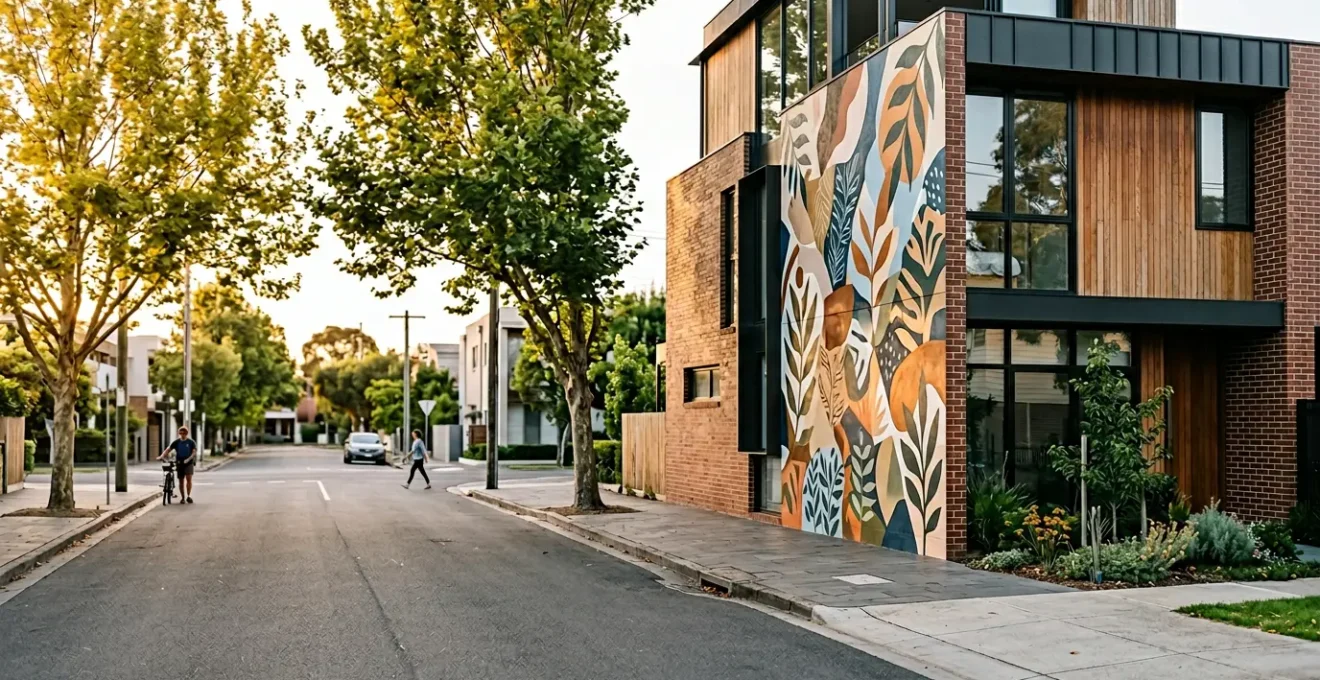
Commissioning a residential mural is not an aesthetic choice but a calculated real estate investment that transforms a wall into a socio-economic asset with measurable impacts on value and security.
- A well-executed mural functions as “territorial reinforcement,” actively deterring vandalism and signaling a cared-for, monitored environment.
- Legal complexities, specifically the Visual Artists Rights Act (VARA), grant the artist moral rights that can lead to significant financial liability for the property owner if ignored.
Recommendation: Treat the project as a strategic urban intervention. Prioritize legal due diligence and community engagement from the outset to mitigate risks and maximize the positive impact on your property’s long-term value.
For a property owner in a gentrifying neighborhood, the exterior wall is more than a boundary; it’s a statement. The idea of commissioning a mural often begins with a simple desire for beautification or to cover a graffiti-prone surface. Conventional wisdom suggests it enhances “curb appeal,” a vague and often unquantifiable benefit. This perspective, however, barely scratches the surface of a far more complex and strategic decision. Viewing a mural as mere decoration is a critical oversight.
The true impact of residential street art on property value lies beyond the paint. It is an act of urban planning in miniature, a strategic tool that interacts with legal frameworks, community dynamics, and economic perceptions. It involves navigating a labyrinth of municipal permits, understanding nuanced copyright laws that can create significant liabilities, and actively managing the asset to preserve its value. The conversation must shift from aesthetics to a rigorous analysis of risk, maintenance, and return on investment.
This analysis moves beyond platitudes to deconstruct the mural as a socio-economic instrument. What are the legal lines between your property rights and an artist’s moral rights? How does a mural function as a deterrent to crime, and what architectural principles support this? How do you engage a community not just to avoid complaints, but to turn them into stakeholders who actively protect the asset? This is not about choosing colors; it’s about making a calculated investment in your property’s place within the urban fabric.
This guide provides a framework for property owners to navigate this complex terrain. We will explore the process from a real estate planner’s perspective, covering the critical legal, economic, and social considerations that determine whether a mural becomes a valuable asset or a costly liability.
Summary: Commissioning Residential Street Art: A Strategic Analysis of Its Impact on Property Value
- Mural Permits: Do You Own the Wall or Does the City?
- Does Commissioning a Mural Deter Illegal Graffiti Tagging?
- Copyright vs Property Rights: Who Owns the Image on Your Wall?
- How to Clear-Coat an Exterior Mural to Survive UV and Rain?
- How to Involve Neighbors in Mural Design to Avoid Complaints?
- Why Does Poor Flow Reduce Property Value by Up to 15%?
- Windows vs Art Preservation: The UV Risk in Modern Glass Homes
- How to Use Interior Murals to Alter Depth Perception in Small Rooms?
Mural Permits: Do You Own the Wall or Does the City?
Before any paint touches a wall, the first and most critical step is navigating the legal and bureaucratic landscape. The common assumption that you have absolute authority over your property’s exterior is a frequent and costly mistake. In most urban and suburban jurisdictions, a wall visible to the public is subject to municipal oversight, including zoning codes, design review boards, and specific permit requirements for “original art murals.” Ignoring this process can result in fines, mandated removal of the artwork, and legal disputes.
The level of scrutiny often depends on the property’s location. If your building is situated within a designated Historic District or a Design Overlay Zone, the aesthetic and material requirements will be significantly stricter. The goal of these regulations is to maintain a cohesive neighborhood character, and your proposed mural will be evaluated on its ability to contribute positively to that vision. This is where the economic justification begins; a city-approved mural is a recognized improvement, and some media reports indicate property prices increased by 10 to 15% in New York neighborhoods after the introduction of commissioned murals.
Obtaining a permit transforms the project from a private act into a sanctioned public improvement. The process typically requires detailed submissions, including design renderings, material specifications, and a plan for long-term maintenance. Crucially, it also requires you, the property owner, to formally accept responsibility for the mural’s upkeep. This legally codifies the mural as a permanent fixture of your property, an asset that you are obligated to maintain, which has direct implications for its appraisal value.
The permit process, while often arduous, serves as the foundation for the mural’s legitimacy as a property asset. It is the first formal step in converting a blank wall into a value-adding feature recognized by both municipal authorities and, consequently, the real estate market.
Does Commissioning a Mural Deter Illegal Graffiti Tagging?
One of the most compelling arguments for commissioning a mural, from a property management perspective, is its role in crime prevention. This goes beyond simply covering a “problem wall”; it is an application of a core urban planning principle known as Crime Prevention Through Environmental Design (CPTED). CPTED operates on the idea that the physical design of an environment can influence offender decisions and reduce the incidence of crime. A well-maintained mural is a powerful tool for what CPTED calls “territorial reinforcement.”
This principle is rooted in the “Broken Windows Theory,” which posits that visible signs of neglect—like broken windows, litter, and graffiti tags—encourage further crime and disorder. A commissioned mural inverts this theory. It sends a clear, non-verbal signal that the space is cared for, managed, and actively monitored. As the Covington Police Department notes in its CPTED guidelines, this proactive stance is a significant deterrent.
Painting wall murals discourages graffiti… Installing art on sites reinforces that the property is cared for and spaces are managed, thus increasing territorial reinforcement.
– Covington Police Department, Crime Prevention Through Environmental Design (CPTED) Guidelines
The psychological impact on potential vandals is profound. A blank wall is an anonymous, low-risk canvas. A vibrant, complex mural represents a significant investment of time, effort, and community identity. Tagging over it is not just an act of vandalism but a violation of a respected piece of community art, often increasing the social risk for the offender.
This effect is amplified when the mural is a product of community engagement, transforming the property from a private entity into a shared point of pride. This establishes an informal network of surveillance, where neighbors and passersby feel a sense of ownership and are more likely to report defacement.
Case Study: CPTED Principles in Detroit
An ongoing research initiative by the NEA Research Lab is studying how murals in Detroit communities serve as an implementation of CPTED principles. The research explores the hypothesis that these artworks can reduce firearm-related crimes not just by beautifying a space, but by improving residents’ social and emotional well-being. By fostering place-based connections and a sense of ownership, the murals act as proactive environmental deterrents that influence a potential offender’s decision-making process before a criminal act occurs.
Copyright vs Property Rights: Who Owns the Image on Your Wall?
Once the mural is complete, a critical legal question arises: who owns the art? While you own the physical wall, you do not automatically own the intellectual property of the image painted on it. This distinction is governed by copyright law, and in the United States, specifically by the Visual Artists Rights Act of 1990 (VARA). Misunderstanding VARA is one of the most significant financial risks a property owner can face when commissioning a mural.
VARA grants “moral rights” to the artist of a “work of visual art,” even after the work is sold or commissioned. These rights are personal to the artist and cannot be transferred, though they can be waived in a signed written agreement. The two most important moral rights for a property owner to understand are:
- The Right of Attribution: The artist’s right to be credited as the creator of the work.
- The Right of Integrity: The artist’s right to prevent any intentional distortion, mutilation, or modification of the work that would be prejudicial to their honor or reputation. Crucially, this also includes the right to prevent the destruction of a work of “recognized stature.”
This “right of integrity” is where property owners face the greatest liability. If you decide to renovate, repaint, or demolish the wall, you could be found liable for destroying the artwork. The financial consequences are not trivial. In a landmark case involving the 5Pointz complex in New York, a court awarded $6.75 million in damages to a group of artists after finding that the property developer willfully destroyed their murals. To be protected, you must secure a written VARA waiver from the artist as part of your initial contract. This document explicitly states the artist waives their moral rights, giving you the freedom to modify or remove the mural in the future without liability.
VARA grants what are known as ‘moral rights’ to the author or artist of certain ‘works of visual art.’ These rights are only given to the artist of the work and cannot be transferred (although they can be waived through a signed contract).
– Oregon Volunteer Lawyers for the Arts, Visual Artists Rights Act (VARA) Legal Guide
Without a signed waiver, the artist retains significant control over the artwork on your building, creating a legal entanglement that can complicate future sales, renovations, and your overall control of the property. This legal due diligence is a non-negotiable part of treating a mural as a professional real estate asset.
How to Clear-Coat an Exterior Mural to Survive UV and Rain?
A mural’s contribution to property value is directly tied to its condition. A vibrant, well-maintained mural signals care and investment, while a faded, peeling, or vandalized one suggests neglect and can detract from value even more than a blank wall. A long-term maintenance strategy is therefore not an afterthought but a core component of the initial investment. This strategy begins with material selection and culminates in a protective clear-coat.
The longevity of an exterior mural depends on a system of compatible materials. The process starts with selecting the right paints. Artists should use lightfast, mineral-based, or silicate paints specifically designed for high-UV environments. These pigments are more resistant to fading than standard acrylics. The next, and most crucial, layer is the protective clear-coat. There are two primary categories:
- Sacrificial Coatings: These are clear, typically wax-based, coatings that sit on top of the mural. If the mural is vandalized with graffiti, the coating (and the graffiti) can be removed with high-pressure hot water, sacrificing the clear layer but leaving the artwork underneath unharmed. A new sacrificial coat is then reapplied. This is an excellent option for highly accessible, high-risk areas.
- Permanent (Non-Sacrificial) Coatings: These are often two-part urethane or acrylic varnishes that create a hard, non-porous barrier. Graffiti can be cleaned off this surface using specific solvents without damaging the coating or the mural. These coatings offer robust UV protection and a longer lifespan but can be more difficult to remove if the mural itself ever needs to be retouched.
The choice of coating must be chemically compatible with both the paint and the wall substrate (brick, concrete, wood) to prevent yellowing, peeling, or other adverse reactions. Beyond the initial coating, a successful strategy includes an annual inspection and cleaning schedule to remove pollutants and an insurance plan. Scheduling the mural as a valuable ‘other structure’ on your homeowner’s policy is a prudent step to protect the investment. This transforms the mural from a simple paint job into a durable, defensible, and insurable asset in “appraisable condition.”
How to Involve Neighbors in Mural Design to Avoid Complaints?
A mural’s success is not just determined by its artistic merit or legal compliance, but by its social acceptance. A piece of art that is beloved by the community becomes a protected asset; one that is resented can become a source of conflict and complaints, undermining its value. Proactive community involvement is the primary strategy for mitigating this social risk and transforming neighbors from potential opponents into vested stakeholders.
The process of engagement should begin long before a design is finalized. Announcing a fully formed plan can be perceived as an imposition, whereas inviting collaboration fosters a sense of shared ownership. This can take several forms, from informal coffee meetings to more structured design charrettes where residents can share ideas about themes, colors, and imagery that resonate with the neighborhood’s identity. This process not only builds goodwill but also generates valuable insights, ensuring the final artwork feels authentic and representative. The data supports this: research suggests that 80% of people believe street art in their neighborhood creates a positive atmosphere.
The goal is to create a “place-based connection,” where the mural becomes part of the community’s story. When residents see their ideas reflected on the wall, they are more likely to defend it, report vandalism, and speak of it with pride to others—all of which positively influences the perceived value and safety of the area.
Case Study: The Marcus Garvey Youth Clubhouse
In a Brooklyn neighborhood, partners engaged local youth to transform an abandoned lot. Instead of simply commissioning an artist, the young people themselves led the effort to clean the area and co-design the artwork. This resulted in the Marcus Garvey Youth Clubhouse, a vibrant community asset. By making creative stakeholders out of the neighbors, the project avoided opposition and turned a neglected space into a hub for ongoing community engagement and public art, demonstrating the power of co-creation.
This collaborative approach is a powerful form of risk management. By investing time in community dialogue, you are not just preventing complaints; you are building social capital that directly translates into the security and perceived value of your property asset.
Your Community Engagement Audit Plan
- Stakeholder Mapping: Identify all key parties who will see or be affected by the mural. This includes immediate neighbors, the local community association, and nearby businesses. List their potential concerns and interests.
- Outreach Inventory: Plan your communication channels. Will you use flyers, a posted notice, a social media group, or door-to-door conversations? A multi-channel approach is most effective.
- Design Input Framework: Define how you will collect and use feedback. Will you hold a vote on themes, an open design workshop, or a survey? Establish clear criteria for how input will influence the final design.
- Feedback Synthesis: After gathering input, create a summary document showing the key themes and ideas that emerged. Share this back with the community to demonstrate that their voices were heard.
- Final Communication Plan: Once a final design is chosen based on the feedback, create a plan to announce it. Explain how the design reflects the community’s input and provide a timeline for the mural’s installation.
Why Does Poor Flow Reduce Property Value by Up to 15%?
In real estate appraisal, “flow” typically refers to the logical layout of a home’s interior. However, from an urban planning perspective, the concept extends to the exterior. The “flow” of public perception and engagement with a property’s facade is a powerful, if often overlooked, driver of value. A property with poor external flow—characterized by blank, intimidating, or neglected walls—creates a psychological barrier. It discourages pedestrian traffic, feels unsafe, and projects an image of vacancy or disregard, all of which can negatively impact the perceived value of the property and the surrounding area.
A commissioned mural directly addresses this issue by transforming the property’s external flow. It turns a passive, uninviting surface into an active point of interest. This beautification is not merely cosmetic; it is an economic catalyst. As one analysis notes, the aesthetic improvement is the first step in a chain reaction of value creation.
Murals and art installations contribute to the beautification of public spaces, increasing their appeal and boosting the overall value of surrounding properties.
– Street Buddha Urban Art Analysis, The Impact of Street Art on Property Values and Real Estate
The introduction of art creates a destination, however small. It encourages pedestrians to pause, draws positive attention, and fosters a sense of place. This shift in public interaction is a tangible change that appraisers and potential buyers notice. It signals that the property is a contributing part of a vibrant, evolving neighborhood. Research has formalized this connection; a study from the University of Warwick established a direct link, finding that increases in residential property prices are significantly associated with the density of street art.
Therefore, a mural is a strategic intervention to correct poor external flow. By breaking up monotonous facades and creating visual engagement, it enhances the property’s relationship with the public realm. This improved interaction translates into a stronger sense of safety, community, and desirability—key factors that directly support a higher property valuation.
Windows vs Art Preservation: The UV Risk in Modern Glass Homes
While a public-facing exterior mural is a statement to the world, the art you choose to live with *inside* your home is a personal asset that also requires strategic protection. This is especially true for properties with large, modern windows—the very feature that provides light and views also poses a significant threat to paintings, prints, and photographs. Ultraviolet (UV) radiation from sunlight is a primary cause of irreversible damage to art, causing pigments to fade, paper to yellow, and canvases to become brittle.
As a property owner investing in exterior appeal, it is logical to assume you also value your interior assets. Protecting them from UV damage is a critical aspect of home asset management. Standard glass blocks some, but not all, UV radiation. For homes with significant glass exposure, several levels of protection should be considered:
- Low-E (Low-Emissivity) Glass: Many modern homes are built with Low-E glass, which has a microscopic metallic coating that reflects UV and infrared light while allowing visible light to pass through. It is a highly effective first line of defense.
- UV-Filtering Window Films: For existing windows, professionally installed clear films can block up to 99.9% of UV radiation. These films are virtually invisible and are the single most effective retrofitting solution for art preservation without altering the appearance of your windows.
- Strategic Placement: The simplest strategy is to never hang valuable or sentimental artwork in direct sunlight. Be mindful of how light travels through your home at different times of the day and throughout the year. North-facing walls receive the least direct light and are generally the safest for sensitive pieces.
Considering these protective measures is a mark of a sophisticated property owner. It demonstrates an understanding that value is not just about the structure itself, but also about its ability to safely house other valuable assets. Protecting your interior art from UV damage ensures that these personal investments will last for generations, complementing the long-term value you are building on the exterior.
Key Takeaways
- A residential mural is a strategic real estate asset, not just decoration; its value is tied to legal compliance, maintenance, and community integration.
- The Visual Artists Rights Act (VARA) grants artists “moral rights” over their work. A signed waiver is essential to avoid future liability for the property owner.
- Community engagement is a form of risk management. Involving neighbors in the design process fosters shared ownership and turns a potential point of conflict into a protected community asset.
How to Use Interior Murals to Alter Depth Perception in Small Rooms?
Just as an exterior mural can alter the perceived scale and value of an entire neighborhood, an interior mural can strategically manipulate the perception of space within a single room. This is a powerful tool for property owners, especially in urban areas where compact living spaces are common. By applying principles of art and optics, a mural can make a small room feel larger, a low ceiling seem higher, or a narrow hallway appear wider. This is not an illusion; it is a calculated design intervention to enhance the functionality and desirability of interior square footage.
The economic impact of this approach can be understood by looking at large-scale examples. The Wynwood Walls project in Miami is a powerful case study in altering perceived value.
Case Study: The Economic Impact of Wynwood Walls
Beginning in 2009, the Wynwood Walls project transformed a district of old warehouses with large-scale murals. This visual overhaul had a dramatic economic effect: warehouse spaces that once leased for under $10 per square foot now command an average of $50. The murals fundamentally altered the perceived scale and value of the entire district. This same principle of visual transformation can be applied to an interior room.
To create the illusion of depth in a small room, an artist can employ several techniques:
- Atmospheric Perspective: This classic technique involves painting distant objects with less detail, lighter tones, and cooler, bluer colors. A mural depicting a landscape that recedes into the distance on a far wall can make the wall seem to disappear, extending the space.
- Trompe-l’œil (“Deceive the eye”): This hyper-realistic style can be used to paint architectural features that aren’t there, such as a window overlooking a garden or a hallway extending into another room.
- Linear Perspective: Using converging lines (like a road or railway tracks disappearing into the distance) creates a powerful and immediate sense of depth.
- Color Theory: Cool colors (blues, greens, violets) tend to recede, while warm colors (reds, oranges, yellows) advance. Painting the longest wall of a narrow room with a cool-colored mural can make it feel wider.
By thoughtfully commissioning an interior mural, you are not just adding art; you are redesigning the room’s perceived dimensions. This can be a significant selling point, directly addressing the common buyer concern of limited space and demonstrating a sophisticated approach to maximizing a property’s potential. Indeed, in markets like the UK, research suggests areas with colorful street art could add up to £50,000 to a property’s value, a principle that holds true for well-executed interior art as well.
Ultimately, a mural is a dynamic tool of place-making. Whether on an exterior wall to redefine a property’s relationship with its community or on an interior wall to reshape the experience of a room, it is an investment in perception. By approaching the project with strategic foresight—addressing the legal, social, and maintenance aspects from day one—a property owner can transform a simple wall into a complex, value-generating asset that pays dividends for years to come. To begin this process, the first step is a thorough evaluation of your property’s specific context and your long-term goals.