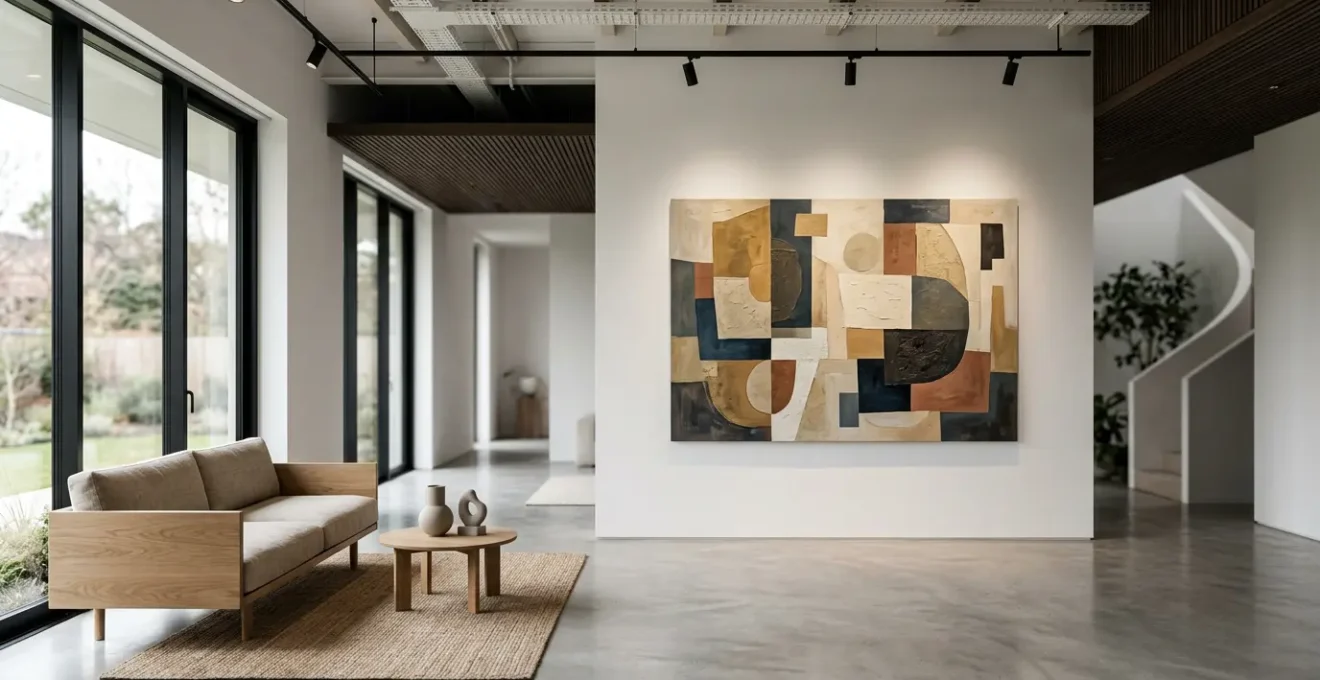
The success of an art-centric home is determined not by decorative choices but by structural and technical decisions mandated before a single wall is raised.
- Wall structures must be pre-engineered with plywood or steel reinforcement to support art exceeding 25kg; standard drywall is a point of structural failure.
- A lighting designer must be engaged at project inception to influence architectural elements and integrate layered, conservation-grade lighting systems.
Recommendation: Mandate a collaborative hierarchy where architectural, interior design, and lighting teams work in parallel from day zero to prevent irreversible and costly design compromises.
Commissioning a home to house a significant art collection is an exercise in precision, not preference. The common approach—designing a beautiful house and then finding places to hang art—is a fundamental, and often costly, mistake. It treats priceless assets as afterthoughts and results in compromised displays, irreversible UV damage, and expensive structural retrofitting. This method is anathema to the serious collector. It mistakes decoration for integration.
The conversation must shift from aesthetics to engineering, from placement to preservation. It requires understanding that the architectural envelope itself is the first and most critical layer of the collection’s curation. The dialogue with an architect cannot be a gentle suggestion of needs; it must be a firm mandate of technical requirements. This involves preemptively solving challenges of structural load, lighting science, and environmental control at the blueprint stage.
This article is not a guide to decoration. It is a strategic framework for you, the client, to direct your architectural team. We will deconstruct the process, moving beyond generic advice to establish non-negotiable protocols. We will define how to brief an architect for a collection that doesn’t exist yet, detail the necessary structural reinforcements for museum-grade works, clarify the hierarchy of professional collaboration, and establish the critical timeline for engaging specialists. The goal is to build not just a house, but a legacy vessel engineered for art.
The following sections provide a detailed roadmap for this process, outlining the critical questions to ask and the technical standards to demand. This is the blueprint for a successful collaboration that respects both architecture and art as equal partners.
Summary: How to Collaborate With Architects to Design Art-Centric Homes?
- How to Brief an Architect on a Collection You Don’t Own Yet?
- Why Do Standard Drywall Studs Fail With Museum-Grade Art?
- Windows vs Art Preservation: The UV Risk in Modern Glass Homes
- Architect vs Interior Designer: Who Decides Art Placement?
- When to Bring a Lighting Designer into the Architectural Process?
- How to Reinforce Walls for Sculptures Exceeding 50kg?
- How to Light a Statement Armchair for Dramatic Evening Impact?
- How to Install Large-Scale Art in Residential Atriums Without Blocking Flow?
How to Brief an Architect on a Collection You Don’t Own Yet?
Briefing an architect for a future collection is an exercise in strategic abstraction. You are not defining specific works; you are defining the physical and atmospheric parameters that will accommodate future acquisitions. This requires moving beyond a “wish list” to a formal, conceptual framework. The goal is to imbue the architecture with the capacity and flexibility to house works of a certain character, scale, and medium, ensuring the home is a vessel, not a constraint.
The brief must articulate intangible aspirations as well as technical specifications. Describing how you want a space to feel—contemplative, grand, intimate—provides the architect with an emotional target that informs massing, sightlines, and materiality. This is about designing for the *experience* of art. As demonstrated by institutional projects like the National Gallery’s NG200 initiative, the most successful art spaces are designed around the anticipated engagement of the visitor. The brief focused on creating an environment for visitors to “relax, reflect and plan,” a principle directly applicable to a private residence.
Your mandate is to provide a conceptual framework, not an inventory. This involves defining ranges for scale (e.g., “capacity for canvases up to 4 meters in height”), weight (“wall reinforcement for sculptures up to 200kg”), and medium (“controlled humidity zones for works on paper”). Using visual references and mood boards is effective for conveying aesthetic direction, but the core of the brief must be a clear delineation of negotiable versus non-negotiable elements. This clarity prevents scope creep and ensures your primary objectives—the secure and impactful display of future art—are embedded in the design from day one.
Why Do Standard Drywall Studs Fail With Museum-Grade Art?
Standard residential construction is engineered for shelter and code compliance, not for the demands of significant art. The ubiquitous drywall-and-stud wall assembly represents a fundamental point of failure when confronted with the weight of museum-grade works. A typical drywall surface is not a structural element; it is a cosmetic skin with minimal load-bearing capacity. Trusting it to support a valuable, heavy artwork is a catastrophic risk.
The issue lies in the material’s inherent weakness and the physics of load transfer. Drywall is brittle and crumbles under concentrated shear and tensile forces. While various anchors and toggles exist, they are merely stopgap measures. Industry standards suggest that even with specialized hardware, a single point on a drywall wall should not be trusted to hold more than 50 pounds (approximately 23kg) maximum. This capacity is grossly inadequate for heavy canvases, framed works under glass, and virtually any form of sculpture.
Attempting to hang a heavy piece on standard drywall risks not only the art itself but also the integrity of the wall finish. The point load can cause cracking, pull-out failure, and ultimately, a complete detachment of the artwork. The only correct approach is to bypass the drywall entirely and transfer the weight directly to the building’s structural framework—the wooden or metal studs behind it. For art of significant weight, however, even standard stud framing may be insufficient. This necessitates structural pre-engineering during the construction phase, a topic we will explore in greater detail.
The image above illustrates the necessary shift in thinking: from surface-level hanging to integrated structural support. Elements like steel plates and reinforced blocking are not add-ons; they are essential components planned at the architectural level to create walls capable of supporting art as an integral part of the building’s fabric. To do otherwise is to invite structural failure.
Windows vs Art Preservation: The UV Risk in Modern Glass Homes
The prevalence of floor-to-ceiling glass in contemporary architecture presents a direct and significant threat to art collections. While expansive windows create a connection with the landscape, they also flood interiors with natural light, which contains ultraviolet (UV) and infrared (IR) radiation. These wavelengths are the primary drivers of irreversible damage to art: fading pigments, yellowing varnishes, and degradation of organic materials like paper and textiles. A home designed for art must treat its entire glazed envelope as a conservation-grade filter.
Standard residential double-glazing is wholly insufficient, blocking as little as 20-40% of UV radiation. Even modern Low-E (low-emissivity) coatings, designed for thermal performance, typically only block up to 70%, which falls far short of conservation standards. The Professional Picture Framers Association recommends a minimum of 97% UV blockage for any glazing used to protect art. Achieving this level requires a specific, mandated solution integrated into the architectural plans.
The choice of solution depends on whether it’s new construction or a retrofit, but the performance target is non-negotiable. For new builds, laminated glass with a dedicated PVB (polyvinyl butyral) UV-blocking interlayer is the superior, permanent solution. For existing windows, high-performance museum-grade films can be professionally applied to achieve over 99% UV rejection. Automated solar shades, with an openness factor of 1-3%, offer a dynamic layer of protection, blocking light at the source when needed. Each option presents a different balance of cost, permanence, and aesthetic impact.
This comparative analysis shows the clear inadequacy of standard residential windows and highlights the technical solutions required to create a safe harbor for art. The following table, based on an analysis of UV protection methods, outlines the options that should be discussed with your architect.
| Solution Type | UV Blockage | Application | Advantages | Limitations |
|---|---|---|---|---|
| Regular Double-Glazed Windows | 20-40% | Standard residential | Energy efficiency, thermal performance | Insufficient for art protection, ongoing UV damage |
| Low-E Coated Windows | Up to 70% | Modern construction | Improved energy performance, basic UV reduction | Does not meet conservation grade (97% minimum) |
| Museum-Grade UV Film (3M) | 99%+ | Retrofit to existing windows | Near-total UV rejection, cost-effective retrofit, maintains visible light | Requires professional installation, may affect window warranty |
| Laminated Glass with UV Interlayer | 99% | New construction or replacement | Permanent solution, enhanced safety (shatter-resistant) | Higher initial cost, requires window replacement |
| Automated Solar Shades (1% openness) | 99% | Window treatment layer | Dynamic control, blocks UV at source, adjustable | Reduces natural light when deployed, requires motorization |
Architect vs Interior Designer: Who Decides Art Placement?
The question of who decides art placement reveals a common, and flawed, project hierarchy. In a conventional build, the architect designs the shell and the interior designer decorates it, often leading to a territorial conflict over where art should go. An architect might prioritize a pure architectural vista, while a designer focuses on a furnishing arrangement. Both may be wrong. In an art-centric home, art placement is not a decision to be made, but a condition to be designed for. This requires a fundamental shift to a collaborative, parallel process.
The effective model, as demonstrated by integrated firms like DKOR Interiors, involves engaging both the architect and interior designer from day zero. The architect is responsible for the building’s core and shell—the structure, massing, circulation, and fenestration. The interior designer works simultaneously within that proposed framework, analyzing the functionality, flow, and human scale of the interior spaces. This integrated review allows for critical adjustments before construction begins. The interior designer can flag a proposed window that would eliminate a key art wall, or the architect can adjust a ceiling height to accommodate a planned large-scale work.
As design expert Alisha Taylor notes in her analysis of professional partnerships, this synergy is key. She states that “architects and interior designers collaborate to provide a creative space that is both breathtaking and functional.”
Each member brings a unique skill set to the table, including an interior designer’s eye for design and an architects’ practical knowledge of how a space will be built out.
– Alisha Taylor, Benefits of Architect and Interior Designer Collaboration
Therefore, your mandate as the client is to establish this collaborative hierarchy from the outset. The decision of “where art goes” is dissolved. Instead, the teams work together to create walls, sightlines, and focal points specifically engineered for art. The architect provides the structural capacity and spatial volume; the interior designer ensures the human-scale experience and functional adjacency. The art is not placed *in* the room; the room is built *for* the art.
When to Bring a Lighting Designer into the Architectural Process?
The most common and costly mistake in lighting an art collection is treating it as a final step. Selecting fixtures after the walls are closed is an act of compromise, not design. A lighting designer is not a decorator; they are a technical specialist whose input is critical from the project’s inception. They must be engaged on Day Zero, alongside the architect, because their decisions fundamentally influence the architecture itself.
A lighting designer’s early involvement informs ceiling heights (to accommodate recessed housing), window placement (to model and mitigate daylight), and even the selection of surface materials (to control reflectance and color rendering). They work with the architect and interior designer to establish a layered lighting scheme—a flexible system with separate circuits for ambient (general illumination), task (functional light), decorative (chandeliers), and, most importantly, accent lighting for the art. This creates the ability to toggle between “scenes”: a bright, even “gallery mode” for viewing, a dramatic “evening mode” with focused art spots, or a soft “entertaining mode.”
This requires planning the entire electrical infrastructure during the design phase. The lighting designer will specify the precise locations for recessed “block-outs,” plan conduit paths for future fixtures, and ensure dedicated, clean circuits are available for sensitive art lighting. Retrofitting these elements is disruptive, expensive, and often architecturally impossible. Your role is to mandate this early collaboration, ensuring the lighting is woven into the home’s DNA, not stapled on as an afterthought.
Your Action Plan: Integrating Lighting Design
- Engage lighting designer at project inception (Day Zero) – their input influences fundamental architectural decisions like ceiling height, window placement, and surface materials.
- Conduct joint evaluation of natural light conditions – architect, interior designer, and lighting designer assess room orientation and daylight patterns together.
- Establish layered lighting circuits early – separate systems for ambient, task, accent (art-specific), and decorative lighting to create flexible ‘scenes’ (gallery mode, evening relaxation, entertaining).
- Specify technical requirements for art lighting – Color Rendering Index (CRI) >95 for accurate color representation, precise beam angles for artworks, and adjustable color temperature.
- Plan electrical infrastructure during design phase – include locations for recessed ‘block-outs,’ conduit paths for future fixtures, and dedicated circuits for art lighting to avoid retrofitting costs.
How to Reinforce Walls for Sculptures Exceeding 50kg?
Supporting wall-mounted sculptures or artworks exceeding 50kg (110 lbs) is a matter of structural engineering, not carpentry. Standard 2×4 or 2×6 wood stud framing, while sufficient for building codes, may not have the rigidity or load capacity to handle the concentrated, cantilevered forces exerted by heavy art. The solution must be integrated during the construction phase, creating a dedicated load transfer path from the artwork, through the wall, and into the building’s primary structure.
The fundamental principle, as a structural engineering expert emphasizes, is to move the burden off the surface. “The key to safe hanging lies in transferring the weight from the fragile drywall surface to the building’s structural framework—specifically, the wooden or metal studs behind the wall.” For substantial weight, this requires going a step further and reinforcing the framework itself.
Several methods of structural pre-engineering should be specified in the architectural drawings. The most common is installing plywood blocking. This involves fitting 3/4-inch or 1-inch thick plywood sheets snugly between the studs, flush with the stud faces. This creates a continuous, solid mounting surface behind the drywall, allowing heavy-duty fasteners to be secured anywhere within that zone, not just on a narrow stud. This method distributes the load across multiple studs and prevents the crushing of the drywall.
For exceptionally heavy pieces (over 100kg), more robust solutions are required. A steel flitch plate—a steel plate bolted alongside a wooden stud or beam—can be specified to dramatically increase rigidity and load capacity without significantly increasing the wall’s thickness. In extreme cases, a dedicated steel post may be integrated directly into the wall framing, with mounting points welded on, providing an uncompromisingly solid anchor point tied directly to the building’s foundation or primary frame.
How to Light a Statement Armchair for Dramatic Evening Impact?
A statement armchair from a celebrated designer—an Eames Lounge, a Cassina LC2, a Womb Chair—is more than furniture. It is a piece of functional sculpture. As such, it demands the same level of lighting consideration as a fine art object. To create a dramatic evening impact, the goal is not merely to illuminate the chair, but to choreograph light and shadow to reveal its form, texture, and presence within a space. This is an application of theatrical and museum lighting principles on a domestic scale.
The technique relies on creating high contrast and a clear focal point. During the evening, ambient light levels should be lowered significantly, allowing the chair to emerge from the relative darkness. The primary tool is a narrow-beam accent light, often a ceiling-recessed “pin spot” or an adjustable monopoint fixture. This fixture should be positioned to cast a controlled pool of light onto the chair, highlighting its key features—the curve of an armrest, the texture of the velvet, the grain of the wood.
As the illustration demonstrates, the quality of light is paramount. A warm color temperature (around 2700K) creates an inviting, intimate atmosphere. A high Color Rendering Index (CRI) of 95+ ensures the fabric’s color is rendered accurately and richly. The angle of the light is also critical. A steep angle from above creates dramatic shadows, sculpting the chair’s form. This can be softened with a low-intensity, low-angle fill light to reveal texture without eliminating the drama. The result is a chair that doesn’t just occupy space, but commands it, transformed into a luminous sculpture that serves as the anchor of the room’s evening mood.
This approach elevates a design object into an art installation. It requires the same foresight as lighting a painting: planning for the specific fixture, beam angle, and circuiting during the initial architectural and lighting design phases. The impact is a testament to a holistic design philosophy where every significant object is given its moment to shine.
Key Takeaways
- Brief for a future collection’s parameters—scale, weight, medium—not just for current works.
- Mandate structural pre-engineering, such as plywood blocking or steel reinforcement, as standard wall construction is inadequate.
- Specify conservation-grade (97%+ UV blocking) glazing and environmental controls as a non-negotiable architectural requirement.
How to Install Large-Scale Art in Residential Atriums Without Blocking Flow?
An atrium or double-height space presents a prime opportunity for displaying large-scale art, but also a significant challenge. The primary objective is to install the work in a way that is secure, visually impactful, and does not obstruct the home’s circulation or compromise the feeling of openness. This requires architectural foresight and the use of specialized installation systems that integrate the artwork with the building’s structure, often making it appear to float.
For suspended sculptures, the most elegant solution is a ceiling-mounted suspension system. This involves securing aircraft-grade steel cables or solid rods to the structural joists or beams in the ceiling. This work must be specified by a structural engineer during the design phase to ensure the ceiling can handle the point loads. The system completely eliminates floor obstruction, preserves flow, and creates a powerful illusion of weightlessness. It transforms a heavy object into a dynamic aerial installation.
For massive wall-mounted pieces, a French cleat system spanning multiple studs is a robust and invisible method. This involves two interlocking wooden or metal strips cut at a 45-degree angle. One is secured to the wall, distributing the load across the structural framework, while the other is attached to the artwork. The piece is then simply lowered into place, creating a secure lock that resists both downward and outward forces. For ultimate flexibility, a permanent picture rail system, mounted high on the wall and anchored into the structure, can also distribute weight effectively while allowing for easier rotation of works.
Crucially, the logistics of installation must be planned architecturally. Doorway widths, corridor heights, staircase turning radii, and potential crane access points must be considered before construction is finalized. Furthermore, the acoustic properties of a large, hard-surfaced atrium must be addressed. An echo-filled space can feel cold and unwelcoming. Integrating sound-absorbing art panels or specifying absorptive architectural materials can mitigate this, ensuring the grand space remains intimate.
By mandating these technical and collaborative protocols, you transform the process from one of passive hope to active direction. The result is a home that does not merely contain art, but honors it—a space where architecture and collection merge into a single, cohesive statement of purpose. Your next step is to formalize these requirements into a comprehensive brief for your project team.