The solution to open-plan noise isn’t just adding soft furnishings; it’s about engineering invisible ‘acoustic boundaries’ that control how sound travels, is absorbed, and is perceived.
- Effective sound blocking relies on the ‘Mass-Air-Mass’ principle, not just material density.
- Hidden pathways like HVAC systems (acoustic crosstalk) are often the primary source of sound leakage between zones.
- Psychological principles like ‘Prospect-Refuge’ are as crucial as physical materials for creating a true sense of privacy.
Recommendation: Stop trying to muffle your entire space. Instead, adopt a zoning strategy, treating your loft as a system of distinct acoustic environments to manage noise at its source.
The allure of loft living is undeniable: soaring ceilings, abundant light, and a sense of boundless space. Yet, for many couples, this dream quickly collides with a noisy reality. The clatter of pans in the kitchen bleeds into a work call, the television disrupts a quiet reading corner, and the fundamental need for solitude feels like an impossible luxury. The open-plan, designed for connection, ironically becomes a source of constant, low-grade tension. The standard advice is predictable: lay down thick rugs, hang heavy drapes, and hope for the best. But these are mere bandages on a complex acoustic problem.
These common solutions only address one part of the equation: sound absorption. They fail to tackle sound blocking, diffusion, and the hidden pathways through which noise cleverly travels. More importantly, they ignore the deep-seated psychological craving for enclosure and refuge that an open space, by its nature, denies. The real challenge isn’t just to dampen sound, but to reclaim a sense of personal territory and tranquility without sacrificing the aesthetic you love. The mistake isn’t the open plan itself; it’s the absence of a deliberate acoustic design strategy.
But what if the key wasn’t to fill your space with muffling materials, but to strategically engineer invisible acoustic boundaries? This guide moves beyond the platitudes of rugs and curtains. We will explore how to think like an acoustic consultant, using principles of physics and psychology to create distinct zones of privacy. We will deconstruct how to turn everyday furniture into high-performance sound barriers, reveal the ventilation errors that sabotage your peace, and explain why creating a small ‘nook’ can have a more profound impact on your well-being than soundproofing an entire wall.
This article provides a complete framework for reclaiming your sanctuary. Below, we’ll dive into specific, actionable strategies, from the floor to the ceiling, that allow you to define your space acoustically and restore harmony to your open-plan home.
Summary: A Blueprint for Acoustic Zoning in Open-Plan Living
- How to Use Bookshelves as Sound-Dampening Room Dividers?
- Curtains vs Sliding Panels: Which Offers Better Sleep Privacy?
- The Ventilation Error That Spreads Kitchen Smells to the Bedroom
- Why Does the Human Brain Crave Enclosed “Nooks” in Large Spaces?
- How to Transition Flooring Materials to Mark Kitchen Boundaries?
- Open Plan vs Broken Plan: Which Fits a Family of Four Better?
- How to Dampen Echoes in Open Plan Spaces Without Curtains?
- How Do Monochrome Palettes Make Small Apartments Feel 30% Larger?
How to Use Bookshelves as Sound-Dampening Room Dividers?
A large, well-stocked bookshelf seems like a natural room divider, but its acoustic effectiveness is often overestimated. Simply placing a single unit between two areas will primarily diffuse, or scatter, sound waves rather than block them. To transform a bookshelf from a mere visual barrier into a functional acoustic one, you must leverage the ‘Mass-Air-Mass’ principle, a cornerstone of professional soundproofing. This concept, similar to how double-pane windows work, involves creating a sandwich of two solid layers (mass) separated by a sealed air gap.
To implement this, you need two parallel bookshelves. The space between them creates an air cavity that decouples the two sides, making it significantly harder for sound vibrations to pass through. Doubling the mass of a barrier can significantly improve its Sound Transmission Class (STC) rating, which measures how well a partition blocks airborne sound. The density of the items on the shelves is also critical; a collection of dense, heavy hardcover books will vastly outperform sparse paperbacks or decorative objects. The goal is to maximize mass.
However, even the most massive barrier is rendered useless by leaks. Sound, like water, will find the easiest path. This is known as sound flanking. Gaps at the top, bottom, or sides of your bookshelf setup will allow sound to travel around it, completely undermining your efforts. It is essential to seal these flanking paths using acoustic caulk or high-density foam gaskets. Furthermore, an open-back bookshelf offers almost no sound-blocking capability. To complete the ‘mass’ layer, you must add a solid back panel to each unit, or better yet, retrofit them with a layer of Mass-Loaded Vinyl (MLV), a thin, heavy material designed specifically for blocking sound.
Curtains vs Sliding Panels: Which Offers Better Sleep Privacy?
When creating a private sleeping area within a loft, the choice between acoustic curtains and solid sliding panels is pivotal. While both can create visual separation, their performance in blocking sound—especially the nuanced frequencies that disrupt sleep—varies dramatically. Acoustic curtains are primarily sound absorbers, not blockers. Their multi-layered, porous fabric is effective at reducing echo and reverberation within a space, measured by a Noise Reduction Coefficient (NRC). However, their ability to block sound from passing through, measured by STC, is inherently limited.
The primary weakness of curtains is sound leakage. Even the heaviest “soundproof” curtains struggle to create a complete seal. Inevitable gaps at the ceiling and floor provide easy pathways for sound to flank the barrier. Solid-core sliding panels, on the other hand, offer a far more robust solution for sound blocking. When installed in a ceiling-to-floor track system, they can be sealed much more effectively. The choice of material—such as solid-core wood or acoustically-rated composite—provides the sheer mass needed to achieve a higher STC rating, effectively stopping more sound from passing through.
The psychological impact also differs. A curtain, being soft and pliable, provides a moderate sense of enclosure. A solid panel, with its physical rigidity and weight, creates a much stronger feeling of security and separation, more akin to a real wall. This can significantly enhance the perception of privacy and safety, which is conducive to better sleep. As a comparative analysis from an in-depth look at acoustic solutions shows, the material composition and sealing capability are the deciding factors for true acoustic isolation.
| Feature | Acoustic Curtains | Solid-Core Sliding Panels |
|---|---|---|
| NRC Rating (Sound Absorption) | 0.20 – 0.45 | Not primary function |
| STC Rating (Sound Blocking) | Low (not standardized) | Higher (depends on material) |
| Primary Weakness | Sound leakage from top and bottom gaps | Installation complexity |
| Material Composition | Multi-layer fabric with porous front, heavy non-porous back (MLV or wool) | Solid-core wood, acoustically-rated glass, or composite materials |
| Sealing Capability | Difficult to seal completely | Ceiling-to-floor systems can be fully sealed |
| Psychological Impact | Moderate sense of enclosure | Strong sense of solidity and safety due to physical rigidity |
The Ventilation Error That Spreads Kitchen Smells to the Bedroom
You’ve created visual separation, but the smell of last night’s garlic salmon still permeates your sleeping area. The culprit is often an invisible and overlooked highway for sound and smells: your HVAC system. In many open-plan homes, shared ductwork acts as a direct conduit between zones, a phenomenon known as acoustic crosstalk. Without proper attenuation, the sounds from the kitchen—and the airborne particles that carry odors—are efficiently delivered to the quietest corners of your home.
This problem is pervasive in buildings with common ventilation systems, where inadequate attenuation in ductwork creates crosstalk between separate spaces. The smooth, hard surfaces inside metal ducts are highly reflective for sound waves, allowing them to travel long distances with little energy loss. The solution lies in interrupting this pathway. Installing inline duct silencers or mufflers in the main trunk lines is a highly effective method. These devices contain baffled, sound-absorbent material that disrupts the transmission of mid-tone frequencies, where most speech and kitchen activity sounds fall.
Another strategy is to wrap exposed ductwork with acoustic insulation or Mass-Loaded Vinyl (MLV). This reduces “breakout” noise, where sound radiates through the thin walls of the duct itself. A more advanced approach involves creating acoustic zoning through air pressure. By configuring your kitchen exhaust fan to create negative pressure, it pulls air (and sound) inward, containing it within the kitchen zone. Simultaneously, a gentle supply of fresh air into the bedroom can create positive pressure, effectively pushing unwanted sounds and smells out. Finally, pay close attention to the noise generated by the fans themselves. A kitchen or bathroom fan with a high Sone rating (a measure of loudness) can be a major source of noise pollution. Opting for models rated below 1.0 Sone ensures near-silent operation.
Why Does the Human Brain Crave Enclosed “Nooks” in Large Spaces?
In a vast, open loft, it’s a common paradox: despite having so much space, we often find ourselves drawn to a corner, a spot by a window, or an area defined by a change in ceiling height. This isn’t a design flaw; it’s a deep-seated psychological impulse explained by Prospect-Refuge theory. This foundational concept in environmental psychology proposes that humans are innately drawn to environments that simultaneously offer an unimpeded view (prospect) and a sense of safe, protected enclosure (refuge).
An open-plan living area provides abundant prospect but very little refuge. This can leave us feeling exposed and subconsciously on alert, which is antithetical to relaxation. Creating a “nook” directly addresses this need. As environmental psychologist Jay Appleton outlined in his foundational work:
Prospect-refuge theory suggests that humans are drawn to landscapes that offer both a clear view (prospect) and a safe, sheltered space (refuge).
– Jay Appleton, The Experience of Landscape (1975)
A nook doesn’t require walls. It can be created by positioning a high-backed armchair, placing a bookshelf perpendicular to a wall, or tucking a small desk under a low-hanging pendant light. Even a large, leafy plant can help define the edge of a refuge. These elements provide a ‘back’ to our protected space while allowing us to look out into the larger ‘prospect’ of the loft. The feeling of security this provides is immediate and profound, allowing our brains to switch off surveillance mode and truly relax.
Acoustically, these nooks are also highly effective. The surrounding surfaces (the back of the chair, the books on the shelf) provide close-range sound absorption and diffusion, creating a micro-environment that is audibly quieter and more intimate than the main space. By intentionally designing these small zones of refuge, you cater directly to an evolutionary need, making your large space feel not just bigger, but safer and more psychologically comfortable.
How to Transition Flooring Materials to Mark Kitchen Boundaries?
The floor is one of the largest, most overlooked surfaces for creating acoustic zones in an open-plan home. A seamless expanse of polished concrete or hardwood may look beautiful, but it’s an acoustic nightmare, acting as a massive amplifier that reflects sound throughout the entire space. By strategically transitioning flooring materials, you can create a powerful, invisible boundary that helps contain noise at its source—the kitchen.
The core strategy is to move from hard, reflective materials in the “loud zone” (kitchen) to soft, absorbent materials in the “quiet zone” (living area). Transitioning from tile or concrete in the kitchen to cork, luxury vinyl tile (LVT), or low-pile carpet in the adjacent living space creates an acoustic dam. This change in material dampens footfall noise and absorbs airborne sounds, like the clatter of dishes, before they can travel further. For a more potent, invisible solution, install a high-STC acoustic underlayment beneath the kitchen flooring. This specialized layer works to block impact noise from transmitting through the subfloor, a requirement that echoes the principles behind the STC 50 minimum rating required by the International Building Code for floors in multi-family dwellings to ensure privacy.
You can enhance this boundary physically and psychologically by creating a subtle level change. A slightly raised platform for the kitchen or a sunken living area serves as a tangible marker that helps contain sound. This ‘breaking’ of the single plane signals a shift from one type of space to another. The choice of materials should also consider the frequencies you want to absorb. For instance, carpet is excellent for mid-to-high frequencies (like speech), while materials like cork or rubber-based underlayments are superior for reducing low-frequency impact noise (like footsteps or dropped objects). Combining materials effectively creates a multi-layered defense against a wider spectrum of sounds.
Open Plan vs Broken Plan: Which Fits a Family of Four Better?
For a couple, the challenges of an open-plan home are significant. For a family of four, they are magnified exponentially. The competing needs for a play area, a quiet homework spot, a social kitchen, and a relaxing adult space can create a constant battle for acoustic territory. While the open-plan ethos promotes togetherness, it often fails to provide the separation needed for a family to function harmoniously. This is where the concept of the “broken-plan” home emerges as a superior model.
A broken-plan design retains the spacious feel of an open layout but introduces subtle, often flexible, divisions to create distinct zones. It’s not about building permanent walls but about using semi-permanent structures like bookshelves, changes in floor level, or sliding screens to delineate spaces. This approach provides the adaptability a growing family needs. For example, a play area for toddlers can be partially screened off, and as they grow, that same screen can become a more solid acoustic divider for a teenager’s study space. The key is planning for evolution.
The first step is to map out your home into ‘loud zones’ (kitchen, TV area) and ‘quiet zones’ (home office, reading corner). The layout should then be planned to maximize the physical distance between them. Furniture can act as a soft barrier; positioning a deep sectional sofa with its back to the kitchen island, for instance, creates a clear division and absorbs sound. As demonstrated in a London townhouse renovation, simple sliding fabric panels on a ceiling track allowed a family to close off the living area during movie nights, providing instant acoustic privacy without permanent construction. This flexibility is the hallmark of the broken-plan advantage.
Action Plan: Acoustic Zoning for a Family Loft
- Map Your Zones: Clearly identify ‘loud zones’ (play area, TV, kitchen) and ‘quiet zones’ (home office, reading corner). Plan the layout to maximize the physical distance between competing activities.
- Use Furniture as Barriers: Position large pieces like sectional sofas or bookshelves perpendicular to primary noise sources (like the kitchen) to create soft acoustic and visual dividers.
- Install Soft Partitions: Implement flexible solutions like fabric screens or acoustic curtains on ceiling rails. They add privacy and absorb sound while maintaining a sense of openness when not in use.
- Plan for Evolution: Design dividers that can adapt as your family’s needs change. A partial screen for a toddler’s play area can later be upgraded to a heavier acoustic curtain for a teenager’s study nook.
How to Dampen Echoes in Open Plan Spaces Without Curtains?
In a loft characterized by high ceilings and hard surfaces like concrete floors and large windows, echo, or reverberation, is often the biggest acoustic complaint. Sound waves bounce endlessly between these parallel surfaces, creating a cluttered and fatiguing auditory environment. While curtains are a common solution, they aren’t always aesthetically desirable or sufficient. To truly tame echo, you must treat the largest reflective surfaces—the walls and, most importantly, the ceiling.
The goal is to achieve a target reverberation time (RT60) suitable for comfortable living. For speech clarity, acoustic design targets suggest a reverberation time of 0.6 seconds or less for residential spaces. This requires a combination of absorption and diffusion. While absorption soaks up sound energy, diffusion scatters it in multiple directions. This breaks up strong, distinct echoes without making the room sound unnaturally “dead.” You can introduce diffusion with 3D wall art, irregularly shaped bookshelves, or purpose-built wooden diffusers, which can double as striking design features.
Case Study: The Brooklyn Loft Echo Solution
A renovated Brooklyn loft with 14-foot ceilings and polished concrete floors was nearly uninhabitable during social gatherings due to severe echo. The owners implemented a strategic mix of solutions: large wool area rugs defined the seating areas, floor-to-ceiling linen drapes were added (though the goal here is to find alternatives), and, crucially, a large run of wood slat paneling was installed on the wall behind the dining zone. This paneling acted as both an absorber and a diffuser. The result was a dramatic drop in reverberation, transforming the space into a comfortable, inviting home while fully preserving its industrial aesthetic.
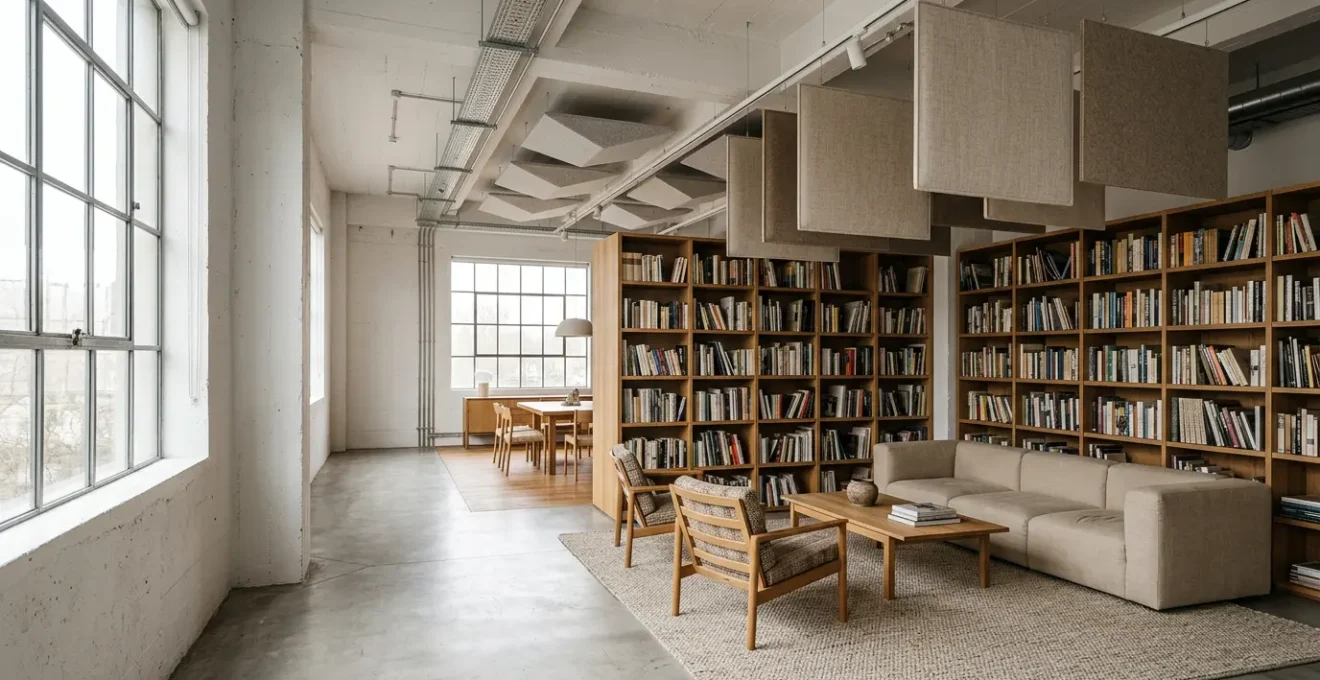
For a minimalist aesthetic, invisible solutions are highly effective. Acoustic plaster or spray can be applied directly to ceilings and walls. These finishes contain microscopic pores that trap and dissipate sound energy, reducing echo without any visible change to the surface. Another powerful, and often stylish, option is to install suspended acoustic clouds or ceiling baffles. Hanging these panels from the ceiling targets the largest reflective surface in the room and can be used to create a strong architectural statement, defining a zone (like a dining area) from above while providing exceptional sound absorption.
Key Takeaways
- Go Beyond Absorption: True acoustic control combines absorption (soft materials), blocking (mass), and diffusion (irregular surfaces).
- Identify Hidden Pathways: Sound travels through overlooked channels like HVAC ducts and gaps around dividers. Sealing these is critical.
- Design for Psychology: Creating small, enclosed ‘refuge’ spaces satisfies a deep human need for security in large, open ‘prospect’ areas.
How Do Monochrome Palettes Make Small Apartments Feel 30% Larger?
While a monochrome palette is celebrated for its ability to make a space feel larger and more cohesive by reducing visual clutter, its powerful acoustic benefits are often overlooked. The same principle of reducing “visual noise” can be applied to reduce auditory noise. A serene, unified color scheme creates a calmer environment where the brain is less overwhelmed, which can heighten sensitivity to auditory disruptions. By integrating acoustic solutions into this monochrome strategy, you can create a space that is not only visually calm but audibly serene as well.
The best noise solutions in open-plan homes don’t look like noise solutions at all. They look like intentional design choices.
– Seasons in Colour Design Editorial, Open-Plan Noise Solutions – Acoustic Design Ideas for Luxury Interiors
The key is to make your acoustic treatments disappear. By color-matching fabric acoustic panels or specifying acoustic plaster in the exact shade of your walls, these high-performance materials blend in seamlessly. They solve the echo and reverberation problem without interrupting the minimalist aesthetic. A monochrome approach doesn’t mean boring; it’s an opportunity to play with texture. Layering varied textures within the same color family—a bouclé sofa, velvet cushions, a thick wool rug, a matte wall finish—creates a rich visual landscape. Each of these materials also has different absorptive properties, collectively building an acoustic powerhouse through material diversity.
This strategy can also be used to create intentional ‘acoustic cocoons.’ Using a dark, matte monochrome scheme, such as charcoal gray or deep navy, for a media corner or a reading nook does more than create a cozy vibe. Dark, matte surfaces absorb more light, making the space feel more enclosed and intimate. This effect is mirrored acoustically, as the soft, textured materials used in these zones also absorb more sound. This creates a designated quiet zone where you can retreat from the ambient noise of the larger open space. The result is a sophisticated design that works on two sensory levels, providing both visual harmony and audible peace.
By moving beyond generic advice and adopting a multi-layered strategy of blocking, absorbing, and diffusing sound, you transform from a resident into the acoustic architect of your own home. Implementing these principles allows you to sculpt invisible boundaries, creating the pockets of privacy and tranquility essential for harmonious living. Your open-plan home can finally deliver on its promise of freedom without the cost of peace. The next logical step is to audit your own space and identify the primary acoustic challenges to address.