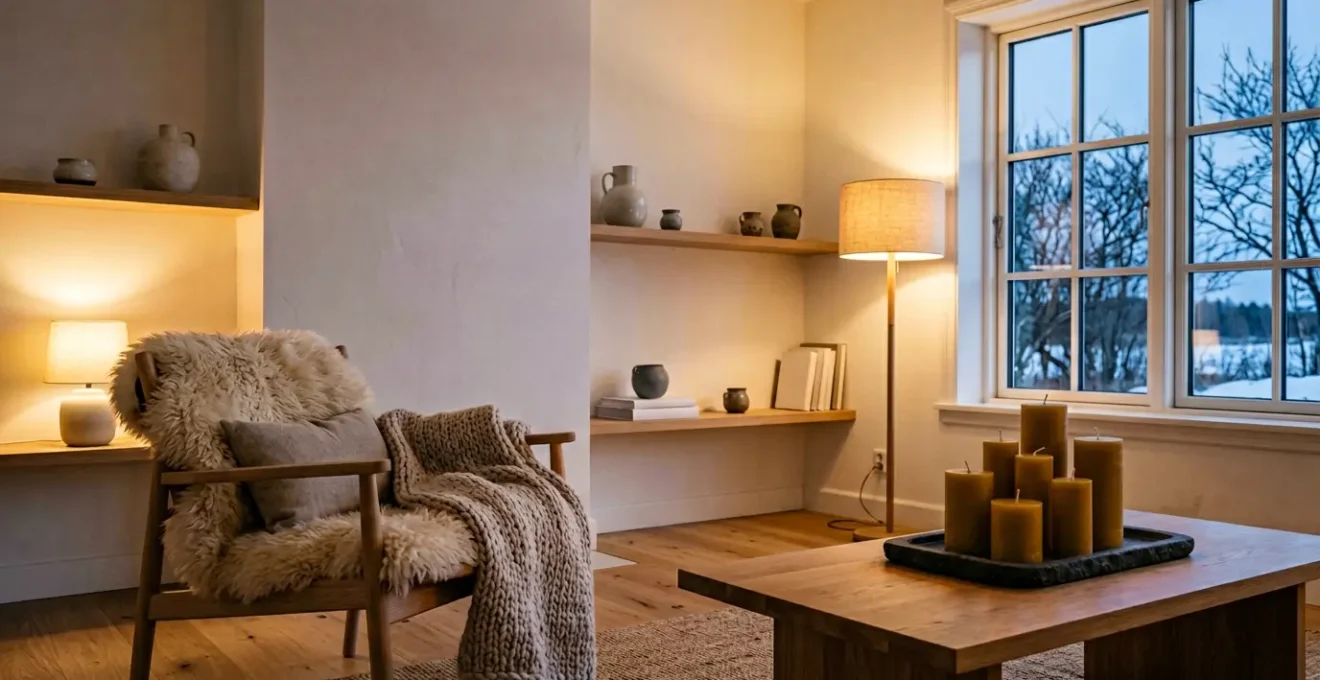
Designing a Hygge home to fight winter depression isn’t about collecting cozy objects; it’s a strategic environmental intervention to manage your brain’s chemistry.
- Light at 2700K directly impacts melatonin production to improve sleep, a key defense against SAD.
- Specific textures like natural sheepskin can trigger the release of oxytocin, the “bonding” hormone.
- Visual clutter is not just messy; it is scientifically shown to elevate levels of the stress hormone cortisol.
Recommendation: Treat your home as a toolkit, not a showroom, by making deliberate choices that support your neurobiology through the dark months.
As the days shorten and a perpetual twilight descends, many of us in northern climates feel a familiar shift. It’s more than just a chill in the air; it’s a deep, biological response to the encroaching darkness. We call it seasonal depression, or SAD, and the instinct is to retreat. The common advice is to embrace Hygge: light some candles, grab a fuzzy blanket, and wait for spring. But this passive, decorative approach misses the point entirely. It treats a deep-seated survival challenge as a problem of aesthetics.
The truth is, a genuine Hygge interior isn’t a style; it’s a strategy. It’s an active, conscious environmental intervention designed to support your mental and emotional wellbeing. It’s about understanding that your home is not a static container but a dynamic tool that directly interacts with your brain chemistry. The Scandinavian cultures that perfected this didn’t do it to create magazine-worthy photos; they did it to survive.
This guide reframes the conversation. We will move beyond the platitudes of “coziness” and delve into the neuro-aesthetics of survival. We will explore how specific, measurable design choices—from the Kelvin temperature of your light bulbs to the haptic feedback of your textiles—can become your arsenal in the fight against the winter blues. This is not about decorating. This is about engineering a sanctuary that actively works to keep your mind resilient and your spirit intact until the light returns.
This article provides a blueprint for transforming your home into a powerful ally against seasonal depression. We will dissect the key environmental factors you can control and explain the psychological and physiological science that makes them effective tools for winter survival.
Summary: A Strategic Guide to a Hygge Interior That Fights Winter Depression
- Why is 2700K Lighting Essential for Scandinavian Winter Evenings?
- Sheepskin vs Wool: Which Texture Triggers the Brain’s Warmth Response?
- How to Arrange Furniture to Encourage “Fika” Style Conversation?
- Cluttered vs Cozy: Where is the Line in Hygge Decor?
- How to Create a Fire Focal Point Without a Chimney or Gas Line?
- Rugs vs Heated Floors: Which Warms a Modern Living Room Best?
- The “Hospital Effect”: Signs Your White Room Is Too Sterile
- Why Is European Linen Worth the Investment for Bedding Longevity?
Why Is 2700K Lighting Essential for Scandinavian Winter Evenings?
In the battle for winter wellness, light is your most powerful weapon. The absence of natural sunlight is the primary trigger for SAD, disrupting our internal body clock, or circadian rhythm. Your home’s lighting can either exacerbate this problem or become the primary tool for circadian entrainment. The key is not just having light, but having the right *kind* of light at the right time. Standard cool, blue-toned LED lights (4000K and above) mimic midday sun, which is disastrous in the evening. They signal to your brain that it’s time to be alert, suppressing the production of melatonin, the hormone that tells your body it’s time to sleep.
This is where the 2700K temperature becomes non-negotiable. This specific color temperature emits a warm, yellowish-orange glow that is scientifically analogous to the light of a sunset or a campfire. It’s a primal cue for safety and rest. It lacks the blue wavelengths that interfere with our sleep cycle. In fact, one study demonstrated the profound effect of warm light on sleep.
Melanopsin is the direct link between blue light’s effect on whether we feel alert or sleepy. When melanopsin receptors in our eyes absorb light with blue wavelengths, it suppresses the production of melatonin, promoting alertness.
– Waveform Lighting Research Team, Blue Light, Melatonin and Circadian Rhythms
Choosing 2700K bulbs for all evening light sources—table lamps, floor lamps, pendants—is a direct environmental intervention. It tells your brain to wind down, to produce melatonin, and to prepare for restorative sleep, which is critical for mental health. Studies have confirmed the tangible benefits, showing how warm, wellness-focused lighting helps people fall asleep up to 19 minutes faster. This isn’t interior decoration; it’s managing your neurobiology with a light switch.
Sheepskin vs Wool: Which Texture Triggers the Brain’s Warmth Response?
After sight, touch is the most powerful sense for cultivating a feeling of safety and comfort. In the sensory deprivation of winter, surrounding yourself with the right textures is not an indulgence; it’s a necessity. But not all “cozy” textures are created equal. The choice between materials like sheepskin and wool is a lesson in neuro-aesthetics, activating different primal cues in the brain. Wool is excellent for insulation and provides a rustic, comforting visual. However, natural sheepskin has a unique neurological advantage.
The human brain is wired with specific nerve fibers called C-tactile afferents, which are designed to process the emotional quality of touch. These nerves respond optimally to slow, gentle stroking at skin temperature—the kind of touch associated with social bonding and care. Natural sheepskin, with its fine, dense, and silky fibers, is exceptionally effective at stimulating these pathways. This isn’t just a feeling; it’s a physiological event. This type of gentle tactile stimulation can trigger the release of oxytocin, the “love hormone,” which promotes feelings of calm, connection, and well-being. This is confirmed by science, where research published in Neuropeptides confirms that low-intensity, non-noxious stimulation triggers oxytocin release, directly combating feelings of stress and isolation.
This image highlights the profound difference in texture that the brain can perceive, impacting your emotional state.
While a chunky wool knit offers visual warmth and excellent insulation, the unique micro-texture of sheepskin offers a deeper, more direct path to the brain’s emotional centers. Draping a real sheepskin over a chair or placing a small one where your feet rest doesn’t just add a layer of warmth; it provides a constant source of calming sensory input, a haptic reassurance that everything is okay.
How to Arrange Furniture to Encourage “Fika” Style Conversation?
Combating the isolation of winter requires more than just personal comfort; it demands fostering connection. The Swedish concept of “Fika”—a dedicated break for coffee and conversation—is a cultural antidote to loneliness. You can engineer your living space to encourage this same intimate interaction by moving beyond aesthetics and applying the principles of proxemics, the study of how humans use space.
The typical living room, with all furniture oriented towards a television, is a space designed for passive consumption, not active connection. To create a “Fika-ready” zone, the entire arrangement must be rethought to prioritize face-to-face interaction. The goal is to create a “social anchor” that pulls people together psychologically and physically. This isn’t about having the right brand of sofa; it’s about the distance and angles between people.
Creating this social gravity requires a deliberate, strategic approach to furniture placement. The following principles are not style tips but functional rules for encouraging human connection:
- Position seating within the ‘personal distance’ zone of 1.5 to 4 feet to encourage intimate conversation without invading personal space.
- Angle two chairs or a sofa and armchair at 90-120 degrees to each other rather than face-to-face, creating an ‘open’ arrangement that signals collaborative, non-confrontational interaction.
- Replace the TV as a focal point with a ‘social anchor’ such as a low coffee table, shared ottoman, or textured area rug that draws people and their attention together.
- Ensure all seating has eye-level or below lighting sources (table lamps, floor lamps) to create pools of warm light that define intimate zones.
- Leave clear walking paths between furniture pieces to signal psychological ‘breathability’ and reduce feelings of being boxed in.
By implementing these spatial rules, you are building an environment that doesn’t just permit conversation but actively invites it. You are creating a physical framework for Fika, making connection the path of least resistance. This is a powerful social survival tactic for the long winter months.
Cluttered vs Cozy: Where is the Line in Hygge Decor?
There is a dangerous misconception that Hygge is about accumulation—more blankets, more pillows, more stuff. This is a path not to coziness, but to chaos. The line between cluttered and cozy is a psychological one, and crossing it has measurable biological consequences. Clutter is not a subjective mess; it is a form of constant, low-grade visual static that overloads the brain’s sensory processing systems. Your mind is forced to work overtime to filter out irrelevant stimuli, leading to mental fatigue and anxiety.
This isn’t just a feeling; it’s a documented physiological stressor. In a landmark study, researchers found a direct link between the density of objects in a home and the occupants’ stress levels. Specifically, a landmark UCLA study of dual-income couples found that women in cluttered homes showed elevated cortisol and heightened symptoms of depression. Your body perceives a cluttered environment as a field of unresolved tasks, triggering a constant, low-level fight-or-flight response. Cozy, on the other hand, is about curated complexity and intentionality.
A true Hygge space embraces negative space, or “visual breathability,” as a core element. It understands that for an object to be truly appreciated and provide comfort, it must have room to exist.
The line, therefore, is drawn at purpose. In a cluttered space, objects are present by default. In a cozy space, every object has earned its place. It is there because it is beautiful, useful, or holds personal meaning. Ask yourself of each item: “Does this actively contribute to my peace, or does it demand my energy?” If it’s the latter, it is clutter, and it is actively working against your well-being. True coziness is the peace that comes from being surrounded only by things that serve you.
How to Create a Fire Focal Point Without a Chimney or Gas Line?
The human fascination with fire is deeply embedded in our DNA. For millennia, a fire meant warmth, safety, cooked food, and a social gathering point. It’s a powerful primal cue for security. The gentle, non-repeating flicker of a flame engages a state of “soft fascination”—a type of effortless attention that calms the mind and allows for gentle reflection. This is why a fireplace is such a potent weapon against the anxieties of winter. But what if a traditional fireplace is not an option?
The goal is to replicate the *psychological effect* of fire, not necessarily the heat. The key elements to reproduce are a centralized focal point, a warm glow, and dynamic, moving light. Modern technology offers several powerful ways to achieve this without any structural modifications.
The Primal Brain Response to Flickering Light Patterns
Danish culture has long utilized the psychological power of fire as a coping mechanism for seasonal affective disorder. The concept of hygge specifically incorporates candlelight and fireplace rituals as core elements to combat isolation and depression during dark winters. Research on Scandinavian populations shows that the dynamic, non-repeating flicker of real flames captures attention through a phenomenon called ‘soft fascination,’ which calms the mind without demanding focused concentration. This explains why Danes often rank among the happiest people despite harsh winters—the ritualized use of fire focal points creates measurable improvements in contentment.
Your primary tool is the bio-ethanol fireplace. These are freestanding or wall-mounted units that burn clean, plant-based fuel, produce a real, dancing flame, and require no chimney or vent. They offer the authentic visual appeal and movement of a real fire. A slightly more accessible option is a high-quality electric fireplace with a realistic flame effect, often created with LEDs and mist. The key is to invest in a model that prioritizes a convincing, non-repeating flame pattern. Finally, for the most minimalist approach, a dense cluster of real candles (in varying heights, placed on a fire-safe tray) can create a powerful focal point. The combined light of a dozen flickering wicks provides that same dynamic, living glow that our brains are hardwired to find soothing.
Rugs vs Heated Floors: Which Warms a Modern Living Room Best?
Thermal comfort is a cornerstone of a Hygge environment. The feeling of cold seeping up from the floor is a constant, draining physical stressor. The two primary solutions, area rugs and radiant floor heating, are often seen as an either/or choice. However, a strategic, survivalist approach analyzes them not just for heat, but for their total sensory and psychological impact. One provides instant tactile comfort and visual layering, while the other offers an invisible, pervasive, and deeply primal form of warmth.
A thick, high-pile rug is a multi-sensory tool. Visually, it breaks up a cold, monolithic floor and defines a cozy zone. Tactilely, it provides a soft, warm surface for bare feet, directly insulating you from the cold. Psychologically, it acts as an anchor for a seating area, pulling the space together. Radiant floor heating, by contrast, is a single-sensory experience, but a profoundly effective one. It warms objects in the room (including you) directly, much like the sun. This type of heat is perceived as more natural and comforting than forced air. It also allows for a clean, minimalist aesthetic, free from visual breaks.
The following analysis compares these two approaches across several critical factors for creating a truly warm and comforting modern living room. As the data suggests, while both have their merits, a hybrid approach often provides the most complete sensory experience, as shown in this comparative analysis of comfort factors.
| Factor | Radiant Floor Heating | Textile Rugs | Hybrid Approach (Both) |
|---|---|---|---|
| Heat Type | Radiant heat – warms objects and people directly | Convected heat – traps air, warms indirectly | Radiant base + textile comfort |
| Thermal Comfort | Consistent, natural warmth perceived as comforting (like sunshine) | Insulation from cold floors, less consistent | Optimal warmth + tactile comfort |
| Visual Impact | Unbroken minimalist aesthetic, clean sightlines | Adds texture but visually breaks up floor space | Texture without coldness |
| Haptic Feedback | None – smooth surface only | Essential soft texture for feet and visual warmth | Best of both worlds |
| Sensory Layers | Single-sensory (thermal only) | Multi-sensory (visual, tactile, thermal insulation) | Complete multi-sensory experience |
| Psychological Effect | Calm from clean lines; may feel sparse if alone | Cozy but can contribute to ‘boxed in’ feeling | Warmth + coziness without claustrophobia |
Ultimately, the “best” solution depends on your primary goal. For pure, invisible thermal comfort in a minimalist space, heated floors are superior. For a rapid, multi-sensory boost of coziness and visual warmth, a rug is essential. For the ultimate survivalist sanctuary, combining the consistent radiant warmth of heated floors with the tactile comfort of a well-placed area rug creates an unbeatable foundation of well-being.
The “Hospital Effect”: Signs Your White Room Is Too Sterile
In the pursuit of a clean, minimalist Scandinavian aesthetic, it’s dangerously easy to overshoot the mark and create a space that feels less like a cozy haven and more like a sterile clinic. This is the “Hospital Effect”—an environment so devoid of texture, imperfection, and sensory richness that it becomes psychologically cold and alienating. A truly Hygge space feels lived-in, personal, and safe. A sterile space feels impersonal, temporary, and devoid of life. It lacks the subtle cues that tell our subconscious we are in a nurturing environment.
The problem with a sterile room is a lack of sensory information. The walls are perfectly smooth, the lighting is flat and uniform, the surfaces are hard, and there is no scent. It’s a sensory void. To combat this, you must consciously re-introduce layers of sensory data. This means adding texture (wood, linen, stone), embracing imperfection (the Japanese concept of wabi-sabi), using light to create pools of shadow and depth, and ensuring the room has a gentle, comforting scent.
Is your room a sanctuary or a sterile box? A simple diagnostic can reveal the truth. If you answer ‘yes’ to several of the following questions, your room is likely suffering from the Hospital Effect and requires an immediate sensory intervention. This audit will help you identify the specific areas where your environment is failing to provide the necessary psychological comfort.
Your Action Plan: Diagnostic Checklist for Sterile Interior Syndrome
- Acoustic Test: Clap your hands in the room. If you hear a sharp echo or harsh reverberation, the space lacks sound-absorbing materials (textiles, rugs, upholstered furniture) and feels clinically sterile.
- Imperfection Audit: Examine surfaces for any visible grain, wear, or texture. If everything is perfectly smooth and mass-produced, the room lacks ‘wabi-sabi’ (beauty in imperfection) and feels soulless.
- Shadow Check: Observe lighting at different times of day. If the room has flat, uniform illumination with no shadows or depth, it creates visual monotony—add accent lighting (picture lights, uplights) to ‘paint with shadows’.
- Texture Count: Inventory tactile surfaces. A truly cozy hygge space requires at least 3-4 different natural textures (wood, linen, wool, stone) to counteract sterility.
- Scent Presence: Note if the space has any comforting scent. Sterile environments are often odorless—introduce natural scents (candles, baked goods, wood) to activate the limbic system and create emotional warmth.
Each “no” on this checklist is an opportunity. An echo calls for a rug or a tapestry. A lack of imperfection invites a piece of reclaimed wood. Flat lighting is a plea for a warm table lamp. By systematically addressing these sensory deficits, you transform a sterile box into a living, breathing sanctuary.
Key Takeaways
- Hygge is a Survival Strategy: It’s not about decoration, but about making conscious environmental choices to manage your brain chemistry and fight the neurobiological effects of winter.
- Light and Texture are Medicine: Using 2700K lighting to regulate melatonin and natural textures to trigger oxytocin are direct, science-backed interventions for well-being.
- Your Environment is an Active Tool: From furniture arrangement that fosters connection to decluttering that lowers cortisol, every design choice can either support or sabotage your mental health.
Why Is European Linen Worth the Investment for Bedding Longevity?
We spend a third of our lives in bed, and during the winter, quality sleep is our most critical defense and recovery mechanism. For those affected by seasonal depression, this is even more crucial. The American Psychiatric Association notes that for the 5% of U.S. adults who experience SAD, symptoms can last for approximately 40% of the year, with disrupted sleep being a major complaint. Your bedding is not just a decorative element; it is a high-performance technical fabric that directly impacts your body’s ability to achieve deep, restorative sleep. In this context, European linen is not a luxury, but a strategic investment in your health.
Unlike cotton, which traps moisture, or synthetic fabrics, which don’t breathe, linen has a unique molecular structure. It’s a hollow fiber, which gives it remarkable thermoregulating properties. It acts like a natural ventilation system, wicking moisture away from the skin and allowing air to circulate. This keeps you warm in the winter without overheating, and cool in the summer. For someone struggling with SAD-related sleep disturbances, maintaining a stable and comfortable body temperature throughout the night is paramount for preventing the restlessness that fragments sleep cycles.
European linen’s hollow fibers allow exceptional breathability and moisture-wicking, helping maintain optimal skin temperature throughout the night and promoting deeper, more restorative REM sleep—which is critical for combating symptoms of depression.
– Sleep Science Research, Textile Properties and Sleep Quality Studies
Furthermore, linen is incredibly durable. It gets softer and stronger with each wash, meaning an initial investment pays dividends in longevity for decades. The subtle, natural texture of linen also provides gentle haptic feedback, contributing to the overall sensory comfort of the sleep environment. Choosing high-quality linen bedding is a conscious decision to optimize your sleep sanctuary, providing your body with the best possible conditions to rest, repair, and build resilience against the psychological pressures of winter.
Start today. Don’t aim for a full renovation. Pick one thing from this guide—change a lightbulb to 2700K, clear one cluttered surface, or run the sterility diagnostic in one room. Begin the process of transforming your home from a passive container into an active partner in your winter survival.