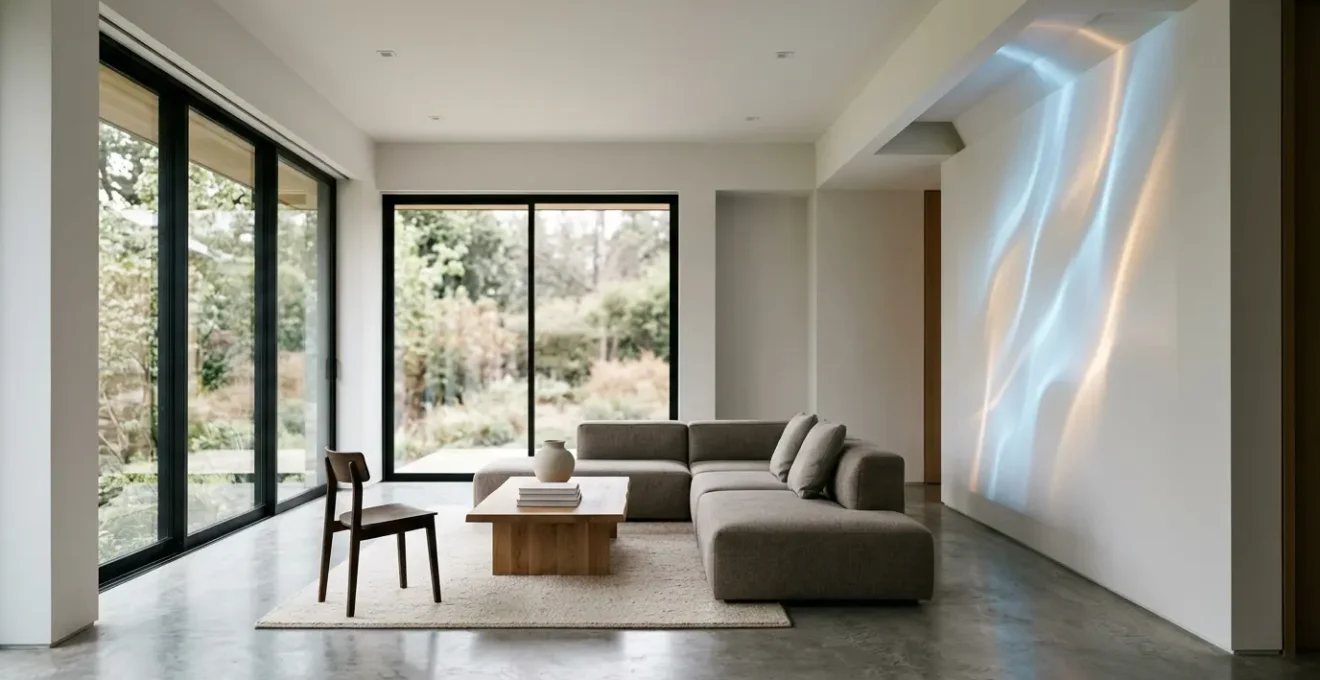
In summary:
- Treat your interactive art system as an “unseen choreographer” rather than a collection of gadgets.
- Prioritize the guest experience by designing a “behavioral palette” for your art, from playful to calm.
- Use low-tech solutions like kinetic mobiles and shadow play for poetic, high-impact interactions.
- Address practicalities like privacy (Lidar vs. camera), energy use, and software updates from the start.
- The goal is a “kinetic dialogue” where the home doesn’t just react but truly interacts with presence.
You’ve curated the perfect playlist, mixed the signature cocktail, and arranged the furniture for effortless conversation. But as guests mingle, does your home itself join the party? For entertainers who crave a space that surprises and delights, static wall art can feel like a missed opportunity. The common advice often points towards smart lighting or digital frames, solutions that can feel more like tech demos than integrated, magical experiences.
These approaches treat the home as a passive stage for technology. They touch on elements of interactivity but rarely capture the essence of a truly responsive environment. What if the goal wasn’t just to install sensors, but to choreograph a dance between your space and its inhabitants? What if your walls could sense the energy of a room and respond not with a simple trigger, but with a change in personality?
This is where the mindset of an interaction designer changes the game. The secret isn’t in the hardware itself, but in the artful design of its behavior. We’re moving beyond simple reactions to create a genuine kinetic dialogue. This guide re-frames the challenge: instead of asking “what tech should I buy?”, we will ask “what story do I want my home to tell?”. It’s about creating an environment with its own behavioral palette, capable of everything from quiet contemplation to playful engagement.
Throughout this article, we will explore the design principles and technical choices needed to transform your home into a dynamic and engaging partner. We will cover how to seamlessly hide the technology, program your art to respect the home’s natural rhythms, and address the critical concerns of energy, privacy, and long-term maintenance. Let’s design an experience, not just an installation.
Table of Contents: Designing the Kinetic Dialogue in Your Home
- Where to Hide Motion Sensors for Seamless Art Interaction?
- How to Program Interactive Walls to Calm Down at Night?
- The “Phantom Load”: How Much Electricity Do Interactive Walls Consume?
- What Happens When the Software Update Breaks Your Art Installation?
- Camera vs Lidar: Which Sensor Respects Home Privacy Better?
- How to Position Kinetic Mobiles to Catch HVAC Airflow?
- The “Cinema to Gallery” Switch: Programming Smart Lights for Dual Use
- Why Does Kinetic Art Transform Static Rooms Through Shadow Play?
Where to Hide Motion Sensors for Seamless Art Interaction?
The magic of responsive art is destroyed the moment a guest spots the clunky plastic sensor. The goal is to create an “unseen choreographer,” where the technology is so perfectly integrated it feels like the art has a mind of its own. This isn’t just about hiding wires; it’s about strategic placement that creates intentional and seamless interactions, distinguishing between a person walking by and someone genuinely engaging with the piece.
The first layer of this strategy involves using architecture as camouflage. Think of sensors embedded within crown molding, baseboards, or even behind drywall. For example, millimeter-wave radar sensors can “see” through materials, making them completely invisible while providing rich presence data. According to industry analysis, over 75% of recent interactive installations in professional settings now utilize integrated enclosures or behind-the-scenes placement to maintain aesthetic integrity. This moves the sensor from being a piece of hardware to part of the room’s fabric.
The second layer is about creating a hierarchy of detection. A primary, wide-angle sensor at an entryway can trigger a subtle “welcoming” behavior. But for more nuanced interaction, secondary sensors are key. Piezoelectric pads under a specific floor tile or a rug can detect when a person is standing directly in front of an artwork, triggering a more complex and detailed response. This dual-sensor approach allows the system to understand intent, creating a far more sophisticated and rewarding kinetic dialogue than a single motion detector ever could.
Your Action Plan: Achieving the Unseen Choreographer Effect
- Map Entry Points: Position primary sensors (e.g., PIR or radar) at entry zones, aimed to capture all initial movement and initiate a “welcome” sequence.
- Isolate from False Triggers: Keep sensors away from heat sources like vents and direct sunlight to prevent false positives. If unavoidable, use sensors with adjustable sensitivity to compensate for temperature fluctuations.
- Architectural Integration: Integrate sensor enclosures into features like crown molding, recessed lighting, or furniture to make them functionally invisible. The technology should disappear.
- Differentiate Engagement: Implement a dual-sensor system. Use inconspicuous primary sensors (e.g., millimeter-wave radar behind drywall) for general presence and secondary sensors (e.g., piezoelectric floor pads) to detect intentional engagement in a specific spot.
- Account for Verticality: In multi-level spaces, place sensors near staircases to monitor vertical traffic, allowing art to react to someone ascending or descending.
How to Program Interactive Walls to Calm Down at Night?
An interactive wall that dazzles guests during a party can become a source of distracting light pollution when you’re trying to wind down. True experiential design demonstrates environmental empathy—the ability of the system to adapt its behavior to the time of day and the mood of the home. This means programming your art not just for “on” and “off,” but for a full behavioral palette that includes a “sleep” mode.
The most elegant solution is to align the art’s behavior with the body’s natural circadian rhythm. As evening approaches, the system should transition from bright, energetic displays to a calmer, more serene state. This involves shifting the color palette to warmer tones (ambers, soft oranges) and reducing the intensity and frequency of movement. The animation can change from quick, reactive patterns to slow, “breathing” pulses that promote a sense of tranquility. This gradual shift signals to our bodies that it’s time to relax, supporting natural melatonin production.
This approach transforms a purely decorative piece into a functional element of a healthy home environment. The artwork becomes a beautiful, ambient timepiece that reflects the natural cycle of day and night.
As shown in the visual above, the transition is about creating an atmosphere, not just dimming a light. It’s a designed experience that helps bridge the gap between an active day and a restful night, making the art a thoughtful contributor to your well-being.
Case Study: Chrono-Decorating with Digital Frames
A design philosophy known as Chrono-Decorating demonstrates this principle beautifully. The system uses high-quality digital frames programmed with different art playlists for “Morning,” “Workday,” and “Evening” modes. During evening hours, the program automatically shifts to display art with cooler, more serene palettes and reduces its reactivity to emulate the calm of twilight. This proactive approach aligns the home’s visual environment with the body’s circadian rhythm, using warm, dim content to signal wind-down time and actively support restfulness.
The “Phantom Load”: How Much Electricity Do Interactive Walls Consume?
The idea of a wall that is “alive” with light and motion immediately raises a practical question for any homeowner: what will this do to my electricity bill? The concern over “phantom load” or standby power consumption is valid, but modern interactive installations are designed with efficiency at their core. The key is not to think of them as constantly running at full power, but as intelligent systems that manage energy based on presence and time of day.
An interactive wall doesn’t have to be a power-hungry beast. By using energy-efficient components like LED lighting and low-power microcontrollers (like Raspberry Pi or Arduino), the baseline consumption can be surprisingly low. More importantly, the same sensors used for interaction are also used for power management. When no one is in the room for a set period, the installation can enter a deep-sleep mode, consuming negligible energy. This is a massive improvement over traditional displays that are either fully on or fully off.
Furthermore, these systems are part of the broader smart home ecosystem, which is proven to reduce energy use. While an art wall adds a new electrical load, the intelligence controlling it contributes to overall savings. For context, broad studies show that IoT integration in home automation has led to a 20% reduction in energy use. Some analyses suggest that a fully-optimized smart home can achieve even more, with potential energy savings of up to 30-40% through intelligent management of lighting, heating, and appliances. Your art installation becomes another smart device in this efficient ecosystem, not a rogue energy drain.
What Happens When the Software Update Breaks Your Art Installation?
In the world of physical art, permanence is a virtue. In the world of software-based art, it’s a vulnerability. What happens when the company that made your interactive wall’s software goes out of business, or a mandatory OS update renders the code obsolete? An expensive, dynamic installation can quickly become an inert, non-functional slab. This is a legitimate fear, and the solution lies in building in robustness and redundancy from day one.
An interaction designer plans for failure. The first line of defense is choosing open-source platforms and hardware where possible. Relying on proprietary, closed-off systems creates a single point of failure. Using community-supported technologies like Arduino or Processing means you’re not dependent on a single company’s survival. The code can be maintained, adapted, and run on new hardware by a global community of developers for decades to come.
The second, more professional-grade strategy is virtualization. This involves creating a self-contained “digital time capsule” of the artwork’s entire software environment—the operating system, the specific software versions, and the code itself. If the underlying hardware or OS changes, this virtual machine can be run on new systems, preserving the art’s functionality perfectly.
Case Study: The Conservation of “Bite the Bullet”
The critical importance of a failsafe strategy is demonstrated by the conservation of “Bite the Bullet,” a 2008 media artwork by Rho Jae Oon. When Adobe discontinued Flash Player, the artwork was facing permanent loss. The conservation team’s solution, as detailed in a study on the conservation of Flash-based media art, was to create a virtual environment using a specific Flash Player version. They exported it in an open standard format (OVF), ensuring it could run on various virtual machine platforms. This method guarantees the artwork will function even after its original software is long gone, proving the value of building rollback capabilities and redundancy into installations from the very beginning.
Camera vs Lidar: Which Sensor Respects Home Privacy Better?
Inviting guests into your home is an act of trust. Integrating technology that “watches” them requires careful consideration of their privacy. The choice of sensor is not just a technical decision; it’s an ethical one. The two primary options for high-fidelity motion tracking are cameras and Lidar (Light Detection and Ranging), and they have vastly different implications for privacy.
A camera-based sensor captures everything: faces, clothing, personal items. Even if the data is processed locally (“on the edge”), the potential for this highly personal information to be stored or compromised presents a significant privacy risk. It can make guests feel scrutinized and uncomfortable, breaking the spell of the experience. Cameras are best reserved for explicit, opt-in interactions, like a “photo booth” mode where guests are fully aware they are being photographed.
Lidar, on the other hand, offers a powerful and privacy-respecting alternative. It works by sending out pulses of invisible laser light and measuring the time it takes for them to bounce back. The result is not an image, but a “point cloud”—a 3D map of the space and the objects within it. Lidar knows *that* someone is there, where they are, and how they are moving, but it has no idea *who* they are. It captures the dance without recording the dancer’s face. This makes it the superior choice for always-on, ambient presence detection and abstract movement tracking, creating a rich interactive experience without compromising personal privacy.
The following table, based on an analysis of different interactive art technologies, breaks down the key differences for a home environment.
| Aspect | Camera-Based Sensors | Lidar Sensors |
|---|---|---|
| Data Captured | RGB images, full visual detail including faces and personal identifiers | Point clouds representing distances and spatial positions without visual detail |
| Privacy Risk Level | High – captures identifiable personal information | Medium-Low – creates abstract spatial maps without personal identifiers |
| Edge Computing Compatibility | Possible but requires more processing power to anonymize image data locally | Naturally suited – raw data is already abstracted from personal identifiers |
| Data Storage Concerns | Images can be stored and potentially misused if security is compromised | Point-cloud data is less useful for identification even if accessed |
| Tracking Precision | High detail for gesture recognition and facial tracking | High spatial precision for position and movement without identity capture |
| Best Use Case for Privacy | Opt-in ‘photo booth’ modes with explicit consent | Always-on presence detection and abstract movement tracking |
How to Position Kinetic Mobiles to Catch HVAC Airflow?
Not all interactive art needs a plug. Some of the most enchanting experiences are powered by the invisible forces already present in your home: the air currents from your heating, ventilation, and air conditioning (HVAC) system. A well-placed kinetic mobile transforms these utilitarian airflows into a source of constant, gentle, and ever-changing performance. This is the ultimate low-tech, high-impact installation.
The secret is to become a “windscape cartographer” of your own home. Air doesn’t move uniformly. It flows in predictable laminar streams from vents, creates chaotic turbulence near doorways, and rises or falls depending on its temperature. To choreograph your mobile’s dance, you must first map these currents. An easy way to visualize them is by using a stick with thin silk ribbons attached or by observing the path of incense smoke near vents, windows, and high-traffic areas. This reveals the “sweet spots” for different types of motion.
Positioning a mobile directly under a ceiling vent will likely create a smooth, repetitive, and graceful sway (laminar flow). Placing one in a hallway between two rooms might cause it to engage in a more energetic, unpredictable dance as different air pressures compete (turbulent flow). You can even design for “seasonal performances” by placing mobiles where they will be activated by falling cool air from the AC in summer and rising warm air from the heat in winter. This approach creates a living sculpture that has a unique dialogue with the changing seasons and the daily life of the home.
The beauty of this method is its subtlety and organic nature. The mobile’s movement is a direct visualization of the invisible life of the room, turning a functional system like HVAC into an integral part of your home’s artistic expression.
The “Cinema to Gallery” Switch: Programming Smart Lights for Dual Use
In a modern home, a single room often serves multiple functions. The living room is a bright, social space by day, a focused art gallery for entertaining, and a dark, cozy cinema by night. Smart lighting shouldn’t just offer color changes; it should enable these rapid, theatrical transformations. Programming a “Cinema to Gallery” switch is a perfect example of using lighting to define a room’s purpose.
This requires thinking like a professional lighting designer and applying a few core principles. The two modes require fundamentally different approaches to light.
- Gallery Mode: The goal here is drama and focus. This mode should use the “Key, Fill, and Accent” principle. Strong, narrow-beam accent lights are angled to “carve out” artworks, creating dramatic shadows and highlighting texture. To ensure the art is seen as the artist intended, the lights should have a high Color Rendering Index (CRI) of 90+, rendering colors with maximum accuracy. The color temperature should be a cool, neutral white (4000-5000K) to mimic gallery lighting.
- Cinema Mode: The priority shifts to comfort and immersion. Here, you want to eliminate glare and reduce eye strain. This mode relies on soft, low-intensity, indirect fill light. The bright accent lights are turned off, and the color temperature shifts to a warm, cozy 2700-3000K. The lighting is just enough to allow safe movement without reflecting on the screen.
The transition between these two states is as important as the states themselves. Instead of an abrupt switch, programming a slow, 5-10 second cross-fade creates a luxurious, theatrical moment. The gradual dimming of gallery lights and the slow rise of the cinema ambiance signals the room’s functional change, elevating a simple movie night into an event.
Key takeaways
- Design for Experience, Not Tech: Focus on the emotional response you want to create—surprise, calm, or delight—and let that guide your technology choices.
- Embrace Invisibility: The most successful interactive art makes the technology disappear, creating a sense of magic. Hide sensors and integrate systems seamlessly into your architecture.
- Privacy is Paramount: Use privacy-preserving sensors like Lidar for ambient tracking to ensure guests feel comfortable and respected, not watched.
Why Does Kinetic Art Transform Static Rooms Through Shadow Play?
Perhaps the most profound effect of kinetic art has nothing to do with the object itself, but with the shadows it casts. A simple mobile or a complex interactive sculpture becomes an engine for shadow play, painting the walls with ever-changing, organic patterns. This secondary effect is often more captivating than the primary object because it taps into a deep, primal part of our human perception.
Our brains are hardwired to be fascinated by natural, unpredictable movement. The slow, gentle dance of shadows on a wall mimics biophilic patterns—the dappling of sunlight through tree leaves, the reflection of light on water, or the slow drift of clouds. These are patterns we find inherently calming and engaging. As the Eastend Arts Council notes in their analysis of the rise of interactive art experiences, this connection is fundamental to our psychology.
The slow, unpredictable movement of shadows mimics natural phenomena our brains are hardwired to find fascinating and calming, like light filtering through tree leaves or water reflections.
– Eastend Arts Council, Engaging the Senses: The Rise of Interactive Art Experiences
This shadow play transforms a static, flat wall into a dynamic, three-dimensional canvas. It adds a layer of depth and life to a room that static art cannot achieve. The room is no longer just a container for objects; it becomes an active participant in the art itself. The shadows animate the space, making it feel alive and responsive. The constant, subtle motion creates a focal point that is mesmerizing but not distracting, encouraging a state of soft fascination and quiet contemplation.
Ultimately, engaging with kinetic art through its shadows is a poetic experience. It reminds us that the most powerful interactions are often the most subtle. It’s not about loud noises or bright flashes, but about the quiet, mesmerizing dialogue between light, motion, and form.
By applying these design principles, you can create a home that does more than just host—it participates. You can choreograph an environment that engages, surprises, and delights, turning every visit into a memorable, kinetic experience. The next step is to start mapping your own space and imagining the stories it could tell.