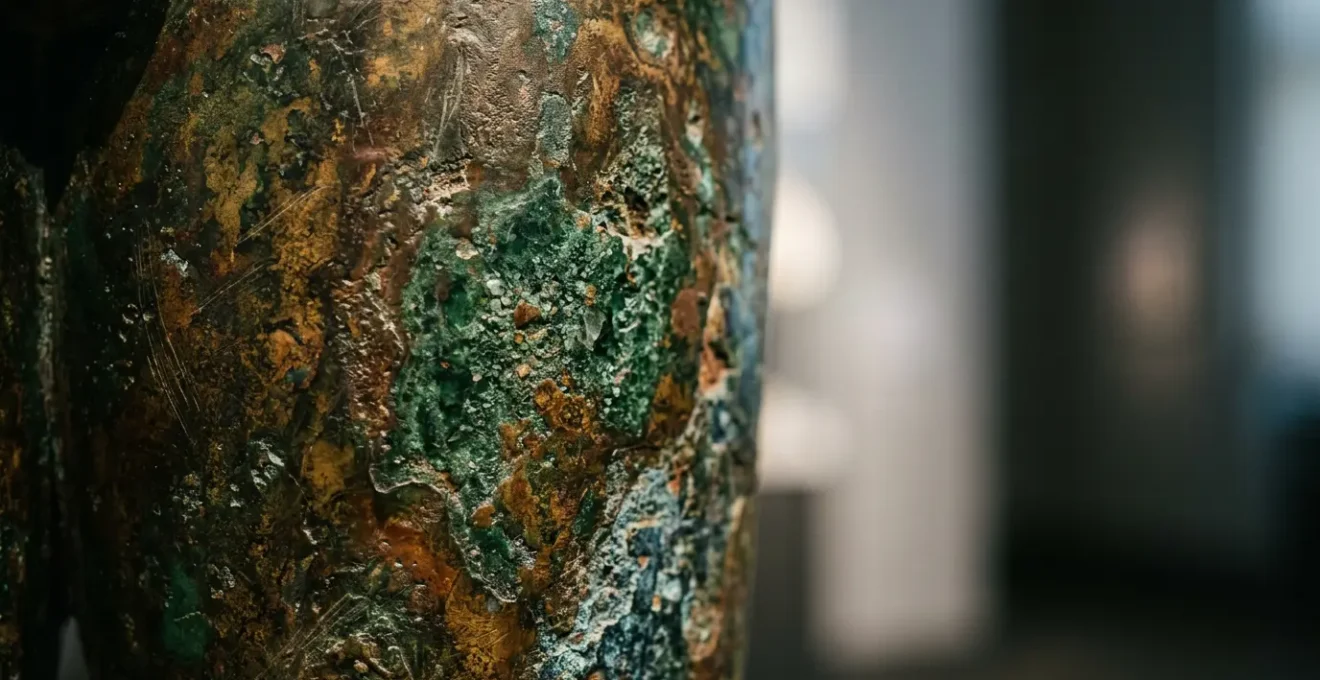
Contrary to popular belief, the goal of caring for antique bronze is not to make it shiny; it is to stabilize its surface as a historical document.
- Aggressive polishing or using household chemicals can strip away centuries of valued patina, potentially reducing an antique’s value by over 50%.
- The collector’s market pays a premium for an object’s “surface narrative”—the authentic, untouched story of its age told through its stable oxidation.
Recommendation: Approach every bronze sculpture with a diagnostic mindset. Before you act, learn to distinguish between stable, desirable patina and active corrosion that requires professional intervention.
The moment a collector acquires a bronze sculpture, a quiet sense of responsibility settles in. It sits there, a masterpiece of form and artistry, gradually accumulating a thin layer of dust. The immediate impulse for many is to clean it, to restore a perceived original luster. This is where the most profound and often irreversible mistakes are made. Common advice found in household cleaning guides, suggesting everything from lemon juice to abrasive polishes, is the sworn enemy of antique bronze. These methods treat the surface as dirt to be removed, rather than what it truly is: a delicate, complex chemical layer known as patina that tells the story of the object’s life.
The value of an antique bronze is inextricably linked to its surface integrity. For a conservator, the primary philosophy is one of minimal and reversible intervention. The aim is not to make an old piece look new, but to stabilize its current state and preserve its history for future generations. This perspective is precisely what discerning collectors pay a premium for. Understanding this principle is the first step away from the fear of causing damage and toward the confidence of a knowledgeable custodian. It requires shifting your goal from “cleaning” to “conservation” and learning to read the object’s surface narrative before taking any action.
This guide adopts the cautious, scientific approach of a museum conservator. We will explore how to perform basic maintenance safely, differentiate between natural aging and dangerous corrosion, and understand the market forces that prize authenticity above all else. By the end, you will be equipped with the diagnostic tools to protect your investment and appreciate the subtle beauty of a well-preserved finish.
Summary: A Conservator’s Approach to Bronze Patina Preservation
- How to Dust Bronze Sculptures Without Scratching the Wax Layer?
- The Polishing Mistake That Devalues Antique Bronze by 50%
- Natural Age vs Chemical Patina: How to Tell the Difference?
- Why Do Collectors Pay a Premium for “Unrestored” Surfaces?
- When to Call a Conservator: The Signs of “Bronze Disease”
- How to Seal Raw Steel to Stop Oxidation Indoors?
- Why Is Provenance the Single Most Critical Factor for Resale?
- How to Use Raw Steel Statues to Create Contrast in Soft Luxury Interiors?
How to Dust Bronze Sculptures Without Scratching the Wax Layer?
The most frequent interaction you will have with your bronze sculpture is dusting. Done incorrectly, this simple act can cause incremental damage, creating micro-scratches in the protective wax layer that dull the finish and trap dirt. The conservator’s approach is methodical and prioritizes the safety of the surface above all. Forget feather dusters, which can snag on intricate parts and shed debris. The professional standard involves a two-stage process using specific tools designed for delicacy.
The first stage is dry brushing with soft, natural-bristle brushes, such as those made from sable or camel hair. The metal ferrule (the part that holds the bristles) of the brush should be wrapped in tape to prevent accidental contact with the bronze. This removes all loose dust and surface debris from every recess before any other step is taken. For more intricate areas, a clean, soft toothbrush can be used with gentle pressure. If the wax layer is intact and stable, a light buffing with a clean, low-lint cotton cloth can follow to enhance its luster. This entire process should be seen as a regular check-up.
The frequency of this care is also a factor in preservation. For indoor sculptures in a typical home environment, this careful dusting should be performed every few months. For pieces in more exposed conditions, such as outdoor or semi-outdoor settings, a more thorough cleaning and re-waxing is essential. In fact, for outdoor sculptures, a full conservation treatment is recommended at least twice per year, according to National Park Service guidelines. This routine prevents the buildup of pollutants and dirt that can degrade the wax and the patina beneath.
The Polishing Mistake That Devalues Antique Bronze by 50%
The single most destructive action a non-professional can take against an antique bronze is to polish it. The desire to see a bright, metallic shine is a fundamental misunderstanding of what gives bronze its value. The dark, nuanced, and sometimes greenish layers on the surface are not tarnish; they are the patina, a complex layer of chemical compounds that has formed over decades or centuries. This surface narrative is a testament to the object’s age and history. Removing it is akin to ripping the title page and publication date out of a first-edition book.
The financial consequences of this mistake are catastrophic. As confirmed by antiques experts, improperly cleaning or polishing a bronze sculpture can result in an over 50% reduction in value. This is because the process is irreversible. The use of abrasive polishes, metal cleaners, or acidic household products physically strips away the layers of oxidation that collectors and appraisers cherish. An ISA Appraiser from the JustAnswer Antiques Expert Panel puts it bluntly:
Polishing a bronze to a shiny surface will decrease the value significantly.
– ISA Appraiser, JustAnswer Antiques Expert Panel
This damage occurs at a microscopic level, destroying the crystalline structure of the patina and replacing a deep, rich surface with a flat, uninteresting gleam. Once this historical evidence is gone, it can never be authentically recovered. Artificial re-patination exists, but it is easily identified by experts and is considered a restoration that documents a past trauma, not a feature of originality.
As the visual contrast shows, the difference between a preserved surface and one stripped by polishing is stark. On one side, you have depth, history, and character; on the other, a superficial shine that has erased the very essence of the object’s journey through time. Respecting this distinction is the cornerstone of responsible ownership.
Natural Age vs Chemical Patina: How to Tell the Difference?
Developing the ability to “read” a bronze surface is a crucial skill for any serious collector. It allows you to distinguish between a natural, time-worn patina that adds immense value and an artificial or chemically induced patina, which may indicate a modern reproduction or a poorly restored piece. A natural patina is the result of a slow, organic reaction between the bronze alloy and its environment. An artificial patina is created rapidly in a workshop using chemicals and heat to mimic the appearance of age.
The key difference often lies in heterogeneity and depth. A natural patina is rarely uniform. It will show subtle variations in color, translucency, and thickness, telling a story of its life. Areas that were frequently touched, like the nose of a bust or the hands of a figure, will often have a softer, thinner patina where the surface has been burnished by contact over many years. A chemically induced patina, by contrast, is often too perfect, too uniform, or suspiciously bright. It may lack the deep, crystalline structure that is visible under magnification.
To aid in this diagnostic process, conservators and experienced collectors use a methodical approach to inspection. This involves more than a quick glance; it is a careful examination using tools and a trained eye to look for the subtle clues that reveal the surface’s true nature.
Collector’s Diagnostic Checklist: Distinguishing Natural from Chemical Patina
- Visual Inspection: Look for heterogeneity. A deep, complex, and uneven corrosion pattern is often the hallmark of an old piece, while a perfectly homogeneous, superficial, or overly ‘perfect’ corrosion may indicate a modern treatment or reproduction.
- Magnification Test: Use a 10x jeweler’s loupe. Examine the surface for crystalline depth and a certain translucency, which are characteristic of natural patina. A flat, opaque, and uniform appearance is more typical of a chemical application.
- Wear Pattern Analysis: Analyze the logic of the wear. A natural patina will be logically softer and thinner on high-touch areas, telling a story of interaction that a uniform chemical patina cannot replicate.
- Color Gradation Check: Observe the color palette. Look for subtle and logical color variations. Be suspicious of unnaturally bright or uniform colors, such as a powdery turquoise that lacks depth or variation.
Why Do Collectors Pay a Premium for “Unrestored” Surfaces?
In the world of high-end art and antiques, the word “original” is paramount. For a bronze sculpture, the original surface includes not just the metal itself, but the stable, mature patina that has developed over its lifetime. This surface is considered an integral part of the artwork, sometimes even an element intentionally initiated by the artist. As the experts at Fine Art Restoration Company note, this layer is highly prized, and removing it can “disturb artistic and historic integrity.” Collectors pay a premium for this material integrity because it is the most authentic state of the object.
An unrestored surface is a guarantee of authenticity. It is physical proof that the object has not been tampered with, aggressively cleaned, or repaired in a way that masks its true age or condition. This is why a bronze with its original, albeit imperfect, patina is often far more valuable than one that has been polished to a mirror shine and re-patinated to look “new.” The latter has lost its historical narrative; its story has been erased and rewritten. The former, however, carries its history on its surface for all to see.
This philosophy is the core of professional conservation and is deeply understood by the market. A museum conservator’s entire approach is built on this principle of preserving history, not creating an idealized version of the past. This is articulated perfectly in a statement on the conservation philosophy:
A trained conservator’s whole philosophy is built on minimal and reversible intervention. Their goal isn’t to make an old piece look brand new; it’s to stabilize it and preserve its history for generations to come, which is precisely what high-end collectors are paying for.
– Museum Conservator, Curio
Therefore, when a collector pays a premium for an “unrestored” piece, they are not just buying a sculpture. They are investing in a tangible piece of history, an object whose value is guaranteed by its untouched, honest surface. They are paying for the confidence that comes with owning the real, unedited story.
When to Call a Conservator: The Signs of “Bronze Disease”
While a stable green or dark patina is desirable, there is a malignant form of corrosion known as “bronze disease.” This is not a biological illness but a cyclical, self-sustaining chemical reaction that can actively destroy the metal. It is caused by the presence of chlorides (often from salt in the air or from handling with bare hands) reacting with the copper in the bronze in the presence of moisture. The most telling sign of bronze disease is the appearance of powdery, light green or blue-green spots. Unlike stable patina, this powder can be easily flaked off, revealing pitting and a fragile surface underneath.
If you see these signs, it is an emergency. The reaction will continue to consume the metal as long as humidity is present. The first step is to isolate the object immediately from other bronzes, as the acidic corrosion products can be transferable. The next is to create as dry an environment as possible. Placing the object in a sealed container with a desiccant like fresh silica gel can temporarily arrest the reaction by removing moisture. It is critical to maintain a stable environment; conservation science research recommends a relative humidity of 42-46% to prevent the activation of bronze disease.
This is not a DIY repair. Attempting to treat bronze disease with home remedies or chemicals will almost certainly push the reactive chlorides deeper into the metal, causing more extensive damage. This condition requires a professional conservator who has the tools and expertise to chemically remove the chlorides and stabilize the object. Document the affected areas with clear photographs and contact a qualified professional immediately. Your role as an owner is to provide emergency first aid and then pass the patient to the specialist.
How to Seal Raw Steel to Stop Oxidation Indoors?
While the historical narrative of patina is prized on bronze, the conversation around raw steel is often different, particularly in an interior design context. For raw steel sculptures or furniture, the desired aesthetic is frequently the clean, industrial look of the un-oxidized metal. However, steel is highly reactive, and even indoors, ambient humidity will quickly lead to rust (iron oxide). To prevent this, a sealant is necessary. The choice of sealant depends on a trade-off between the desired aesthetic finish, durability, and ease of application.
The most durable options are often polyurethane clear coats, which create a hard, non-porous barrier over the steel. These are available in finishes from high gloss to satin and matte, but they can sometimes impart a slightly plastic-like appearance. For a more “invisible” or natural finish, waxes are an excellent choice. Microcrystalline wax, a favorite of museum conservators for many metals, creates a hard, clear barrier that is highly moisture-resistant without significantly altering the metal’s sheen. Paste waxes, like carnauba, offer a similar effect but may require more frequent reapplication. Specialized metal oils are the easiest to apply but offer the lowest level of protection and need regular renewal.
The table below outlines the key characteristics of common sealant options for raw steel, helping you choose the best method to maintain the intended aesthetic while preventing unwanted oxidation.
| Sealant Type | Finish Aesthetic | Durability | Application Difficulty |
|---|---|---|---|
| Polyurethane Clear Coat | Gloss to Satin | High (UV stabilized) | Moderate (spray application) |
| Paste Wax (Carnauba) | Matte to Soft Luster | Moderate (requires reapplication) | Low (hand buffing) |
| Microcrystalline Wax | Invisible to Subtle Sheen | Moderate (barrier protection) | Low (brush or cloth) |
| Specialized Metal Oils | Natural Matte | Low (needs frequent renewal) | Very Low (wipe-on) |
Why Is Provenance the Single Most Critical Factor for Resale?
Beyond the physical object itself, the single most critical factor determining a work of art’s value is its provenance. Provenance is the documented history of an object’s ownership, from the time it left the artist’s studio to the present day. It is the artwork’s biography. A complete, unbroken provenance provides an ironclad guarantee of authenticity and legitimacy. It answers the crucial questions: Who made it? Who has owned it? Has it been exhibited? This paper trail can multiply an object’s value, while a lack of provenance can cast a shadow of doubt that no amount of physical perfection can overcome.
The condition of the patina is intrinsically linked to provenance. As the specialists at CIRAM Laboratory state, “Patina has often been purposefully created by the artist and removing it may completely disturb artistic and historic integrity.” An untouched surface is a key piece of evidence in the object’s provenance, confirming it has been cared for according to professional standards throughout its life. A record of conservation work, performed by a reputable conservator, also becomes a positive part of the provenance. Conversely, evidence of aggressive cleaning or poor restoration detracts from the story and thus the value.
As an owner, you are not just a possessor but a temporary custodian and a contributor to the object’s ongoing provenance. Meticulously documenting your period of ownership is one of the most significant value-adding activities you can undertake. This includes retaining all purchase documents, logging the object’s condition, and recording any exhibitions or publications. This effort builds the unbroken chain of history that future buyers will scrutinize and pay a premium for.
- Purchase Documentation: Retain original gallery receipts, auction catalogs, certificates of authenticity, and any correspondence with dealers or artists.
- Conservation Records: Document all professional conservation work with detailed treatment reports, before/after photographs, and conservator credentials.
- Condition Logging: Create a timestamped condition log with annual photographs showing patina evolution, noting any environmental changes or incidents.
- Exhibition History: Record any museum loans, gallery exhibitions, or publications featuring the piece, as these add scholarly validation.
- Ownership Chain: Maintain correspondence or documentation linking you to previous owners, building the unbroken chain that future buyers will value.
Key Takeaways
- Preservation Over Cleaning: Your goal is not to make bronze shiny, but to stabilize its historical surface.
- The Peril of Polishing: Aggressively polishing a patinated bronze can destroy over half its market value instantly and irreversibly.
- Patina is History: The varied, stable layers on an antique bronze are a desirable historical document, not dirt.
How to Use Raw Steel Statues to Create Contrast in Soft Luxury Interiors?
A well-preserved collection, whether of historic bronze or modern steel, finds its ultimate expression when thoughtfully integrated into a living space. In the context of soft luxury interiors—defined by rich textiles like velvet, wool, and silk, and warm materials like wood—the inclusion of metal sculptures creates a powerful point of textural and material contrast. Using a raw steel statue in such an environment introduces a cool, industrial, and minimalist element that heightens the softness and warmth of its surroundings.
The dialogue between these opposing materials is what defines sophisticated design. The sharp, clean lines and matte or brushed finish of a steel sculpture provide a visual anchor in a room dominated by plush textures. It creates a textural triangulation between soft fabric, warm wood, and cool metal. This principle is even more powerful when a patinated bronze piece is also present. The deep, historic warmth of the bronze and the cool, precise finish of the steel create a dynamic conversation about time, material, and craft.
Case Study: Material Dialogue in Sculpture Display
The aesthetic power of patina can be seen in famous sculptures worldwide. From the Statue of Liberty’s iconic green to the Bronze Horseman of St. Petersburg, these works show how patinated bronze communicates history and organic aging. When a piece like this is positioned in a contemporary interior near an object of raw steel, a compelling dialogue emerges. The contrast between the warm, historic depth of the bronze and the cold, industrial precision of the steel creates the textural tension that elevates luxury design, where each material’s distinct personality amplifies the other.
The key is balance. The steel should feel intentional, not out of place. It can be a single, bold statement piece or a series of smaller objects that create a recurring industrial motif. By juxtaposing the hard, immutable nature of metal with the soft, inviting qualities of a luxury interior, you create a space that is not only visually interesting but also intellectually engaging.
By applying these principles of conservation and thoughtful display, you transition from simply owning an object to becoming its custodian, preserving its physical integrity and historical narrative for the future while celebrating its aesthetic power in the present.