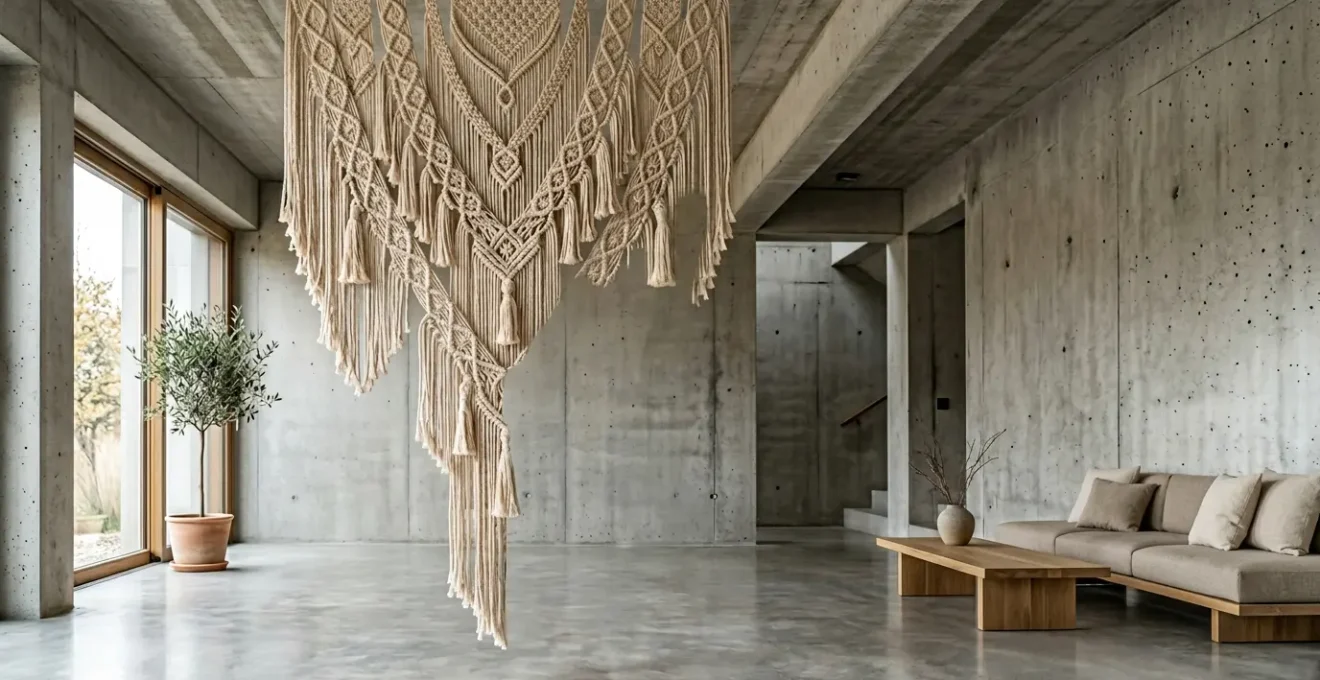
Macramé is more than decor; it’s a tunable acoustic tool that can transform a room’s sonic signature by absorbing harsh echoes.
- The acoustic power of a macramé piece is determined by intentional choices like fiber type, knot density, and overall size.
- Proper, safe installation is critical for heavy pieces, and modern styling techniques prevent a dated ’70s look.
Recommendation: Treat your next macramé project as an act of ‘acoustic sculpting’ by starting with an audit of your room’s sound profile to target echo hotspots effectively.
That persistent, sharp echo in a room with high ceilings and hard floors can be incredibly grating. Whether it’s the clatter of kitchen activity, the amplification of a toddler’s shrieks, or just the hollow feel of a minimalist living space, poor acoustics can make a beautiful home feel uncomfortable. The common advice is to add soft furnishings—rugs, curtains, pillows. While effective to a degree, this approach often overlooks one of the most artistic and impactful solutions: large-scale textile art.
But we’re not just talking about hanging any fabric on the wall. This is where macramé transcends its bohemian reputation and becomes a functional, sophisticated design element. Forget the simple idea of “soft things absorb sound.” We are going to approach this from the perspective of a fiber artist and acoustic hobbyist, treating macramé as a customizable system for sound management. The true magic lies in understanding how to purposefully shape sound through your creative choices.
This is a guide to acoustic sculpting with macramé. It’s about learning how every decision—from the fiber you choose and the density of your knots to the final placement on your wall—directly influences how sound behaves in your space. By mastering these variables, you can turn a beautiful, handcrafted object into a targeted acoustic treatment that softens, warms, and clarifies the sonic signature of your home.
To guide you on this journey, this article covers every critical question. We will explore the science behind why certain rooms amplify noise, delve into material choices and styling, and cover the practicalities of cost, customization, and safe installation. Let’s begin crafting a quieter, more beautiful space.
Summary: A Fiber Artist’s Guide to Acoustic Macramé
- How to Anchor a 10kg Macramé Piece into Drywall Safely?
- Cotton vs Jute: Which Fiber Resists Dust Accumulation Better?
- The “70s Trap”: How to Style Macramé Without Looking Dated?
- DIY vs Commission: Is It Cheaper to Knot Your Own Wall Hanging?
- How to Dip-Dye Macramé to Match Your Existing Color Palette?
- Why Do Concrete Ceilings Amplify Toddler Noise to Unbearable Levels?
- Why Buying Direct From Artisans Supports Local Economies Better Than Retail?
- Why Do Handcrafted Objects with “Wabi-Sabi” Flaws Cost More?
How to Anchor a 10kg Macramé Piece into Drywall Safely?
Before you can enjoy the acoustic benefits of a large, heavy macramé wall hanging, you must ensure it’s mounted securely. A 10kg (22 lbs) piece represents a significant load, and relying on a simple nail or screw is a recipe for disaster. Drywall itself has very little structural strength; the key is to use an anchor that transfers the weight to a wider area or to a structural element behind the wall.
For hollow walls where a wall stud isn’t conveniently located, your best friend is the toggle bolt. When inserted through a pre-drilled hole, its spring-loaded wings open up behind the drywall, distributing the load over a much larger surface area. This prevents the anchor from pulling straight out. High-quality heavy-duty toggle bolts can support well over 100kg in standard half-inch drywall, providing more than enough strength for your artwork. The principle is to always over-engineer for safety.
A crucial strategy for heavy pieces is load distribution. Instead of hanging a 10kg piece from a single point, use a mounting bar or a French cleat system. This allows you to use two, three, or even four anchor points, each bearing only a fraction of the total weight. This not only increases safety exponentially but also makes it easier to level the artwork. Remember to calculate the total potential load, accounting for accidental tugs or the force of cleaning, and choose hardware rated for at least double your piece’s static weight.
Action Plan: Auditing Your Room’s Sonic Signature
- Identify Echo Hotspots: Clap your hands sharply in different areas of the room (center, corners, between parallel walls). Listen for a sharp, ringing “zing” or flutter. These are your primary target zones for acoustic treatment.
- Inventory Hard Surfaces: Make a quick list of all the sound-reflecting surfaces. This includes glass (windows, doors), bare floors (concrete, tile, hardwood), large bare walls, and even large pieces of wood or metal furniture.
- Assess Existing Absorption: Note what soft materials are already in the room—rugs, curtains, upholstered sofas, throw pillows. Estimate their total coverage. This helps you understand what’s already working and how much more absorption is needed.
- Define Your Acoustic Goal: Are you trying to improve speech clarity for conversations, dampen the high-frequency sounds from a kitchen, or create a cozy, quiet reading nook? Your goal will determine the size, thickness, and placement of your macramé.
- Map Potential Installation Points: Using your hotspot analysis and aesthetic judgment, mark potential locations on a simple sketch of the room. Consider a large piece on the wall opposite your main sound source (like speakers or a TV) or smaller pieces to break up parallel walls.
Cotton vs Jute: Which Fiber Resists Dust Accumulation Better?
The choice of fiber for your macramé piece is a foundational act of acoustic sculpting. It impacts not only the look and feel but also its performance as a sound absorber and its maintenance requirements. When it comes to dust, the fiber’s surface texture is the primary determining factor. Cotton, with its relatively smooth and uniform fibers, naturally offers fewer nooks and crannies for dust particles to settle in. This makes it inherently more resistant to dust accumulation and easier to clean with a gentle shake or light vacuuming.
Jute, on the other hand, possesses a much rougher, coarser, and more ‘scaly’ texture. While this provides a wonderfully rustic and earthy aesthetic, its complex surface is a magnet for airborne dust and particles. A macramé piece made from jute will typically require more frequent and thorough cleaning to keep it looking fresh and to prevent it from becoming a reservoir for allergens. This textural difference is key to your long-term maintenance plan.
However, the decision isn’t just about dust. The table below, drawing from data on natural fiber acoustic properties, shows a fascinating trade-off. While cotton is cleaner, jute’s inherent roughness and porosity can give it a slight edge in sound absorption coefficients in certain frequency ranges. This is where your role as an acoustic sculptor comes in: Do you prioritize lower maintenance (cotton) or potentially higher acoustic performance in a dust-tolerant space (jute)?
| Fiber Type | Dust Resistance | Sound Absorption Coefficient | Maintenance Frequency |
|---|---|---|---|
| Cotton | High (smooth fibers) | 0.40-0.50 at 1000 Hz | Every 2-3 months |
| Jute | Low (rough, scaly fibers) | 0.48-0.55 at 1000 Hz | Monthly cleaning |
| Wool | Medium | 0.55-0.65 at 1000 Hz (superior) | Every 6-8 weeks |
| Linen | Medium-High | 0.42-0.52 at 1000 Hz | Every 2-3 months |
The “70s Trap”: How to Style Macramé Without Looking Dated?
One of the biggest hesitations for people considering macramé is the fear of falling into the “70s trap”—creating a space that feels like a dusty, dated time capsule. The key to a contemporary look is not the macramé itself, but its context. Modern styling is all about intention, contrast, and integration. Instead of a cluttered collection of small, folksy pieces, think of a large macramé hanging as a single, powerful piece of sculptural art.
The first principle for a modern feel is material contrast. The softness and intricate texture of macramé shines brightest when juxtaposed with hard, clean, contemporary materials. Imagine a beautifully knotted, undyed cotton piece hanging against a raw concrete wall, a sleek metal frame, or dark, smooth wood paneling. This tension between soft textile and hard architecture feels deliberate and sophisticated, immediately pulling the macramé out of the past and into the present.
The second principle is mastering scale and negative space. The 1970s aesthetic often involved filling every available space. The modern approach does the opposite. Use one large, impactful macramé piece as a focal point and give it room to breathe. The empty wall space around it is just as important as the piece itself, allowing the eye to appreciate its form and texture. This turns it from a simple decoration into a deliberate artistic statement.
Case Study: Modern Macramé in a Minimalist Music Room
A contemporary guitar practice space successfully integrated macramé into a bohemian-meets-modern aesthetic. The design featured multiple guitars mounted on the wall as functional art, surrounded by large, simple macramé tapestries. The layered textiles provided essential acoustic dampening for practice sessions while their visual warmth softened the clean architectural lines of the room. This demonstrated how pairing textiles with contrasting elements like musical instruments creates a fresh, intentional space rather than dated clutter.
Finally, think beyond the boho box. Adapt macramé to other design languages by cross-pollinating aesthetics. A minimalist, undyed piece with clean lines fits perfectly in a Japandi interior. For a Dark Academia or Maximalist room, consider a dip-dyed macramé in a rich jewel tone like emerald or sapphire. By integrating it with your existing style, it becomes a unique accent rather than a defining, and potentially dating, feature.
DIY vs Commission: Is It Cheaper to Knot Your Own Wall Hanging?
On the surface, the math seems simple. The raw materials for a large macramé hanging—several hundred feet of cotton cord and a dowel—can be relatively inexpensive. According to a detailed DIY guide for acoustic panels, homemade solutions can cost as little as $20 per panel, whereas commercial equivalents can easily exceed $150. While not a direct comparison, this illustrates the significant material cost savings of a DIY approach. If your primary goal is to cover a wall with sound-absorbing material for the lowest possible price, knotting it yourself is almost always the cheaper option in terms of cash outlay.
However, this calculation completely ignores the most valuable resource: your time. A large, intricate wall hanging can take anywhere from 20 to 100 hours to create, depending on its complexity and your skill level. This includes the time spent learning knots, planning the design, the physical act of knotting, and correcting mistakes. Commissioning a piece from an established fiber artist means you are paying not only for their materials but also for their expertise, design sense, and the hundreds of hours they have invested in honing their craft.
This forces a more philosophical evaluation of “cost.” Is the time you spend knotting a ‘cost’ to be endured, or is it a ‘reward’ in itself? For many, the process of creating something with their own hands is a meditative, rewarding hobby. The final piece holds personal value that goes far beyond its monetary worth. For others, who may not enjoy the process or have the time, those hours are better spent elsewhere, and the ‘cost’ of the artist’s labor is a worthwhile investment for a guaranteed, professional result.
The true cost of DIY isn’t just materials—it’s the value of your time multiplied by hours spent learning and knotting, forcing you to honestly assess if those hours are a ‘cost’ or a ‘rewarding hobby.’
– Community feedback on acoustic panel DIY projects
How to Dip-Dye Macramé to Match Your Existing Color Palette?
Dip-dyeing is a fantastic way to elevate a macramé piece from a simple textile to a bespoke work of art that integrates perfectly with your room’s color story. It allows you to move beyond the standard off-white and create something truly unique, whether it’s a subtle ombré gradient or a bold splash of color. For macramé, which is primarily made of natural fibers like cotton, dyeing is highly effective. The process involves preparing a dye bath and submerging parts of the finished piece to absorb the color.
A common concern is whether dyeing affects the textile’s acoustic properties. It’s a valid question: if the dye stiffens the fibers or clogs their porous structure, it could theoretically reduce its ability to absorb sound. However, as experts in acoustic textiles note, this is generally not a major issue with proper techniques.
Dyeing or printing fabrics can alter their acoustic properties. However, advanced manufacturing processes ensure that performance remains consistent, regardless of the chosen colour or design.
– Acunic Acoustic Textiles, The Science Behind Sound Absorption in Textiles
The key is to use dyes and methods that maintain the fiber’s softness and porosity. To achieve sophisticated, artistic results, you can explore several advanced techniques beyond a simple single-color dip:
- Multi-color Gradient (Ombré): This classic technique creates a beautiful, smooth transition from light to dark or between different colors. It’s achieved by progressively dipping the piece into the dye bath at different depths and for varying durations, allowing the color to wick up the fibers.
- Ice-Dyeing: For a more organic, unpredictable result, try ice-dyeing. You lay the macramé piece on a rack, cover it with ice cubes, and then sprinkle powdered dye over the ice. As the ice melts, it creates stunning, watercolor-like patterns that are impossible to replicate.
- Bundle-Dyeing with Botanicals: This natural dyeing method involves wrapping sections of your macramé tightly around plant materials like flower petals, leaves, or even food scraps like onion skins, and then steaming the bundle. The heat and moisture transfer the natural pigments onto the fiber, creating unique, eco-friendly patterns.
Why Do Concrete Ceilings Amplify Toddler Noise to Unbearable Levels?
If you’ve ever lived in a modern apartment or loft with concrete surfaces, you’ve experienced this phenomenon. A simple dropped toy sounds like an explosion, and a child’s high-pitched voice can feel piercing. This isn’t your imagination; it’s physics. The problem lies with two main acoustic principles: reflection and flutter echo. Hard, non-porous surfaces like concrete, glass, and bare drywall act like acoustic mirrors. Instead of absorbing sound energy, they reflect it back into the room with very little loss of intensity.
When you have two large, parallel reflective surfaces—such as a concrete ceiling and a tile floor—you create a perfect environment for flutter echo. A high-frequency sound, like a toddler’s squeal, bounces rapidly back and forth between these two surfaces. This creates a series of rapid, distinct echoes that decay very slowly, resulting in a ringing, metallic, and often irritating sound that makes the initial noise seem much louder and more persistent than it actually is.
The solution is to introduce porous absorption. This is precisely where macramé and other textiles come in. As acoustic research explains, these materials work by trapping sound waves within their structure.
Porous absorbers are materials where sound propagates through an interconnected pore network resulting in sound energy dissipation. They are only effective at the mid-to-high frequency range, which is most sensitive to the human ear.
– IntechOpen Textiles Research, Textiles for Noise Control
A thick, heavily knotted macramé hanging acts as a perfect porous absorber for those problematic mid-to-high frequencies. When the sound wave hits the textile, it has to navigate the complex web of fibers and knots, losing energy as friction and heat with every interaction. This stops the wave from reflecting back into the room, instantly breaking the cycle of flutter echo. For general echo reduction, acoustic experts recommend covering between 20-30% of the wall space in a room. A large macramé piece can make a significant contribution to this goal, turning an acoustic battleground into a calm, comfortable space.
Why Buying Direct From Artisans Supports Local Economies Better Than Retail?
When you decide to commission a macramé piece instead of attempting a DIY project, you’re faced with another choice: buy from a large retail chain or purchase directly from an independent artisan? While both options get you a finished product, the economic impact of your decision is vastly different. Buying directly from the maker is a powerful act of support for local economies, thanks to a principle known as the local multiplier effect.
When you buy from a mass-market retailer, a large portion of your money immediately leaves your community to pay for corporate overhead, national marketing campaigns, and distant shareholders. In contrast, when you buy from a local artisan, a much larger percentage of that money stays and recirculates within your local economy. The artisan uses it to buy supplies from a local craft store, purchase groceries from the neighborhood market, and pay for local services. This recirculation creates a ripple effect, generating more local wealth, jobs, and even charitable contributions.
The numbers are striking. As the American Independent Business Alliance (AMIBA) highlights, your money works much harder for your community when spent locally. They state that “your dollars recirculate through your local economy 2-4 times more than money spent at a non-local company.” This difference is quantified in the table below, which shows how a hypothetical $100 purchase is broken down in each model.
| Price Component | Chain Retail Model | Direct from Artisan |
|---|---|---|
| Retailer Margin | 50% | 0% |
| Marketing & Advertising | 10% | Minimal |
| Distribution & Shipping | 10% | Direct delivery |
| Maker Compensation | 30% | 90-95% |
| Local Economic Impact | $13.60 | $52.90 |
Key Takeaways
- Macramé functions as a ‘porous absorber,’ trapping and dissipating mid-to-high frequency sound waves to reduce flutter echo.
- The acoustic effectiveness of a piece is a direct result of craft choices: fiber type (porosity), knot density (thickness), and overall size.
- Modern styling relies on contrast (soft vs. hard materials) and scale (one large piece vs. many small ones) to avoid a dated aesthetic.
Why Do Handcrafted Objects with “Wabi-Sabi” Flaws Cost More?
In a world of mass production, we are conditioned to see perfection as the standard of quality. A machine-made object is valued for its uniformity and lack of error. Yet, in the realm of handcrafted goods, the opposite is often true. An object that bears the subtle marks of its maker—a slightly uneven knot, a minor variation in tension—can be more valued and command a higher price. This is the essence of wabi-sabi, the Japanese aesthetic centered on the acceptance of transience and imperfection. These “flaws” are not defects; they are the signature of the human hand.
This higher cost reflects a shift in what we value. Instead of paying for machine-like precision, you are paying for authenticity and story. Each imperfection is evidence of the time, focus, and physical effort invested by the artisan. It’s a tangible connection to the creative process, a reminder that the object was not simply extruded by a machine but was brought into existence through human skill and touch. This narrative is a luxury that mass production cannot replicate.
Furthermore, these ‘flaws’ often contribute directly to the object’s function, especially in acoustic macramé. The slight variations in knot tightness and density create a more complex and irregular surface. This varied topography is actually more effective at scattering and absorbing a wider range of sound frequencies than a perfectly uniform surface would be. As the Soundproof Guide notes, “The heavy knotting that is in the macramé is what helps it absorb sound.” The very process that leaves a human trace is what enhances its acoustic power.
Ultimately, a handcrafted object with wabi-sabi qualities costs more because you are acquiring more than just a physical item. You are investing in an artist’s time, a unique story, and an object whose very imperfections enhance both its beauty and its function. It is a celebration of the human touch in an increasingly automated world, and that authenticity has profound value.
To begin your own journey of acoustic sculpting, the next logical step is to analyze your space and identify where a piece of fiber art could make the most impact, both visually and sonically.