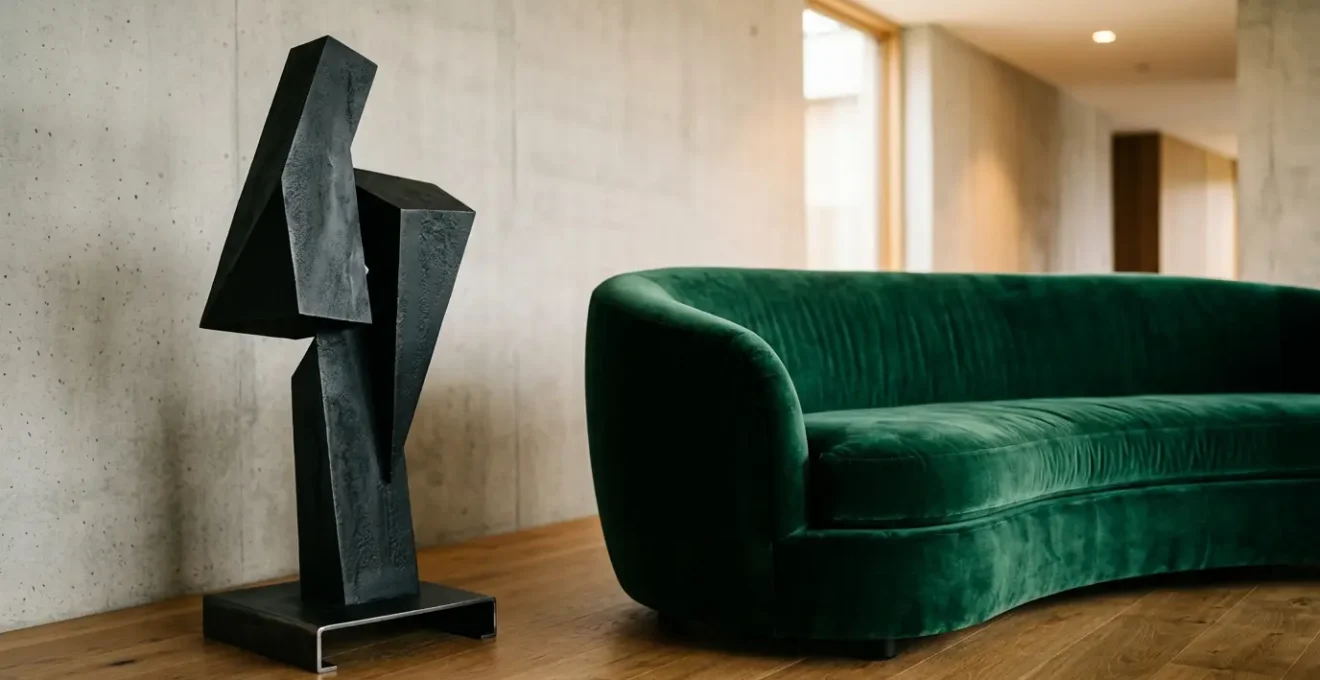
In summary:
- Steel doesn’t just contrast with soft materials; it amplifies their perceived softness through a principle of sensory friction.
- Mitigate practical risks by planning for weight distribution with custom plinths and properly sealing raw metal with wax or specialized lacquers to prevent rust.
- Select your metal based on the desired emotional temperature: warm, earthy Corten harmonizes with warm palettes, while cool stainless steel creates dynamic tension.
- Achieve a livable, sophisticated industrial aesthetic by balancing raw elements like steel and concrete with acoustic softeners, warm wood tones, and oversized textiles.
The world of luxury interiors often defaults to a sanctuary of softness. Rooms swathed in velvet, cashmere, and plush rugs create comfort but can sometimes melt into a single, predictable note—a sea of beige elegance. The common advice is to “add a focal point” or “mix materials,” but this advice falls short. It treats design as a checklist, not an art form. The real challenge for a discerning designer isn’t just to fill a space, but to make it resonate with a palpable energy.
The answer isn’t to abandon softness, but to heighten it. This is where the strategic introduction of raw, industrial elements, specifically steel sculpture, becomes a masterstroke. Forget the idea of simply adding an object for contrast. The true strategy lies in engineering a sensory friction—a deliberate dialogue between the unyielding coldness of steel and the inviting warmth of textiles. It’s a move that doesn’t just decorate a room; it fundamentally changes how every texture within it is perceived.
This guide moves beyond the surface-level platitudes. We will first dissect the psychological power of this material dialogue. Then, we will tackle the critical practicalities: protecting priceless floors from immense weight and stopping the inevitable threat of rust. We’ll compare the soul of different metals, explore the art of sealing steel without sacrificing its raw honesty, and finally, integrate these bold statements into a cohesive, livable, and deeply sophisticated family environment.
To guide you through this process, this article breaks down the essential considerations for mastering industrial contrast. Explore the topics below to understand both the theory and the practice of using raw steel to its full, transformative potential.
Summary: How to Use Raw Steel Statues to Create Contrast in Soft Luxury Interiors?
- Why Does Hard Steel Make Velvet Furniture Look Softer?
- How to Protect Hardwood Floors From 100kg Steel Sculptures?
- The Rust Risk: Preventing Stains on Rugs From Raw Steel Bases
- Corten vs Stainless Steel: Which Metal Suits a Warm Palette?
- How to Seal Raw Steel to Stop Oxidation Indoors?
- Raw Steel vs Powder Coat: Which Is Safer for Households With Kids?
- How to Introduce Wood Tones into a Concrete Shell?
- How to Soften the Industrial Loft Edge for Family Living?
Why Does Hard Steel Make Velvet Furniture Look Softer?
The magic of placing a raw steel sculpture next to a velvet sofa isn’t just a visual trick; it’s a phenomenon of perceptual amplification. Our brains understand the world through comparison. The unyielding, cold, and hard nature of steel provides an extreme sensory counterpoint to the plush, warm, and yielding texture of velvet. The steel doesn’t just sit there; it actively makes the velvet seem more luxurious, more inviting, and profoundly softer than it would on its own. This is the essence of creating a material dialogue.
This effect is rooted in psychology. As research on color and material psychology shows, contrast creates focus and rhythm, guiding the eye and the senses. By introducing an element of “sensory friction,” you disrupt the monolithic softness and force a deeper appreciation for each individual texture. The sleek, reflective surface of polished steel or the matte, porous finish of raw steel provides a narrative of industry, strength, and permanence. This narrative, when placed in conversation with the story of comfort and domesticity told by a textile, creates a space that is layered, intelligent, and emotionally resonant.
Ultimately, it’s about engaging more than just the eyes. You are composing a tactile symphony. The viewer mentally “feels” the coldness of the steel and the warmth of the fabric, creating a rich internal experience that elevates the entire room from a simple decorated space to an immersive environment. This is a deliberate design choice that speaks volumes about confidence and an understanding of material essence.
The tactile experience of a home directly influences comfort, mood, and perception, affecting everything from relaxation to productivity.
– Interior Design Psychology Research, ITALdoors Psychology of Interior Design Study
How to Protect Hardwood Floors From 100kg Steel Sculptures?
You’ve sourced a magnificent, heavy steel sculpture—a true statement piece. But before it can command the room, it threatens to destroy the very foundation it rests on: the pristine hardwood floor. A 100kg object resting on small contact points exerts immense pressure, risking deep indentations, scratches, and permanent damage. The solution is not to shy away from bold art, but to master the physics of weight distribution.
Dragging is forbidden; lifting is mandatory. But the real professional technique is to increase the surface area of the base, spreading the load so that no single point bears the brunt of the weight. This is where a custom-cut plinth becomes an essential tool, not an afterthought. A thick, clear acrylic or polycarbonate sheet, cut slightly larger than the sculpture’s base, is a sophisticated and almost invisible solution. It diffuses the pressure across a wider footprint while preserving the visual integrity of the floor below.
As the image demonstrates, a transparent platform seamlessly integrates into the design, offering robust protection without visual clutter. For less extreme weights or for furniture legs, high-density felt or rubber pads are non-negotiable. The key is to create a soft, non-abrasive barrier between the hard metal and the delicate wood finish. Sourcing the right protective medium is a critical step in the installation process.
Action Plan: Protecting Floors From Heavy Art
- Assess the Load: Determine the precise weight and the contact points of the sculpture. Are they sharp, small, or flat? This dictates the strategy.
- Select a Distribution Medium: For very heavy pieces, commission a custom plinth from plywood (hidden) or clear acrylic (visible). For furniture, use robust, thick furniture cups or pads. Sourcing is key, as demonstrated by this guide on protecting engineered wood.
- Add a Sacrificial Layer: Always apply high-density felt pads to the underside of the sculpture’s base or the distribution plinth. This is the final, non-negotiable barrier against scratches.
- Execute a “No-Drag” Policy: Ensure installers and movers always lift, never slide or drag, the object across the floor. Even a momentary drag can cause irreparable damage.
- Perform Regular Checks: Periodically inspect the floor around the object for any signs of stress or indentation, especially with seasonal changes in humidity that can affect wood.
The Rust Risk: Preventing Stains on Rugs From Raw Steel Bases
Raw steel possesses a structural honesty that is deeply appealing, but its nature is to oxidize. Rust is not a flaw; it is a chemical inevitability when iron, oxygen, and moisture meet. While a subtle, earthy patina can be a beautiful aesthetic choice, an uncontrolled rust reaction poses a direct threat to your client’s priceless silk rugs and light-colored carpets. A single rust stain is a permanent disaster, making prevention an absolute priority.
The key is to differentiate between a stable patina and active, transferable rust. Active rust is flaky, powdery, and will readily transfer onto any surface it touches, especially in environments with even moderate humidity. Your goal is to arrest the oxidation process at your desired aesthetic point, creating a sealed, stable surface. This is a matter of control, not elimination.
Effective sealing is a multi-step process. First, the steel must be thoroughly degreased to ensure the sealant can achieve a perfect bond. Then, a penetrating sealant is applied. Unlike a paint that sits on the surface, products like oil-based sealants (e.g., Penetrol) or microcrystalline waxes (e.g., Renaissance Wax) soak into the micropores of the metal. They create an invisible, breathable barrier that locks out moisture and stabilizes the existing finish, preventing any particles from flaking off and staining adjacent surfaces. This allows you to celebrate the raw look of steel without any of the collateral damage.
Corten vs Stainless Steel: Which Metal Suits a Warm Palette?
The choice between Corten steel and stainless steel is not merely practical; it is a decision about the emotional temperature of the room. Both are steel, but they speak entirely different languages. Stainless steel is cool, reflective, and precise. It brings a crisp, modern, and almost clinical edge. Corten, or weathering steel, is its opposite: it is designed to develop a warm, earthy, rust-like patina that evolves over time. It is a living finish that tells a story of age and character.
When working within a warm palette—dominated by ochre, terracotta, rich woods, and brass—Corten steel creates harmony. Its orange-brown tones resonate with the existing colors, adding a layer of raw, industrial texture without disrupting the overall warmth. It glows under warm lighting (2700K), enhancing a sense of coziness and rustic elegance. Stainless steel, in this same context, creates a dynamic tension. Its cool, silvery-grey finish provides a stark contrast, injecting a sophisticated, futuristic note and creating complex, layered lighting effects as it reflects the warm tones around it.
The decision hinges on your design intent. Do you want to create a cohesive, resonant space where all elements sing in harmony? Choose Corten. Do you want to introduce a deliberate point of high-contrast, a moment of sleek modernity that makes the warm elements feel even warmer by comparison? Choose stainless steel. This following table, based on insights from a comparative analysis of steel types, breaks down the key characteristics.
| Characteristic | Corten Steel | Stainless Steel |
|---|---|---|
| Color Tone | Warm earthy orange-brown with rustic patina | Cool reflective silver-grey finish |
| Interaction with Warm Palettes | Resonates and harmonizes – creates cohesion | Contrasts – creates dynamic tension |
| Warm Lighting Response (2700K) | Glows and appears richer, enhancing coziness | Reflects warm light but retains cool undertone |
| Evolution Over Time | Living finish that changes, adds narrative of age | Static and unchanging – controlled aesthetic |
| Texture Quality | Raw, porous, tactile industrial texture | Smooth, polished, refined surface |
| Best Use with Warm Palette | Harmony with ochre, terracotta, wood tones | Creates sophisticated layered lighting effects |
How to Seal Raw Steel to Stop Oxidation Indoors?
Sealing raw steel is an art of preservation. The goal is to lock in the metal’s natural beauty—its subtle grain, color variations, and industrial character—while halting the relentless march of oxidation. A poorly chosen sealant can make a million-dollar sculpture look like a cheap plastic imitation. The key is to choose a finish that provides robust protection while remaining as invisible as possible, honoring the structural honesty of the material.
For ultimate durability, professionals often turn to a 2K Urethane clear coat. This is an automotive-grade, two-part system with a separate activator that creates a rock-hard, non-yellowing shell. It is incredibly durable and UV-resistant, but requires professional spray application in a ventilated space. For a less intensive but highly effective approach, specialized metal lacquers like Everbrite or ProtectaClear are excellent. These can be wiped or sprayed on, forming a thin, clear, and durable film that is almost invisible and preserves the natural look of the steel perfectly.
For the most tactile and authentic finish, penetrating protectors are superior. Products like Renaissance Wax or other penetrating oil sealers don’t form a surface film. Instead, they soak into the metal’s micropores, sealing it from within. This method is excellent for preserving a very specific level of patina and feels more like real metal to the touch. Regardless of the product, surface preparation is paramount: the steel must be meticulously degreased for proper adhesion. And always, always choose a matte or satin finish. A gloss finish reflects too much light, creating a “wet” look that cheapens the raw, industrial aesthetic you’ve worked so hard to achieve.
Raw Steel vs Powder Coat: Which Is Safer for Households With Kids?
When industrial aesthetics enter a family home, a new set of priorities emerges. The conversation shifts from pure form to include function and, most importantly, safety. A raw steel piece, with its potential for sharp edges and complex chemical sealants, must be weighed against a powder-coated alternative, especially in a household with curious children.
Powder coating offers an immediate advantage in physical safety. The process involves electrostatically spraying a fine polymer powder onto the metal surface, which is then baked at high temperatures (around 200°C). This melts the powder into a smooth, hard, and continuous shell that adheres firmly to the metal. This process inherently rounds sharp corners and seals away the raw metal entirely, creating a surface that is much safer for small hands. There are no sharp burrs, no risk of metal splinters, and a significantly reduced chance of injury from accidental bumps.
From a chemical standpoint, modern powder coatings are a superior choice for indoor air quality. Unlike solvent-based paints and some raw steel sealants that can release volatile organic compounds (VOCs) during and after curing, the powder coating process is virtually free of VOCs. The finish is cured by heat, not evaporation, making it non-toxic and non-polluting once installed. For a designer creating a family-friendly space, powder coating provides the industrial look of metal with a crucial, added layer of safety and peace of mind. It’s the responsible choice when the end-users are the most vulnerable.
How to Introduce Wood Tones into a Concrete Shell?
A space defined by raw concrete and steel can feel powerful and monumental, but also cold and impersonal. The secret to making such a shell feel like a home is to introduce a mediating element—a material that can bridge the gap between hard industry and human comfort. That material is wood. Wood tones bring warmth, organic texture, and a connection to the natural world that provides a vital counterbalance to the starkness of concrete and metal.
The integration can be structural or decorative. Think of incast wood paneling that breaks up a vast concrete wall, adding a pocket of warmth and intricate grain. Or consider the choice of furniture: a solid walnut dining table or chairs can stand as sculptural objects themselves, their rich, warm tones creating a sophisticated dialogue with polished concrete floors. The key is to choose woods with character and warmth—walnut, oak, teak—that can hold their own against the strong presence of the industrial materials.
This isn’t about covering up the concrete, but complementing it. The goal is to create a layered experience where the smoothness of polished concrete makes the grain of the wood appear more intricate, and the warmth of the wood makes the concrete feel intentionally cool and architectural. It is a material dialogue that elevates all participants.
Case Study: The Bulcke House by Hrdalo Architects
A masterful example of this principle is seen in the Bulcke House in Chile. The architects composed the interior with a palette of Corten steel, poured in-situ concrete, and incast wood paneling. As detailed in an architectural review by Wallpaper* Magazine, the designers specifically chose polished concrete floors to offset the profound warmth of the walnut furniture and doors. This intentional pairing creates a sophisticated conversation between the raw, brutalist shell and the refined, natural wood elements, resulting in spaces that are both monumental and intimately livable.
Key takeaways
- Contrast is a psychological tool: Use the unyielding nature of hard materials like steel to amplify the perceived softness and luxury of textiles.
- Mitigate all practical risks from the start: Proactively plan for weight distribution with plinths and meticulously seal all raw metal to prevent catastrophic rust stains.
- Balance the raw with the refined: Integrate warm wood tones and oversized textiles to counteract the coldness of industrial materials, ensuring the space is comfortable and acoustically pleasant.
How to Soften the Industrial Loft Edge for Family Living?
Transforming a raw industrial space into a warm, functional family home is the ultimate design challenge. It requires moving beyond pure aesthetics to address the human experience of living in the space: acoustics, comfort, and tactile warmth. An industrial loft’s grand volumes, hard surfaces, and exposed structures can feel cavernous and unwelcoming if not properly tamed. The strategy is not to erase the industrial character, but to wrap it in a layer of comfort.
Acoustic softening is the first priority. Sound bounces relentlessly off concrete, steel, and glass, creating a harsh, noisy environment. The solution is absorption. Introduce large-scale textile art, heavy velvet curtains that pool on the floor, and oversized, plush area rugs. Upholstered wall panels can also serve as both a visual feature and a powerful sound buffer. The goal is to introduce soft, porous surfaces that trap sound and create a sense of intimacy and calm within the larger volume.
Next, focus on textural layering and scale. In a large industrial space, small, dainty furniture gets lost. Opt for oversized, deep-seated sofas and generously scaled art pieces that can command a wall. Mix materials with abandon: a weathered leather armchair, a chunky knit wool throw, and plaster or layered canvas art add the physical texture and character needed to stand up to the raw materials. This is about creating a rich, tactile environment where the hand and eye can find rest and delight. Given that research on interior environment impact reveals we spend up to 87% of our lives indoors, creating this sense of comfort is not a luxury, but a necessity for well-being.
Now, go beyond the beige. Wield these principles of contrast and dialogue to create spaces that are not just seen, but deeply felt—a testament to a design philosophy that is both bold and profoundly human.