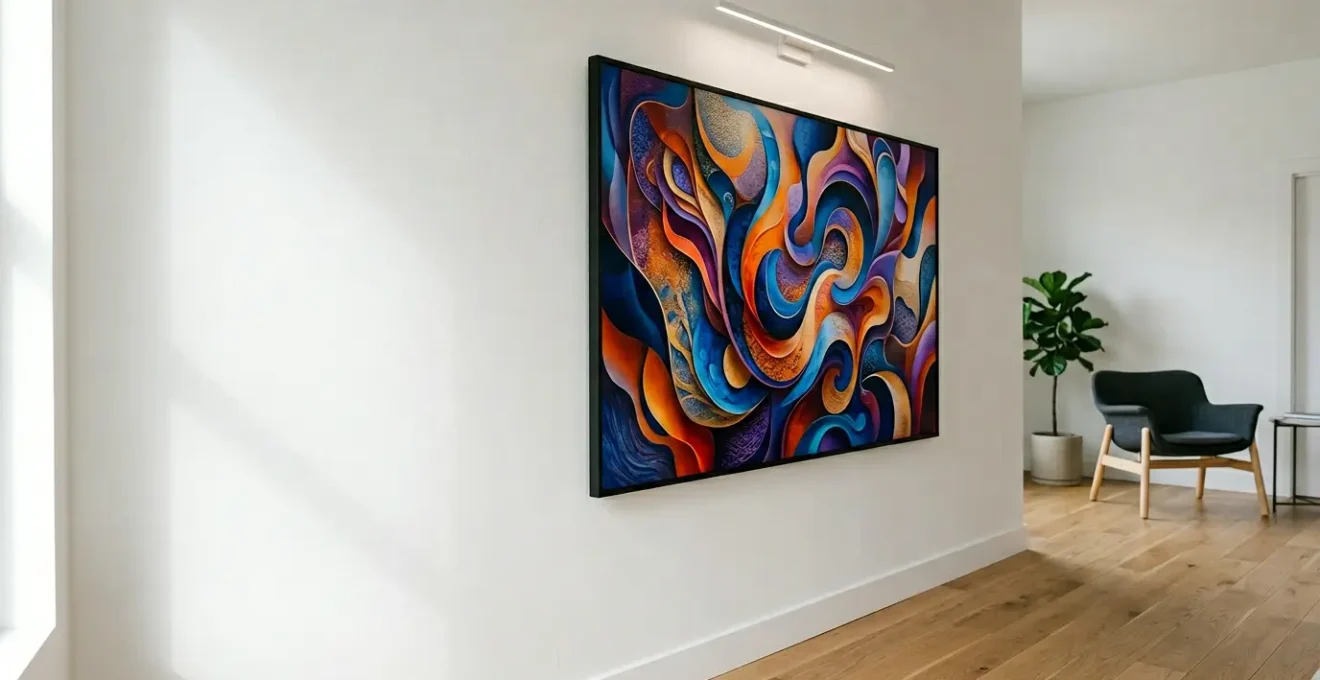
The secret to a museum-quality digital art display has little to do with raw screen specifications and everything to do with achieving ‘perceptual realism’.
- A matte, anti-glare screen surface that diffuses ambient light is more critical than resolution for simulating a physical canvas.
- Automating the display to ‘sleep’ and ‘wake’ with human presence integrates the art into the space, making the technology disappear.
Recommendation: Prioritize a display with a certified glare-free matte finish and invest in smart automation over simply choosing the highest-resolution OLED panel.
For the discerning crypto-art collector, the challenge is profound. You’ve invested in a piece of digital history, an asset of cultural and financial significance, only to see it flattened and trivialized on a conventional glossy television screen. The vibrant energy of a generative piece or the subtle texture of a digital painting is lost, reduced to just another image on a backlit appliance. The common advice—buy a high-end 4K OLED TV—misses the point entirely. While color and resolution are factors, they are not the soul of the presentation. A television is designed for moving pictures; it shouts for attention. Art, in contrast, should command presence with quiet confidence.
This dissatisfaction stems from a fundamental mismatch of medium and display. A glossy screen reflects the room, creating a mirror that constantly reminds the viewer they are looking at a piece of glass. The risk of screen burn-in from static NFT art turns the viewing experience into an exercise in anxiety. The entire endeavor feels temporary and technical, not permanent and artistic. But what if the solution wasn’t in chasing brighter panels or more pixels? What if the key to a museum-quality display was to make the technology itself invisible?
This guide shifts the focus from a technologist’s perspective to a curator’s. We will move beyond the spec sheet to explore the principles of perceptual realism. The goal is to trick the human eye into seeing a physical object, a canvas imbued with light and texture. We will dissect the critical role of screen finish, the strategies for managing static images safely, the art of framing for depth, and the sophisticated automation that allows art to live and breathe within a space. It’s time to stop displaying your collection and start curating it.
This article provides a comprehensive framework for making informed decisions, covering the technical nuances and long-term collection strategies. Explore the sections below to master each aspect of a truly artistic digital display.
Summary: A Curator’s Framework for Digital Art Presentation
- The Burn-In Risk: How to Display Static Digital Art Safely on OLED?
- Matte vs Glossy: Which Screen Finish Looks More Like Painted Canvas?
- Portrait vs Landscape: How to Handle Varying NFT Aspect Ratios?
- Subscription vs Ownership: Is Renting Digital Art Worth the Monthly Fee?
- How to Automate Digital Canvases to Sleep When You Leave the Room?
- Originals vs Limited Prints: Which Offers Better ROI for Beginners?
- How to Choose Frames That Add 3D Depth to Flat Canvases?
- How to Build an Art Collection That Appreciates in Value Over 10 Years?
The Burn-In Risk: How to Display Static Digital Art Safely on OLED?
The specter of burn-in is the single greatest fear for collectors considering an OLED panel for static digital art. OLED technology, prized for its perfect blacks and vibrant colors, achieves this by using organic compounds that degrade over time. When a static image is displayed for hundreds or thousands of hours, these compounds wear unevenly, leaving a permanent ghost image or “burn-in.” For an NFT that is meant to be displayed as a permanent fixture, this presents a significant curatorial and financial risk. However, the conversation has evolved from a simple “it will happen” to a more nuanced understanding of risk mitigation.
Modern OLED displays incorporate several protective features, such as pixel shifting (subtly moving the image to spread wear) and static logo detection (dimming unchanging elements). While helpful, these are designed for the intermittent static elements of television viewing, not for a 24/7 art display. A more robust curatorial strategy involves a combination of technology and behavior. This includes using displays with advanced heat dissipation, scheduling “rest periods” where the screen is off or displaying full-screen motion content, and—most effectively—employing presence automation to ensure the art is only displayed when someone is there to appreciate it.
The severity of the risk is also often contextual. A long-term test on a QD-OLED monitor found that after 6,000 hours, burn-in from static elements like a taskbar was present but often only visible under specific test conditions. For many use cases, the degradation is gradual rather than catastrophic. Therefore, the curator’s choice is not a binary one between a “safe” LCD and a “risky” OLED. It is an informed decision about trade-offs: accepting a manageable, long-term degradation risk in exchange for the unparalleled contrast and color depth that OLED technology offers, while implementing a multi-faceted strategy to maximize the panel’s lifespan. This moves the collector from a position of anxiety to one of active management.
Matte vs Glossy: Which Screen Finish Looks More Like Painted Canvas?
The single most important factor in achieving perceptual realism for digital art is the screen’s surface. A glossy screen, found on virtually all standard televisions, acts as a mirror. It reflects windows, lamps, and the viewer themselves, constantly shattering the illusion of art. This specularity is the primary signal to our brain that we are looking at a piece of glass, not a physical artifact. The solution lies in a matte finish, a surface engineered specifically for light diffusion.
A matte screen has a micro-textured surface that scatters ambient light in multiple directions rather than reflecting it directly. This diffusion dramatically reduces glare and eliminates distracting reflections, allowing the artwork’s true colors and details to remain visible even in brightly lit rooms. The effect is transformative; the screen ceases to be a light source and becomes a surface upon which an image rests. This is precisely how we perceive a physical painting on canvas—its texture scatters light, giving it a soft, tangible presence. Some high-end digital canvases have achieved such effective diffusion that they are UL-certified to be Glare Free and PANTONE-certified for faithful color reproduction, a testament to their curatorial-grade quality.
As the illustration above demonstrates, the microscopic texture of the matte coating is key to this effect. It breaks up the “perfect” surface of a screen, introducing an organic quality that mimics natural materials. This is why a 4K matte display will almost always feel more like “art” than an 8K glossy one. The brain is more convinced by the absence of distracting reflections than it is by a marginal increase in pixel density. For a collector aiming for museum-quality presentation, a matte finish is not a feature; it is the fundamental starting point.
Portrait vs Landscape: How to Handle Varying NFT Aspect Ratios?
The physical art world has long contended with diverse canvas sizes, but the digital realm introduces a unique fluidity of aspect ratios. While a majority of digital canvases are manufactured in a standard 16:9 landscape format, a significant portion of digital art, especially early NFTs and pieces created by mobile-native artists, exists in portrait (9:16), square (1:1), or entirely custom dimensions. Displaying a portrait-oriented NFT on a landscape screen results in large, empty black bars on either side—a void that screams “unoptimized digital file” rather than “finished artwork.”
A proactive curator has several elegant solutions to this challenge. The most direct is to invest in a display that can physically rotate. Some specialized digital art frames are designed with robust rotating wall mounts, allowing them to switch seamlessly between landscape and portrait orientations. This provides the most authentic, full-screen presentation for any piece of art. However, this is not always practical or possible.
When physical rotation is not an option, the solution becomes software-based. The most effective technique is the use of a “digital mat.” Instead of black bars, the collector can create a custom background that acts as a virtual mat board. This mat can be a solid color sampled from the artwork itself, a subtle texture, or even a complementary secondary image. This transforms the empty space into a deliberate part of the presentation. Another advanced strategy is to display a diptych or triptych of smaller, similarly-themed works side-by-side to fill the 16:9 space. This requires a strong curatorial eye but can result in a dynamic, gallery-wall effect. The key is to treat the entire 16:9 screen area as the canvas, not just the portion filled by the art. By actively designing the “negative space,” the collector reclaims curatorial control and ensures every piece is presented with intention.
Subscription vs Ownership: Is Renting Digital Art Worth the Monthly Fee?
As digital canvases have grown in popularity, two distinct models for content have emerged: the open platform and the curated subscription. The open platform, exemplified by displays like the Samsung Frame, functions as a high-quality monitor; you, the collector, are responsible for sourcing and displaying your own content, including your personal NFT collection. The subscription model, offered by services like Blackdove or Meural, provides the hardware often bundled with access to a constantly updated library of digital art for a monthly fee. For the serious NFT collector, the choice between these models hinges on the principle of curatorial integrity.
A subscription service offers discovery and variety. It’s an excellent way to keep a space feeling fresh with new, professionally curated art. However, for a collector who has spent significant time and capital building a personal collection, this can be a double-edged sword. The primary purpose of your display is to showcase the art *you* have chosen, the pieces that reflect your taste and investment strategy. You must critically evaluate a subscription service’s support for external NFT wallets. Can you easily and seamlessly display works from your own collection, or are you primarily locked into the service’s ecosystem? The Blackdove Digital Canvas, for instance, offers a sophisticated streaming service but requires the collector to weigh its curated content against their need to display their own purchased assets.
Ultimately, the decision is one of purpose. If the goal is decorative and ambient, a subscription can provide high-quality, rotating art with minimal effort. But if the goal is to live with and showcase a personal collection, the display must serve that collection first and foremost. A hybrid approach is often best: a display that is fundamentally an open platform, giving you complete control over your NFTs, with an optional subscription for moments when you desire ambient variety. For a true collector, the hardware should be a servant to the art, not a gatekeeper.
How to Automate Digital Canvases to Sleep When You Leave the Room?
A true piece of art integrates into a space; an appliance demands interaction. The need to manually turn a digital canvas on and off is a constant reminder of its technological nature. The most elegant solution is presence automation: the art should awaken when you enter a room and sleep when you leave. This not only creates a magical, seamless experience but also serves the practical purposes of saving energy and mitigating screen burn-in.
The technology behind this is driven by presence sensors, which are far more sophisticated than the simple motion detectors in security lights. Two primary types are used for high-end home automation: Passive Infrared (PIR) and millimeter-wave (mmWave) radar. A PIR sensor detects body heat and movement, making it effective for high-traffic areas. However, it can be tricked if a person sits still for too long while contemplating an artwork, potentially turning the display off. A mmWave sensor is more advanced, using radar to detect even micro-movements like breathing, ensuring the display remains on as long as a person is present in the room, moving or not.
Implementing this requires integrating the digital canvas into a smart home ecosystem (like HomeKit, Google Home, or Home Assistant). A presence sensor is placed in the room and an automation rule is created: “When presence is detected, turn on the canvas. When presence is no longer detected for 5 minutes, turn it off.” This small investment in automation yields enormous returns in both experience and efficiency. While it may seem like a minor detail, the energy savings are analogous to those seen in other smart home devices; smart control and automation technology tools provide an average of 30% savings on home energy consumption, a principle that applies directly here. This transforms the display from an active device that must be managed into a passive, integrated part of the home’s artistic soul.
| Sensor Technology | Detection Method | Best Use Case for Digital Canvas | Limitation |
|---|---|---|---|
| PIR (Passive Infrared) | Detects movement through heat signatures | Rooms with regular traffic and active movement | May turn off if viewer sits still for extended periods |
| mmWave/Radar | Detects presence even without movement | Gallery spaces or reading rooms where viewers remain stationary | Slightly higher cost and more complex setup |
| Smart Home Integration | Location-based via smartphone geofencing | Whole-home automation coordinated with daily schedule | Requires compatible smart home ecosystem |
Originals vs Limited Prints: Which Offers Better ROI for Beginners?
For a beginner collector entering the digital art space, the landscape of assets can be confusing. The two primary categories are 1/1 “Originals” and limited edition “Prints.” A 1/1 is a unique, singular artwork, akin to a master painting. A limited edition is one of a finite set of identical pieces, much like a numbered run of lithographs. From an investment perspective, the distinction is critical, and the blockchain provides a new layer of verifiable scarcity that disrupts traditional art market analogies.
Historically, 1/1 originals hold the highest potential for appreciation. They represent the purest form of an artist’s vision and carry the ultimate level of scarcity. However, they also come with the highest entry price and the greatest risk; their value is tied directly to the trajectory of a single artist’s career. For a beginner, betting on the right 1/1 artist can be daunting. Limited editions, on the other hand, offer a more accessible entry point into an established artist’s market. By purchasing a print from a well-known series, a new collector can acquire a piece with a pre-existing market and community, lowering the risk profile.
The game-changer for digital art is the smart contract. As industry data shows, smart contracts provide cryptographic proof of scarcity, a key advantage over physical prints which can be subject to forgery or un-declared copies. Whether it’s a 1/1 or one of a 100-piece edition, the exact number of authentic copies is permanently recorded on the blockchain for anyone to verify. This digital provenance is a powerful value driver. For a beginner seeking the best ROI, a prudent strategy is often to focus on limited editions from artists with a proven track record and strong community. This allows participation in the upside of a successful artist’s career while managing risk and capital outlay. The 1/1 acquisition can wait until the collector has developed a more seasoned and confident curatorial eye.
How to Choose Frames That Add 3D Depth to Flat Canvases?
A digital canvas, no matter how advanced, is an inherently flat object. A key curatorial task is to create the illusion of three-dimensional depth, tricking the eye into perceiving the art as an object with physical presence. The most powerful tool for this is not in the software, but in the physical world: the frame. The right framing strategy, what we can call dimensional framing, goes beyond simple decoration and becomes an active component of the artwork’s presentation.
The most effective technique is the “floater frame.” This is a frame that is mounted around the digital canvas with a small, recessed gap (typically 1/4 to 1/2 inch) between the frame’s inner edge and the screen’s bezel. This gap creates a natural shadow line, making the digital canvas appear as if it is “floating” within the frame. This simple addition immediately gives the flat panel a sense of depth and objecthood. The choice of frame material—a warm walnut for a classical feel, or a sleek black metal for a modern aesthetic—can then be used to either complement the art or deliberately contrast with the screen’s bezel, further enhancing the effect.
The illusion can be powerfully amplified with directional lighting. Mounting a gallery-style picture light directly above the framed canvas casts real, physical shadows from the floater frame onto the wall below. This interplay of digital image, physical frame, and real shadow is the pinnacle of perceptual realism. It fully integrates the digital work into the physical space. The art is no longer a glowing rectangle on a wall; it is a substantial, tangible object that commands its own space and interacts with the light in the room.
Action plan: Layering techniques for depth
- Create a ‘digital mat’: Add a border in the software around the image before displaying to create a sense of layering.
- Install a physical ‘floater frame’: Mount a frame around the entire canvas device with spacing to create a shadow gap.
- Use gallery-style picture light: Mount a directional light above the canvas to cast real shadows on and around the frame.
- Match or contrast frame style: Choose wood frames to hide plastic bezels or metallic frames for a sleek, modern look.
- Consider shadow box mounting: For smaller canvases, mount the entire device inside a deeper shadow box frame to create a physical recess.
Key takeaways
- The collector’s goal should be ‘perceptual realism’—making the display feel like a physical object, not a screen.
- A matte, anti-glare screen finish is the most critical element for achieving a canvas-like appearance by diffusing ambient light.
- Building a valuable collection requires a curatorial mindset, focusing on artist trajectory, verifiable scarcity, and scholarship—not just market hype.
How to Build an Art Collection That Appreciates in Value Over 10 Years?
Displaying art beautifully is one half of the collector’s journey; building a collection with lasting value is the other. The digital art market, while maturing, is still young and volatile. The Art Basel and UBS Art Market Report 2024 states that from a peak of USD 2.9 billion in 2021, sales of art-related NFTs declined to USD 1.2 billion in 2023. This cooling-off period has separated the speculators from the true collectors and has brought a crucial element to the forefront: scholarship.
A ten-year strategy for appreciation cannot be based on chasing hype. It must be rooted in the same principles that govern the traditional art market: artist’s career trajectory, historical significance, and curatorial context. Look for artists who are not just creating aesthetically pleasing work, but who are innovating with the medium, contributing to a larger artistic dialogue, and building a sustainable career with gallery representation and critical acclaim. Generative art, for example, has emerged as a significant category, with pioneering collections like Chromie Squiggle demonstrating long-term value through their historical importance and the reputation of their creator.
As a curator of your own collection, your role is to research and contextualize. The market is moving beyond simple collectibles towards works with genuine artistic merit. As Robert Norton, CEO of Verisart, noted in a discussion on the market’s evolution:
There’s more scholarship and contextualization – in the past it was a little bit difficult to determine what was by an interesting artist and what was just a collectible.
– Robert Norton, Co-curator and CEO of Verisart, quoted in Art Basel
This is the core task for the long-term collector. Build your collection around a thesis. Focus on a specific movement, medium, or group of artists. Document your rationale. Your collection itself should tell a story. Over a decade, it is this curatorial vision—backed by research and a deep understanding of the art—that will appreciate in value far more reliably than any single, speculative purchase.
By shifting your mindset from that of a tech consumer to a discerning art curator, you can transform a simple screen into a profound artistic statement. The ultimate goal is to create a presentation so seamless and convincing that the technology disappears, leaving only the art to command the space. Applying these principles of perceptual realism, automation, and curatorial strategy is the next logical step in honoring your collection.