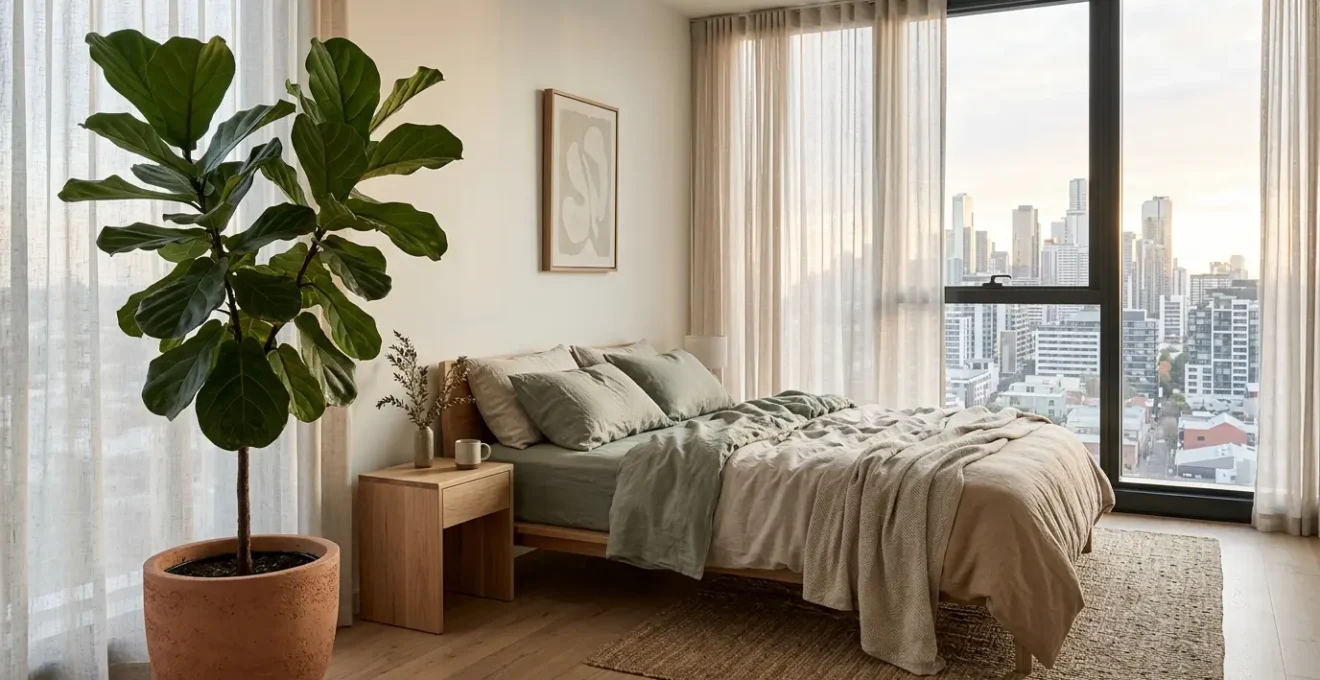
Biophilic design improves sleep not by magic, but by using specific natural cues to biologically reduce stress hormones and reset your body’s internal clock.
- Visual exposure to natural fractal patterns has been shown to lower cortisol, the primary stress hormone.
- Direct interaction with real plants, like watering them, can actively lower blood pressure and calm the nervous system.
- Managing natural light and humidity with plants helps regulate your core body temperature and master circadian rhythm for sleep.
Recommendation: Start by decluttering your sleep space to reduce cognitive load and introducing one element with natural, mid-range complexity patterns, like a fern or a patterned textile.
For the insomniac city dweller, the bedroom can often feel less like a sanctuary and more like the final frontier of a stressful day. The constant hum of traffic, the inescapable glow of screens, and the psychological weight of a cluttered space all conspire against restorative sleep. The common advice is often to simply “add a plant” or “get more sunlight,” but these suggestions barely scratch the surface of a profound biological need. They treat the symptom, not the underlying cause: a fundamental disconnect between our ancient biology and our modern, artificial environment.
This disconnect throws our internal systems into disarray, particularly our circadian rhythm—the master 24-hour clock that governs our sleep-wake cycle. Urban life bombards us with stimuli that elevate cortisol, our stress hormone, and disrupt the signals our body needs to prepare for sleep. The result is a state of perpetual low-grade anxiety that makes deep, restful sleep feel like an impossible luxury. But what if the solution wasn’t about adding more, but about adding smarter? What if the key wasn’t just nature, but the specific patterns, systems, and sensory inputs from nature that speak directly to our biology?
This is the core promise of biophilic design when applied to sleep science. It’s a strategic, wellness-oriented approach that uses elements of the natural world as tools to actively down-regulate the nervous system. This article will deconstruct the biological mechanisms at play, explaining not just that biophilic design works, but *why* it works. We will explore how visual patterns can chemically reduce stress, why interacting with living things calms us, and how to build a micro-ecosystem in your bedroom that systematically resets your body’s clock for a deeper, more natural sleep.
In this guide, we will explore the precise, science-backed strategies you can use to transform your urban apartment into an environment that actively promotes sleep. From the cognitive impact of clutter to the practicalities of maintaining a living wall in low light, you’ll gain a complete understanding of how to re-align your space with your body’s needs.
Summary: A Biological Blueprint for Restorative Sleep Through Design
- Why Does Visual Clutter Increase Anxiety in 70% of Remote Workers?
- Why Do Fractal Patterns in Decor Lower Cortisol Levels?
- Real Plants vs Biomimicry: Which Is Better for Mental Health?
- How to Install a Living Wall That Doesn’t Leak or Die?
- Ferns vs Pothos: Which Plants Survive Vertical Gravity Best?
- The Humidity Risk: Preventing Mold Behind Large Plant Installations
- How to Maintain a Vertical Living Wall in Low-Light Apartments?
- When to Rotate Indoor Plants for Maximum Winter Light?
Why Does Visual Clutter Increase Anxiety in 70% of Remote Workers?
Before introducing new elements, the first step in creating a sleep sanctuary is to address what’s already there. Visual clutter in a bedroom isn’t just untidy; it’s a significant source of chronic, low-grade stress. From a biological perspective, our brains are wired to constantly process our surroundings. A cluttered environment bombards the brain with excessive stimuli, forcing it to work overtime to distinguish between what’s important and what’s not. This creates a high cognitive load, a state of mental exhaustion that keeps the nervous system in a subtle state of high alert.
This effect is magnified for remote workers, whose homes are also their offices. The lines between work and rest blur, and a messy desk in the corner of the bedroom becomes a constant, nagging reminder of unfinished tasks and responsibilities. This persistent visual “noise” contributes to elevated cortisol levels, making it difficult for the mind to switch off and transition into a restful state. The brain remains in problem-solving mode, directly counteracting the biological processes needed to initiate sleep.
Clearing this clutter is a powerful act of sleep hygiene. A minimalist space with clear surfaces and designated storage sends a powerful signal to your brain: “this is a place of rest.” It reduces cognitive load, lowers ambient anxiety, and creates the calm mental canvas necessary for your body’s sleep signals to take precedence. It’s not about sterile emptiness, but about creating intentional order, where every object has a purpose and a place, allowing your mind to finally be still.
Why Do Fractal Patterns in Decor Lower Cortisol Levels?
Once your space is decluttered, the next step is to introduce visual elements that actively calm the nervous system. The most powerful of these are fractal patterns—the complex, self-repeating shapes found everywhere in nature, from ferns and snowflakes to coastlines and lightning. Our brains are uniquely adapted to process these patterns with remarkable ease, a phenomenon known as “fractal fluency.” This effortless processing triggers an automated relaxation response in the brain.
The mechanism is directly tied to stress-hormone regulation. When we view natural fractals of mid-range complexity, our bodies undergo a measurable physiological shift. In fact, research has shown that exposure to fractal patterns can reduce stress levels by up to 60%. This happens because the visual experience lowers cortisol production and activates the parasympathetic nervous system, the body’s “rest and digest” mode. It’s a subconscious signal that tells our primal brain we are in a safe, natural, and non-threatening environment.
You can incorporate these powerful, stress-reducing patterns into your bedroom without turning it into a forest. Look for them in:
- Textiles: Bedding, curtains, or rugs with botanical prints like ferns or branching leaves.
- Artwork: Abstract art or photographs that feature natural landscapes with high fractal content.
- Natural Materials: The grain in a piece of wood or the veining in a marble slab are both forms of natural fractals.
By consciously choosing decor with these characteristics, you are embedding a passive, anxiety-reducing tool directly into your environment, helping to lower your cortisol levels long before your head hits the pillow.
Real Plants vs Biomimicry: Which Is Better for Mental Health?
While fractal patterns (a form of biomimicry) offer passive stress reduction, introducing living plants adds an active, interactive layer of mental health benefits. The choice between real plants and nature-inspired design isn’t about one being “better,” but about understanding their distinct biological effects. Biomimicry calms the eye; real plants engage the body and mind.
The act of caring for a living thing—even something as simple as watering a plant—has a profound grounding effect. It’s a gentle, mindful task that pulls us out of the anxious, future-focused thinking that plagues many insomniacs. This interaction is not just psychological; it’s physiological. For instance, a 2023 study published in BMC Psychology found that simply interacting with and watering indoor plants resulted in a significant reduction in diastolic blood pressure and suppressed sympathetic nervous system activity. This demonstrates a direct, measurable calming of the body’s “fight or flight” response.
Furthermore, real plants contribute to a healthier indoor micro-climate through transpiration, which adds gentle humidity to the air, and through photosynthesis, which improves air quality. While a single plant won’t transform your air, it contributes to a holistic system of wellness. Biomimicry, on the other hand, provides consistent, effortless visual relief. A fern-patterned blanket works its calming magic 24/7 without any care. The ideal strategy for a sleep-focused bedroom is to combine both: use biomimicry for a constant, passive foundation of calm, and add a few carefully chosen real plants for active, interactive relaxation and a tangible connection to the living world.
How to Install a Living Wall That Doesn’t Leak or Die?
For those ready to make a significant biophilic commitment, a living wall is the ultimate statement piece—a vertical garden that becomes a living, breathing part of your home’s architecture. However, the prospect can be intimidating, with fears of leaks, water damage, and dying plants. A successful installation hinges on a methodical approach centered on two principles: robust waterproofing and a supported, automated ecosystem.
First and foremost, the wall behind the installation must be completely protected. This isn’t a step to be taken lightly. It involves applying a professional-grade waterproof membrane or coating directly to the wall surface before any hardware is mounted. This creates an impenetrable barrier that ensures no moisture can ever reach your drywall or building structure. Secondly, the wall must be structurally sound, as the combined weight of the system, saturated soil, and mature plants is substantial. Using the correct mounting hardware, anchored securely into studs, is non-negotiable.
Case Study: The Athenaeum Hotel Living Wall
A prime example of successful large-scale implementation is the living wall at The Athenaeum Hotel in London, designed by the pioneer Patrick Blanc. Covering an entire facade, this vertical garden demonstrates that with proper engineering and waterproofing, even the most ambitious projects can thrive without leakage, all while helping regulate indoor temperature and improve air quality for guests.
To ensure the plants themselves survive, automation is key. A drip irrigation system, often integrated into the panels and controlled by a timer, delivers water directly to the roots, preventing both under- and over-watering. Finally, a drainage tray at the bottom of the system is essential to catch any excess water, protecting your floors and completing the self-contained hydraulic cycle. By focusing on these core engineering steps, you can install a living wall that is not a source of anxiety, but a stunning, life-giving feature.
Ferns vs Pothos: Which Plants Survive Vertical Gravity Best?
Choosing the right plants is critical for the long-term success of a vertical garden. The forces of gravity and the shallow substrate of most systems create a unique environment where not all plants can thrive. Two of the most popular and resilient choices for vertical applications are Pothos and Ferns, but they offer different aesthetics and have different strengths in defying gravity.
Pothos (Epipremnum) is a champion of vertical gardens due to its trailing growth habit. Its vines naturally cascade downwards, creating beautiful, flowing lines of green. Its epiphytic nature means it has adapted to grow on other plants in the wild, with aerial roots that are perfectly suited to gripping onto the shallow, soilless media found in many living wall panels. It is also famously resilient and tolerant of a wide range of light and watering conditions, making it a low-maintenance choice.
Ferns, in contrast, offer a different kind of beauty. Their delicate, arching fronds create a soft, fountain-like effect, adding texture and a deep sense of primeval nature. Many fern varieties are also epiphytic and thrive in the consistently moist, shallow substrates of a vertical wall. They are particularly valuable for their fractal patterns, which, as we’ve discussed, have a direct stress-reducing effect. The key difference lies in their maintenance needs; ferns are generally less forgiving than Pothos and require more consistent humidity and moisture to prevent their fronds from drying out.
This comparative table breaks down the key characteristics of each plant to help you decide which is a better fit for your apartment’s conditions and your desired aesthetic.
| Characteristic | Pothos (Epipremnum) | Ferns |
|---|---|---|
| Growth Habit | Trailing, cascading with gravity creating river-like flowing lines | Arching fronds creating fountain-like effect with upward then downward arc |
| Root System | Epiphytic nature, aerial roots, adapts to shallow vertical substrates | Epiphytic varieties available, thrives in shallow substrates with high moisture retention |
| Light Requirements | Moderate light tolerance, suitable for interior windows or bright indirect light | Low to moderate light, tolerates shade well |
| Water Needs | Moderate, tolerates slight drying between waterings | High, prefers consistently moist substrate |
| Maintenance Level | Low maintenance, resilient to neglect | Moderate maintenance, sensitive to humidity fluctuations |
| Visual Appeal | Bold, heart-shaped leaves, creates movement and dimension | Delicate, complex fractal fronds, adds texture and softness |
The Humidity Risk: Preventing Mold Behind Large Plant Installations
While a living wall brings immense benefits, it also introduces a key variable into your indoor environment: humidity. Plants release moisture into the air through transpiration, which can be beneficial, but if not managed correctly, it can create a risk of mold growth, particularly behind the installation. Preventing this requires proactive humidity management and ensuring proper air circulation.
The first line of defense is creating an air gap. A professionally designed living wall system should never be flush against your drywall. It should be offset, or installed with a dimpled plastic membrane behind it, to create a crucial channel for air to flow. This continuous circulation allows any moisture that accumulates to evaporate, rather than seeping into the wall. This is a non-negotiable feature for any large-scale indoor plant installation.
Secondly, it’s important to monitor and control the overall humidity in the room. For sleep quality, this is a dual benefit. In fact, sleep experts recommend maintaining bedroom humidity between 45-55% for optimal respiratory comfort and better sleep. A smart hygrometer can track your room’s levels, and you can adjust your living wall’s irrigation schedule accordingly. During humid summer months, you might water less frequently, while in the dry winter, the wall’s transpiration can naturally help you reach that ideal humidity zone. Selecting plants with lower transpiration rates, like succulents or snake plants, can also help in naturally humid climates.
Your Action Plan: Mold Prevention Audit for Plant Walls
- System Check: Confirm your installation uses an offset system or an air gap membrane to ensure airflow behind the unit.
- Waterproofing Verification: Inspect the area around the wall for any signs of moisture; ensure the original waterproof barrier is intact.
- Humidity Monitoring: Place a hygrometer in the room and track levels for a week to establish a baseline. Aim for the 45-55% range.
- Irrigation Adjustment: Review your watering timer. Is it appropriate for the current season? Reduce frequency if humidity is consistently high.
- Plant Selection Review: Assess your current plants. If mold is a concern, consider swapping high-transpiration species for hardier, drier options like ZZ plants or succulents.
Key Takeaways
- Passive Stress Reduction: Simply viewing decor with natural fractal patterns can lower cortisol levels by up to 60%, calming your nervous system before sleep.
- Active Physiological Calming: The physical act of caring for a real plant has a measurable effect, reducing blood pressure and suppressing the body’s “fight or flight” response.
- Circadian Rhythm Regulation: Using plants and strategic design to manage natural light, air quality, and humidity helps reset your body’s internal 24-hour clock, promoting a natural sleep-wake cycle.
How to Maintain a Vertical Living Wall in Low-Light Apartments?
One of the biggest challenges for urban dwellers is the lack of abundant natural light. This can seem like a death sentence for a living wall, but with the right plant selection and supplemental strategies, a lush vertical garden can thrive even in a low-light apartment. The secret is to choose plants that are naturally adapted to shady understory environments.
Species like the Snake Plant (Sansevieria), ZZ Plant (Zamioculcas), and Cast-Iron Plant (Aspidistra) are renowned for their incredible tolerance for low-light conditions. They are slow-growing and require minimal maintenance, making them perfect candidates for a low-stress living wall. Pothos and certain varieties of Philodendron also adapt well, their vining nature allowing them to seek out available light sources. Using these “ultra-low-light champions” as the backbone of your wall is the most important factor for success.
In addition to bringing life to a dim corner, these installations are working for your health. A well-designed green wall is a powerful bio-filter. For instance, a study found living green walls can reduce nitrogen dioxide levels by 40% and particulate matter by 60% in urban street canyons, and this air-purifying effect translates indoors on a smaller scale. Beyond plant selection, you must also be strategic. Keep the wall clean, as dust on leaves can block what little light is available. You can also rotate plants within the wall system, moving them periodically to ensure each one gets a turn in the brightest spot. In very dark spaces, consider integrating a small, full-spectrum LED grow light with a timer to provide a few hours of supplemental light each day. This targeted support can make all the difference.
When to Rotate Indoor Plants for Maximum Winter Light?
The final, crucial element in aligning your biophilic bedroom with your sleep cycle is managing light—specifically, the weak and shifting light of winter. Your indoor plants are not just decor; they are living light-meters that can help you connect with these subtle seasonal shifts. Rotating them isn’t just for even growth; it’s a ritual that tunes your own awareness to the natural world and its rhythms.
The core principle is simple: plants grow towards their light source. In winter, when the sun is low in the sky and days are short, this can lead to lopsided, unhealthy growth. The solution is to rotate your plants by a quarter turn every week or two. This ensures all sides of the plant receive some light, promoting balanced, robust health. This small act of care serves as a powerful, non-digital notification of the passage of time, helping to ground you in the physical world and away from the timeless void of screen-based life.
Natural daylight helps regulate your circadian rhythms – those internal 24-hour clocks that respond mainly to light and darkness.
– Sleep Research Team, Bedstar Sleep Talk
This regular, gentle interaction with natural cycles directly supports your own circadian rhythm. Getting morning light, even the filtered, weak light of winter, is a critical signal for your brain to suppress melatonin and start its daytime cycle. Caring for your plants in the morning can become a habit that ensures you get this vital light exposure. This connection to nature, even on a small scale, has a powerful impact on sleep. For example, studies on forest bathing have found that people can gain up to 1 extra hour of sleep per night. While your bedroom isn’t a forest, applying the same principles of nature connection can yield significant benefits for your sleep duration and quality.
Transform your bedroom from a source of stress into a sanctuary for sleep. Begin by implementing one of these strategies tonight and start the process of recalibrating your body’s natural rhythms for a more restful life.