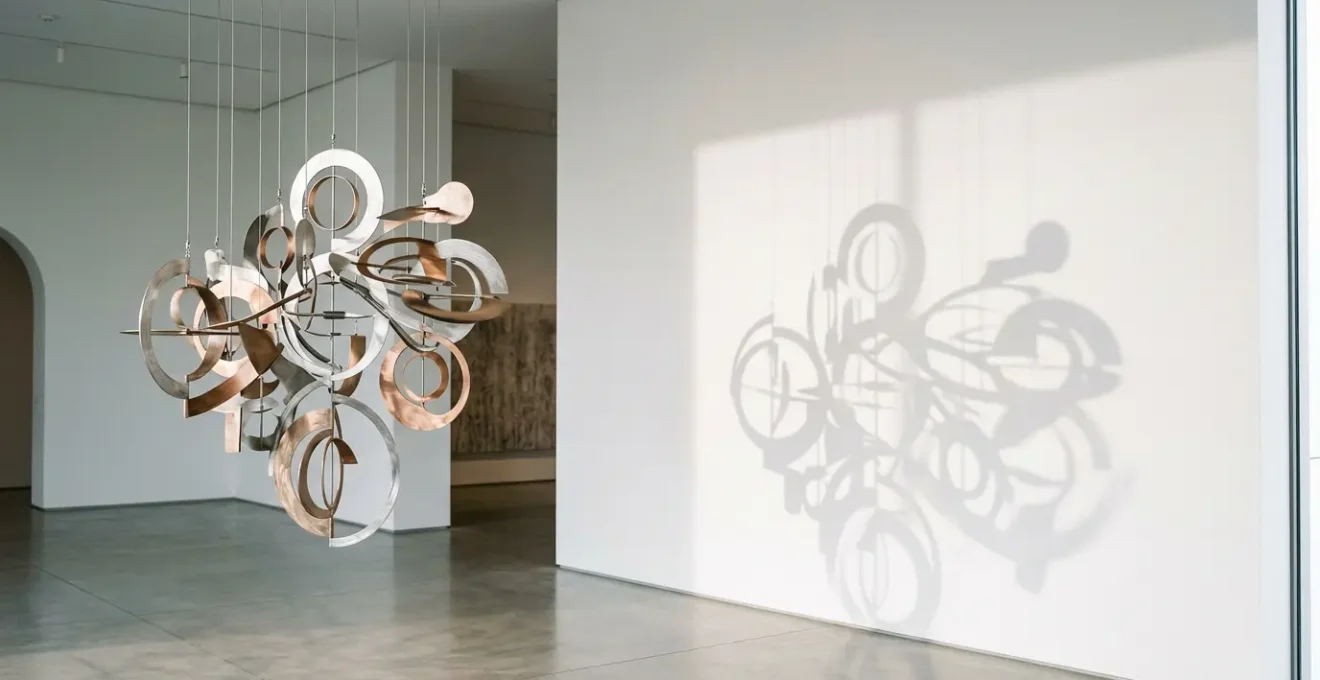
Kinetic art’s true power isn’t in the object itself, but in its ability to choreograph the unseen forces of your home—light, air, and sound—turning static architecture into a dynamic, living canvas.
- Slow, biophilic movement calms the nervous system, while strategic shadow play creates an ever-changing “ephemeral architecture.”
- The key is sensory tuning: managing airflow for natural motion, selecting materials for pleasant acoustics, and using light to sculpt the space.
Recommendation: Shift your focus from “placing an object” to “directing an experience,” using movement and shadow to engage with your environment on a deeper level.
In the quiet stillness of a modern home, perfection can feel strangely lifeless. Clean lines, minimalist furniture, and uncluttered surfaces, while visually pleasing, can sometimes create a space that feels more like a gallery than a sanctuary—static, silent, and waiting for something to happen. The conventional response is to add color, texture, or a statement piece of static art. We might hang a bold painting or place a striking sculpture, yet the room’s fundamental energy remains unchanged. It is still a container for beautiful things, not a living entity in itself.
But what if the solution wasn’t another object, but the introduction of life through motion? Kinetic art offers this possibility, yet its potential is often misunderstood. It’s seen as a novelty, a moving decoration. This view misses the profound transformation that occurs when an object begins to interact with its environment. The true artistry lies not in the sculpture alone, but in its dialogue with the room’s invisible elements: the subtle currents of air from a vent, the shifting afternoon light, and even the ambient silence.
This guide reframes kinetic art not as a decorative accessory, but as a master tool for sensory design. The secret isn’t just adding movement; it’s about consciously choreographing the ephemeral play of shadow and light that this movement creates. It’s about learning to sculpt with absence, to paint with light, and to animate the very soul of a room. We will explore how to harness these forces, turning your static home into a dynamic, responsive environment that breathes and evolves with you.
This article will guide you through the principles of transforming your space with kinetic art. We will delve into the science behind its calming effects, the practicalities of placement and lighting, and the art of creating an engaging, multi-sensory narrative within your own walls.
Summary: Choreographing Light and Motion with Kinetic Art
- Why Does Slow-Moving Art Lower Heart Rates in Waiting Areas?
- How to Position Kinetic Mobiles to Catch HVAC Airflow?
- The Noise Risk: Ensuring Your Kinetic Art Doesn’t Drive You Crazy
- Motorized vs Natural Kinetic Art: Which Maintenance Level Suits You?
- How to Configure Spotlights to Maximize Kinetic Shadow Throw?
- How to Dampen Echoes in Open Plan Spaces Without Curtains?
- Where to Hide Motion Sensors for Seamless Art Interaction?
- How to Integrate Motion-Responsive Art That Engages Guests?
Why Does Slow-Moving Art Lower Heart Rates in Waiting Areas?
The profound calming effect of slow-moving art is not merely an aesthetic preference; it is a deep-seated biological response. This phenomenon, known as kinetic stillness, taps into our innate connection with the natural world. Gentle, predictable, and non-threatening movements, like the sway of tree branches or the slow drift of clouds, signal safety to our primal brain. This sensory input activates the body’s parasympathetic nervous system, our “rest and digest” mode. As a result, the body undergoes a measurable shift toward tranquility.
Scientific research demonstrates that exposure to biophilic elements, which mimic nature, directly results in lower heart rate, reduced blood pressure, and decreased levels of the stress hormone cortisol. A kinetic sculpture that gently turns in the air is, in essence, a distilled form of this natural phenomenon. Its graceful, repetitive motion captures our attention without demanding it, providing a focal point for soft fascination that allows the mind to wander and de-stress. It’s a visual form of meditation, quieting the internal chatter that often accompanies a sterile, static environment.
Case Study: Biophilic VR and Physiological Stress Reduction
To quantify this effect, a 2023 study at Duke Kunshan University immersed participants in virtual classrooms with varying levels of biophilic design. Using wearable sensors to track vital signs, researchers found that exposure to these nature-infused environments led to significant physiological stress reduction. The most notable impacts, including lowered heart rate and blood pressure, were observed within the first four minutes, proving how quickly our bodies respond to environments that incorporate naturalistic elements and movement.
By introducing this form of movement into a home, you are not just adding a decorative piece; you are installing a device for passive wellness. It transforms a waiting area or a quiet corner from a place of idle impatience into a space for subconscious recovery and calm, making the environment an active participant in your well-being.
How to Position Kinetic Mobiles to Catch HVAC Airflow?
The most elegant kinetic art is that which appears to move by magic, animated by an invisible force. This “force” is often the subtle yet persistent breath of your home: the airflow from its heating, ventilation, and air conditioning (HVAC) system. Choreographing this dance requires a shift in perspective—from seeing vents as mere utilities to viewing them as engines of natural motion. The goal is to place your mobile not directly in the blast of air, but within the gentle, wider currents it creates as it circulates through the room.
Think of airflow like a river. A vent is the source, from which a primary current flows. This current will slow, spread, and form eddies as it encounters obstacles like furniture, walls, and beams. The ideal location for a kinetic mobile is often in these slower, broader streams or gentle vortices, where the movement will be graceful and continuous rather than frantic and jarring. Positioning the art too close to the vent can result in erratic motion or cause the piece to hang at a static angle, defeating its purpose. The atmospheric dialogue between the art and the air is one of subtlety.
Visualizing these invisible pathways is key. You can use a simple tool, like a thin ribbon or a stick of incense, to map the air’s journey from the vent. Observe where the ribbon flutters gently versus where it whips around. This practical exploration allows you to find the “sweet spot” where your art will come alive with a serene and captivating energy, turning a functional system into an integral part of an ever-changing artistic display.
Your Action Plan: Mapping Airflow for Sculpture Placement
- Layout Drawing: Sketch your room to scale, noting dimensions and ceiling height, as the room’s shape dictates airflow.
- Mark Key Features: Use distinct symbols to mark all HVAC vents, air returns, windows, and doors on your diagram.
- Identify Thermal Zones: Use an IR thermometer to find hot and cold spots, confirming where air is and isn’t circulating effectively.
- Plot Primary Flow: Draw arrows from each vent, aiming towards the longest part of the room to map the main circulation path.
- Note Obstacles: Mark any furniture, beams, or partitions that block or redirect airflow with an ‘X’.
- Practical Test: Place a small fan where you intend to hang the art and observe the resulting air patterns with a light ribbon to confirm your diagram.
- Adjust and Finalize: Based on your observations, adjust the mobile’s position to ensure it resides in a zone of smooth, gentle circulation, avoiding turbulence.
The Noise Risk: Ensuring Your Kinetic Art Doesn’t Drive You Crazy
While the visual poetry of kinetic art is its primary allure, its auditory presence can be an unintended consequence. A piece that delights the eye but irritates the ear with a persistent clicking, scraping, or squeaking will quickly transform from a source of joy into a maddening distraction. The sound of a kinetic sculpture is an integral part of its sensory output, and just like its movement, it must be choreographed. The risk of unwanted noise is not a reason to avoid kinetic art, but a crucial parameter to consider during selection and installation.
The acoustic signature of a piece is determined by a trinity of factors: the materials used, the mechanism of movement, and the proximity of its moving parts. Hard materials like metal or glass will produce sharper, more resonant sounds upon contact than softer ones like wood or polymer. Similarly, elements that are designed to touch or strike one another will be inherently noisier than those that move freely in space. A critical design element for silent operation is ensuring adequate spacing between components to prevent unintentional contact during their range of motion.
This concept of acoustic design is taken seriously by high-end manufacturers. As a study by EXTECH and IIBEC on large-scale kinetic facades highlighted, sound is a manageable variable. Their research into wind-driven systems found that material choice and system engineering are paramount. By using spacers or selecting materials with specific acoustic properties—from silent PTFE films to muted aluminum—designers can finely tune the auditory experience.
The construction material, suspension system, and flapper geometry can be adjusted to ensure that the level, tone, and timbre of the resulting sound is acceptable.
– EXTECH/Exterior Technologies and IIBEC research team, Understanding Acoustics for Dynamic Building Enclosures With Wind-Driven Kinetic Façade Systems
When choosing a piece, listen to it in motion if possible. Ask the artist or gallery about the materials and bearings used. High-quality, sealed bearings are far less likely to develop squeaks than open, unlubricated mechanisms. This process of sensory tuning ensures that your art contributes to, rather than detracts from, the peaceful ambiance of your home.
Motorized vs Natural Kinetic Art: Which Maintenance Level Suits You?
The force that animates a kinetic sculpture defines not only its aesthetic character but also its long-term relationship with you. The choice between a naturally driven piece, which responds to air and touch, and a motorized one, which performs a predetermined choreography, is fundamentally a choice between organic spontaneity and controlled precision. This decision directly impacts the level of maintenance required, making it a crucial consideration for any homeowner.
Naturally powered art engages in a constant, unscripted dialogue with its surroundings. Its movement is a direct reflection of the environment—a gentle sway in a still room, a lively dance in a cross-breeze. This creates a unique, ever-changing performance. The maintenance for such pieces is typically low, focused on ensuring the balance and bearing smoothness are intact. However, its reliance on external forces means its movement can be inconsistent, remaining still in perfectly calm air. It embodies an organic, wabi-sabi aesthetic.
Motorized art, conversely, offers predictability. It will perform its intended motion flawlessly, on-demand, independent of environmental conditions. This is ideal for spaces where consistent visual impact is desired. However, this reliability comes with a higher initial cost and the need for ongoing maintenance. Motors, electronic controllers, and power supplies have a finite lifespan and may require periodic checks or eventual replacement. There is also the subtle sensory intrusion of a faint motor hum, which must be weighed against the benefit of its dependable performance.
The following table, based on insights from specialists at experts in kinetic sculpture fabrication, breaks down the key differences to help you align your choice with your lifestyle and sensory preferences.
| Aspect | Motorized Kinetic Art | Natural (Wind/Air) Kinetic Art |
|---|---|---|
| Movement Consistency | Predictable, repeatable performance on timer/program | Unique, ever-changing dance responsive to environment |
| Initial Cost | Higher due to motor, electronics, power supply | Lower—relies on bearings and balance alone |
| Operating Costs | Electricity consumption (ongoing) | Zero energy costs |
| Maintenance Frequency | Quarterly: power checks, timer settings, motor tests | Monthly: visual inspection, bearing smoothness checks |
| Common Repairs | Motor replacement, electronic failures, waterproof junction box issues | Bearing lubrication (sealed bearings run dry), balance adjustments |
| Sensory Impact | Faint motor hum (potential distraction) | Silent operation but less reliable movement in still air |
| Longevity | 5-10 years for electronic components; structural elements longer | Decades with proper bearing selection and structural engineering |
| Best For | Controlled environments requiring consistent visual display | Outdoor installations, spaces with natural airflow, organic aesthetics |
Ultimately, the choice is a philosophical one: do you prefer an art piece that is a reliable performer, or one that is a responsive partner to the subtle energies of your home?
How to Configure Spotlights to Maximize Kinetic Shadow Throw?
To unlock the full transformative power of kinetic art, one must look past the object itself and focus on its most dramatic and ephemeral creation: its shadow. The moving sculpture is the puppeteer, but the shadow is the performance. Configuring spotlights is not merely about illumination; it is about deliberately sculpting this performance, turning a blank wall into a dynamic canvas. The size, sharpness, and movement of the shadow are all variables you can control to create a piece of ephemeral architecture within your room.
The character of a shadow is defined by two key factors: the angle of the light and the distance and size of the light source. A small, single-point light source (like an LED spotlight) positioned far from the sculpture will cast hard, crisp shadows with a well-defined edge (the umbra). This creates a graphic, high-contrast effect. Conversely, a larger or more diffuse light source placed closer to the object will produce softer, fuzzier shadows (the penumbra), lending a more gentle and mysterious quality to the projection. Experimenting with this relationship is the first step in shadow choreography.
The angle of illumination dictates the shadow’s drama. A light placed at a low angle (15-30 degrees from the floor) will stretch the shadow vertically, creating long, theatrical forms that dance dramatically across the wall. This is excellent for adding a sense of height and grandeur. A light from a high angle (60-75 degrees) will cast shorter, more grounded shadows, creating a subtler effect that emphasizes the form of the object itself. For the most dynamic results, consider using multiple spotlights, perhaps with different color gels, to create overlapping, color-mixing shadows that add another layer of complexity as the sculpture moves.
Here are several advanced techniques for creating a compelling shadow play:
- Control Umbra/Penumbra: Use a small, distant light source for sharp, graphic shadows. Use a larger, closer source for soft, mysterious shadows with a gentle fade.
- Angle for Emotion: A low-angle spotlight creates long, dramatic, and theatrical shadows. A high-angle light produces shorter, more stable and grounded forms.
- Colored Shadow Mixing: Aim multiple spotlights with different color gels (or use RGBW LEDs) at the same sculpture. Where the shadows overlap, new colors will be created, adding a magical quality to the movement.
- Gobo Projection: Place a gobo (a stencil for light) in front of your spotlight to project a texture or pattern onto the moving sculpture, creating layers of visual complexity.
- The Wall as Canvas: Pay as much attention to the shadow-receiving surface as the art. A textured wall will break up the shadow, while a smooth, light-colored wall will provide the sharpest definition.
How to Dampen Echoes in Open Plan Spaces Without Curtains?
An open-plan space, with its soaring ceilings and hard surfaces, can be an acoustic battleground. Sound waves bounce freely off drywall, glass, and polished floors, creating an echoic, cacophonous environment that feels harsh and impersonal. While heavy curtains are a traditional solution, they can disrupt a minimalist aesthetic and block precious natural light. The modern, design-forward solution is to fight sound with art, integrating acoustic absorption materials so seamlessly into the decor that they become invisible in their function.
The principle is simple: instead of reflecting sound, these materials absorb it. This is achieved using porous substances like high-density fiberglass or foam, which trap sound waves and convert their energy into a minute amount of heat. The key to success in a minimalist home is to embed this functionality within objects that already belong in the space. This is where functional acoustic art comes into play. Rather than adding an ugly foam panel, you can commission a piece of art printed on a special acoustically transparent fabric, which is then wrapped around a high-performance absorptive core.
Acoustic treatment can also take the form of three-dimensional art. As experts at Kinetics Noise Control explain, sculptural “Geometric Diffusers” can be used to break up and scatter sound reflections, preventing harsh echoes without necessarily absorbing the sound. These can be painted to match the wall for a subtle, bas-relief effect or highlighted as a deliberate geometric feature. This strategy of diffusion is excellent for maintaining a sense of “liveness” and energy in a room without the harshness of flutter echo.
Case Study: Kinetics AcoustiGraphix Functional Art
Kinetics Noise Control pioneered this concept with their AcoustiGraphix line. This technology allows any custom image, graphic, or artwork to be printed onto fabric-wrapped acoustical panels without compromising their sound-absorbing properties. Used in spaces from professional studios to minimalist lobbies, these panels serve a dual purpose, providing essential echo reduction while acting as a primary visual feature. This allows designers to achieve sophisticated noise control that is perfectly integrated with the room’s aesthetic, making the solution the art itself.
By treating acoustic panels as canvases and diffusers as sculptures, you can effectively tune the sound of your space. You are not just dampening echoes; you are curating the room’s auditory character, ensuring it feels as good as it looks.
Where to Hide Motion Sensors for Seamless Art Interaction?
For motion-responsive art to feel truly magical, the technology that drives it must become completely invisible. The moment a guest spots a clunky plastic motion detector on the ceiling, the illusion is broken. The experience shifts from wonder to a simple recognition of cause and effect. Therefore, the art of integrating interactive sculptures lies in the clever concealment of their electronic senses. The goal is to achieve seamless interaction, where the artwork appears to possess its own awareness, responding to presence as if by intuition.
The most effective strategy is architectural camouflage. This involves embedding small sensors within existing or simulated architectural elements. A miniature Passive Infrared (PIR) sensor, which detects body heat, can be discreetly housed inside a dummy sprinkler head, a grille of an HVAC vent, or the casing of a recessed light fixture. From these vantage points, the sensor has a clear field of view without ever drawing attention to itself. The sculpture’s base or plinth also offers a prime location for concealment, with a small aperture allowing the sensor to “see” approaching visitors.
Beyond traditional PIR sensors, alternative technologies can offer even more creative solutions for concealment. Pressure-sensitive mats hidden under an area rug can trigger a response when a guest steps into a specific zone near the artwork. Microwave or ultrasonic sensors can be installed entirely behind non-metallic surfaces like drywall or a stretched canvas, making them truly invisible. This allows the wall or floor itself to become the interactive surface. By exploring these strategies, you can preserve the mystery and wonder of the art.
Consider these five strategies for discreet sensor integration:
- Structural Camouflage: Embed small PIR sensors inside dummy ceiling elements like sprinkler heads or HVAC grilles for total invisibility.
- Sculpture Integration: Conceal sensors within the hollow base or plinth of the kinetic sculpture itself, aiming the detection aperture toward visitor approach paths.
- Alternative Technologies: Use pressure mats hidden under rugs or microwave/ultrasonic sensors placed behind drywall for completely hidden activation.
- Furniture Concealment: Mount miniature sensors inside decorative objects on nearby shelves or within strategically positioned planters.
- Celebrated Tech Aesthetic: As a counterpoint, intentionally use beautifully designed, minimalist sensors from high-end smart home systems and place them openly, celebrating the interaction as a deliberate feature of the art.
The success of an interactive piece is measured by the viewer’s delight, not their understanding of its mechanics. By hiding the “how,” you amplify the “wow.”
Key Takeaways
- Kinetic art is a tool for “sensory choreography,” using movement to sculpt a room’s light, shadow, and sound into a living experience.
- The most powerful effects are often subtle, leveraging natural airflow and strategic lighting to create an “ephemeral architecture” of moving shadows.
- True integration involves a holistic approach, considering not just visual movement but also the acoustics of the piece and its potential for interactive engagement.
How to Integrate Motion-Responsive Art That Engages Guests?
Simply making a sculpture move when someone walks by is a start, but it’s not a story. True engagement comes from creating an interaction narrative—a sequence of responses that feels like a genuine dialogue between the artwork and the viewer. This requires programming not just a reaction, but a personality. The art should appear to notice, awaken, perform, and then gracefully return to rest. This elevates the piece from a simple motion-activated device to a compelling performer that invites curiosity and connection.
The foundation of this narrative is layering responses based on proximity and duration. The artwork might have a subtle, “dormant” state—a slow, gentle breathing motion that signals it’s alive but resting. As a guest enters the room, detected from afar, an “awakening” sequence can begin: a gradual increase in speed or complexity that builds anticipation. The “main performance,” featuring the most dramatic and expansive movements, is reserved for when the viewer approaches closely, rewarding their curiosity with a full display. If they linger, the art can cycle through varied patterns to maintain interest, before initiating a “calming down” sequence as they walk away.
Historical Precedent: Nicolas Schöffer’s CYSP 1
The concept of art with a responsive personality dates back to 1956 with Nicolas Schöffer’s pioneering cybernetic sculpture, CYSP 1. As chronicled by art history resource The Art Story, this piece was equipped with an “electronic brain,” including photo-electric cells and a microphone. It didn’t just react to presence, but to its environment’s specific qualities. It would respond differently to variations in light, color, and sound, even performing alongside a ballet company. CYSP 1 established the idea that kinetic art could be a true participant in its environment, blurring the lines between sculpture and artificial intelligence.
Modern technology allows us to build on this legacy with even greater nuance. You can program a five-layer interaction narrative to guide the guest experience: a dormant state, an awakening sequence, a main performance, a period of sustained engagement, and a calming down phase. Advanced systems can even integrate multi-sensory inputs, allowing the artwork to respond to the volume of conversation, the number of people in the room via thermal sensors, or even the time of day. This transforms the art into a dynamic and intelligent resident of the home, one that continually surprises and delights.
Begin today by viewing the empty spaces and blank walls in your home not as voids to be filled, but as stages waiting for a performance. Start to observe the subtle play of light and air, and imagine how the gentle introduction of choreographed movement could transform your environment into a living work of art.