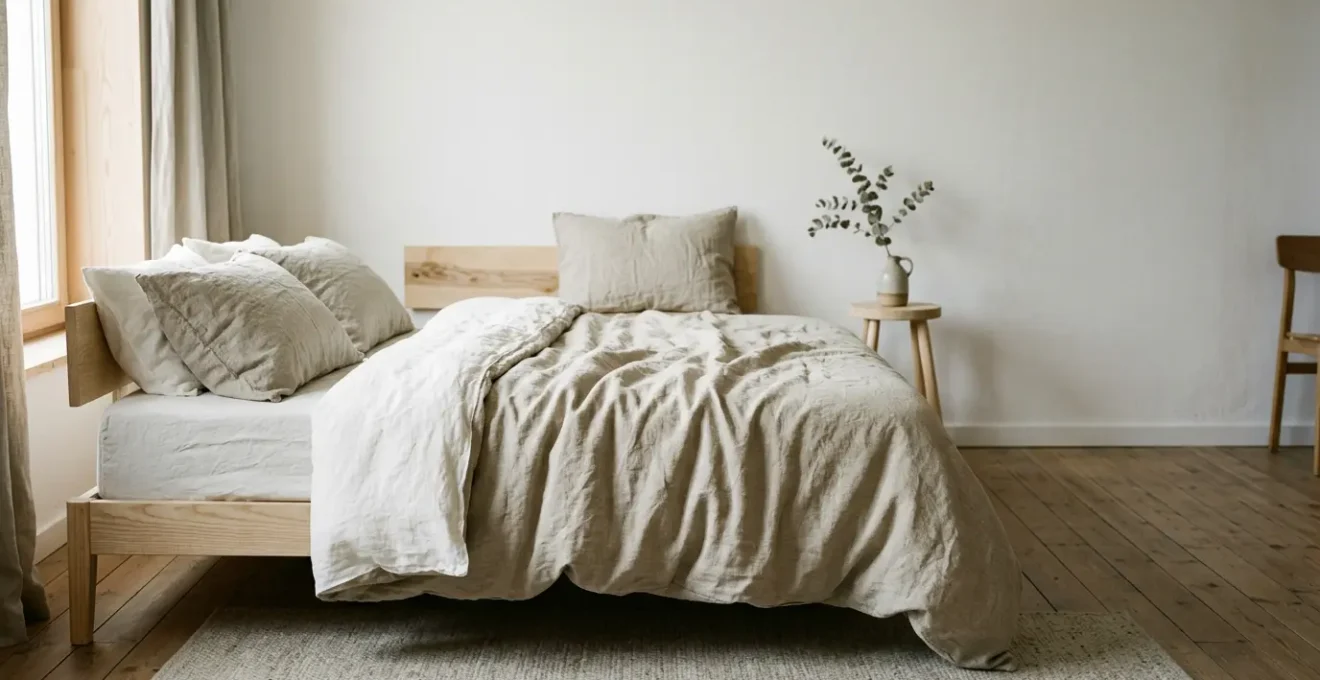
European linen is not a luxury expense but a long-term material investment that delivers a quantifiable return in durability, comfort, and sustainability.
- It outlasts cotton by 2-3 times, with a potential lifespan of over 20 years, fundamentally lowering its cost-per-use over time.
- Its unique hollow fiber architecture provides unparalleled, scientifically proven thermoregulation for better sleep year-round.
Recommendation: Approach your bedding purchase not as a decorative choice, but as a strategic investment in your well-being, where the upfront cost of quality linen is offset by its exceptional longevity and performance.
For the quality-conscious sleeper, the debate between premium cotton and the significantly higher price tag of European linen is a familiar one. Cotton is the default, the known quantity. Linen, on the other hand, is often positioned as a pure luxury, a splurge for the aesthetically minded. This perspective, however, misses the fundamental point. Viewing European linen through the lens of a simple purchase is a mistake; it should be evaluated as a long-term asset. The true value of linen isn’t just in its tactile appeal or rustic charm, but in its material science and proven return on investment.
While many articles will praise its softness or eco-credentials, they often fail to quantify its worth. The conversation needs to shift from “Is linen nice?” to “What is the measurable, decade-spanning value proposition of this textile?” This guide dismantles the “luxury expense” myth by focusing on the tangible ROI of European linen. We will explore the fiber architecture that makes it a thermoregulating miracle, the provenance differences that impact quality, and the care mistakes that sabotage its lifespan. Ultimately, this is not just about buying bedding; it’s about making a calculated investment in decades of superior sleep, enduring style, and conscious consumption. We will demonstrate why, in the calculus of home textiles, linen’s longevity makes it one of the most financially sound decisions you can make for your home.
This comprehensive guide examines the core factors that define linen’s value. From its inherent physical properties to its practical applications in a busy home, each section builds the case for linen as a superior material investment.
Summary: The Enduring Value of European Linen
- Why Does Linen Keep You Cool in Summer and Warm in Winter?
- French vs Baltic Linen: Is There a Tangible Difference in Quality?
- The Washing Mistake That Makes Linen Brittle Instead of Soft
- Ironed vs Crushed: When Is the “Messy Look” Socially Acceptable?
- How to Drape Linen Curtains for the Perfect “Puddle” Effect?
- Velvet vs Performance Linen: Which Hides Cat Hair Better?
- How to Remove Red Wine Stains From Wool Kilims?
- Which Luxury Upholstery Survives Pets and Kids Without Losing Style?
Why Does Linen Keep You Cool in Summer and Warm in Winter?
Linen’s remarkable ability to provide year-round comfort is not magic, but a feat of natural engineering rooted in its unique fiber architecture. Unlike the dense, short fibers of cotton, the long fibers of the flax plant are hollow. This seemingly simple structural detail is the secret to its dual-action thermoregulation, making it an intelligent textile that actively manages your sleeping environment. In essence, you are investing in a material that works for you every single night, regardless of the season.
During warm summer nights, linen’s hollow core and loose weave work together to create exceptional breathability. More importantly, the fiber is highly hygroscopic; linen can absorb up to 20% of its weight in moisture before feeling damp to the touch. This wicks perspiration away from the skin, allowing it to evaporate quickly and creating a tangible cooling effect. Conversely, in the winter, the same hollow fibers trap air, which is then warmed by your body heat. This creates a pocket of comfortable, dry warmth around you, acting as a natural insulator without the clammy, suffocating feeling of less breathable synthetic materials.
To truly appreciate this natural engineering, consider the microscopic view of a flax fiber. The intricate, porous structure is what delivers this high-performance comfort, a feature that simply cannot be replicated by other natural fibers to the same degree.
As this micro-view reveals, the cellular structure is purpose-built for thermal efficiency. This isn’t just a “feature”; it’s the core of linen’s value proposition for sleep quality. Investing in linen is investing in a technology perfected by nature to keep you in the optimal temperature zone for restorative sleep. This performance capability, which does not degrade over time, is a key component of its long-term material ROI. Furthermore, this natural process contributes to linen’s sustainability, as the growing of flax in Europe captures 330,000 tons of CO2 from the atmosphere annually.
French vs Baltic Linen: Is There a Tangible Difference in Quality?
The term “European Linen” is often used as a monolith for quality, but for the discerning investor, the provenance matters. The primary distinction in today’s market lies between linen grown in the traditional “flax belt” of Western Europe (primarily France, Belgium, and the Netherlands) and that from Baltic and other Eastern European regions. While all can produce excellent fabric, there are tangible differences in the final fiber, rooted in terroir—the unique combination of soil, climate, and agricultural heritage.
The loamy, nutrient-dense soils and mild, damp climate of coastal France and Belgium are globally recognized as the ideal environment for growing the longest, finest flax fibers. This results in a linen that is exceptionally smooth, supple, and has a subtle luster. It is this raw material that is most often associated with high-end, luxury bedding that develops a soft, desirable patina over many years. This is not just marketing; it is a matter of agricultural science and its impact on the resulting fiber architecture.
Conversely, linen from the Baltic region and Eastern Europe is often grown in different soil conditions. While these fibers are known for their exceptional strength and durability, they can sometimes be coarser or have a more rustic texture at the outset. As the Szonieier Fabrics Research Team notes in their guide on linen provenance:
French and Belgian soils are loamy and nutrient-rich, contributing to longer, finer fibers. Eastern European regions often rely on more alkaline or sandy soils, which can produce stronger but coarser fibers.
– Szonieier Fabrics Research Team, French vs Belgian vs Eastern European Linen Fabric Guide
This does not make Baltic linen inferior, but different. It is often an excellent choice for more robust applications like upholstery or heavier drapes. For bedding, where next-to-skin softness is paramount from the start, the investment in French or Belgian-grown linen often provides a more immediate and noticeable return in tactile comfort. The decision comes down to your primary investment goal: unparalleled softness (French/Belgian) versus rugged strength (Baltic). For the ultimate longevity and feel, the premium for Western European flax is often a justifiable part of the investment.
The Washing Mistake That Makes Linen Brittle Instead of Soft
One of the most celebrated qualities of linen is its unique aging process; it famously gets softer with every wash. This isn’t a myth, but a chemical process. The flax fibers are bound by a natural plant glue called pectin. With each wash, this pectin gradually breaks down, releasing the fibers to become more pliable and supple. However, there is a common and catastrophic washing mistake that reverses this process, “cooking” the pectin and turning a soft, long-term investment into a brittle, disposable good: using high heat.
Washing linen in hot water or using a high-heat tumble dryer causes the pectin to harden and crystallize within the fiber structure. This makes the fibers stiff and fragile, leading to premature wear, tearing, and a permanently scratchy texture. You are essentially petrifying the very substance that is meant to dissolve and create softness. This single error can destroy the “Material ROI” of your linen and is the number one reason some users complain that their linen sheets didn’t last.
As The Modern Dane’s editorial team explains, the process is meant to be gradual and gentle:
Pectin is water soluble, meaning that it dissolves with washing. More and more of the pectin dissolves with each wash, so your linen sheets become softer and softer as time goes by.
– The Modern Dane Editorial Team, Five Key Benefits of European Linen Bedding
Protecting your investment requires understanding and respecting this process. Avoiding high heat is non-negotiable. To ensure your linen develops its beautiful, soft patina over decades, a strict but simple care protocol is essential. The following steps will not only preserve your linen but actively enhance its softness and longevity with every cycle, maximizing its lifespan and your enjoyment.
Action Plan: The Linen Longevity Protocol
- Temperature Control: Wash linen in cold or lukewarm water only. High heat ‘bakes’ the natural pectin in fibers, causing permanent brittleness that destroys the fabric’s value.
- Additive Avoidance: Avoid fabric softeners completely. They coat the fibers and clog linen’s natural pores, reducing its superior absorbency and negating its breathability.
- Hard Water Reversal: If you have hard water, perform a periodic vinegar soak (1 cup white vinegar in a cold water basin for 30 minutes) to dissolve mineral deposits that create a stiff, scratchy texture.
- Strategic Drying: Remove from the dryer while still slightly damp. The residual moisture helps relax the fibers without the damaging effect of high heat, making it perfect for either immediate use or light ironing.
- Embrace Air: Air dry when possible or tumble dry exclusively on a low or no-heat setting. This preserves the natural fiber structure and is the single best way to promote softening over time.
Ironed vs Crushed: When Is the “Messy Look” Socially Acceptable?
The natural, rumpled state of linen is perhaps its most divisive characteristic. For those accustomed to the crisp, flat perfection of ironed cotton sateen, linen’s tendency to wrinkle can seem messy or unkempt. However, in the world of contemporary design, this “crushed” look is not a flaw to be corrected but a feature to be celebrated. It represents a conscious shift away from sterile, staged perfection towards an “Aesthetic of Authenticity.” The question is no longer *if* the messy look is acceptable, but *when* it is the more sophisticated choice.
The crisp, ironed look for linen is best reserved for formal settings where a traditional, sharp aesthetic is required: think formal dining tablecloths, guest towels, or the cuffs and collar of a linen shirt for a business-casual event. In these contexts, the crispness signals intention and formality. However, in the personal and intimate spaces of a home—particularly the bedroom—the opposite is true. An artfully rumpled linen duvet cover or a softly crushed linen sofa slipcover signals comfort, relaxation, and a life that is actually being lived.
This embrace of imperfection is a core tenet of design philosophies like Wabi-Sabi, which finds beauty in the transient and incomplete. A wrinkled linen bed is not messy; it’s a textural landscape that is inviting and human. Forcing it into a state of ironed rigidity goes against its very nature and, in a modern design context, can look try-hard and dated. This shift in consumer mindset is a documented trend.
Case Study: The Cultural Shift Toward Imperfect Aesthetics
The Modern Dane, a purveyor of high-end linen bedding, observed that contemporary consumers are increasingly rejecting ‘performative perfection’ in home styling. Their customer feedback, detailed in an analysis on the evolving perception of linen’s value, revealed that the fabric’s natural wrinkled appearance is now seen as a conscious design choice embracing authenticity. The company notes that “linen bedding is supposed to look rumpled—that’s precisely its appeal,” and customers appreciate that they can make the bed in seconds with a quick shake. This shift reflects a broader cultural trend valuing realistic, comfortable home life over magazine-perfect staging, with the lived-in linen look serving as a visual signal of this authenticity.
How to Drape Linen Curtains for the Perfect “Puddle” Effect?
The “puddle” or “pool” effect, where curtain fabric is intentionally left long to gather elegantly on the floor, is a hallmark of sophisticated interior design. With linen, this technique can elevate a room from merely decorated to truly designed. However, achieving the perfect, effortless-looking puddle requires technical precision. It’s a balance of choosing the right fabric weight, precise measurements, and training the fabric to fall correctly. An improperly executed puddle looks like a measuring mistake; a perfect one looks like a deliberate, luxurious statement.
The first and most critical variable is the weight of the linen, measured in grams per square meter (GSM). A lightweight, gauzy linen will not have the mass to puddle correctly; it will simply crumple. A heavier, more densely woven linen is required for the fabric’s own weight to create a graceful, sculptural fold. As a rule of thumb, textile weight specifications indicate that heavier weaves are essential for this look. For instance, linen fabrics in the 300-350 GSM range, often used for bedcovers, possess the necessary heft to create a dramatic and satisfying drape, unlike their 180 GSM counterparts.
Once you have the right weight, measurement is key. There are different styles of puddles, each requiring a different amount of extra length. A “break” puddle just kisses the floor with a slight fold, requiring only 1-2 inches of extra fabric. A “standard” puddle, with a soft, generous pool, requires adding 6-10 inches to the floor-to-rod measurement. For a truly dramatic, European-inspired look, you can add up to 20 inches. To achieve the perfect drape, follow a professional technique.
- Choose Appropriate Weight: Select a linen with a substantial weight (ideally 300+ GSM). The gravity and density of the fiber are essential for a luxurious puddle.
- Measure for the Puddle: Add 6-10 inches beyond the floor-length measurement for a gentle pool effect, or 15-20 inches for a dramatic European puddle.
- Train Your Drapes: Immediately after hanging, manually arrange the bottom puddle into your desired shape. You can use small weights or pins to hold the folds in place for 48-72 hours to set the shape.
- Steam Set the Memory: Use a handheld garment steamer on the puddled section. The combination of heat and moisture will help the natural fibers relax and “remember” their trained position.
- Maintain the Shape: After cleaning or significant movement, take a moment to reshape the puddle by hand to reinforce the trained drape pattern and maintain its intentional look.
Velvet vs Performance Linen: Which Hides Cat Hair Better?
For pet owners, the choice of upholstery is a battle between aesthetics and practicality. Two popular luxury options, velvet and performance linen, sit at opposite ends of this spectrum when it comes to managing pet hair. While the plush pile of velvet may seem cozy, it acts as a powerful magnet for cat hair, trapping it within its fibers and making it notoriously difficult to remove. The electrostatic properties of many synthetic velvets only exacerbate the problem.
Performance linen, on the other hand, is fundamentally better engineered to coexist with furry companions. Its flat, tight weave offers nowhere for hair to become deeply embedded. The smooth surface of the flax fibers allows pet hair to be wiped or brushed away with minimal effort. While no fabric is truly “pet-proof,” performance linen offers a far superior solution for maintaining a clean and stylish appearance in a multi-pet household. The key differences in performance are stark when compared side-by-side.
The following table, based on an analysis of pet-friendly upholstery fabrics, breaks down the performance characteristics of each material when faced with the realities of pet ownership.
| Factor | Performance Linen | Velvet |
|---|---|---|
| Hair Release | ✓ Excellent – Flat weave releases hair easily with lint brush | ✗ Poor – Pile structure traps hair deep in electrostatic fibers |
| Claw Resistance | ✓ Good – Tight weave resists snagging, higher thread stability | ✗ Fair – Pile can snag, creating pulled loops and visible damage |
| Pilling Resistance | ✓ Excellent – Long flax fibers minimize loose ends | ✗ Moderate – Synthetic pile can mat and pill over time |
| Cleaning Ease | ✓ Machine washable, quick drying, naturally antibacterial | ✗ Professional cleaning often required, moisture retention issues |
| Hair Camouflage | Heathered or tweeded colorways effectively hide inevitable pet hair | Solid deep colors can hide hair but texture highlights it |
The verdict is clear: from a purely functional standpoint of managing pet hair and resisting damage, performance linen is the superior investment. While velvet offers a specific type of tactile luxury, its structure makes it a high-maintenance choice for pet owners. Linen’s combination of a hair-releasing flat weave, inherent durability, and the availability of heathered colors for camouflage makes it the more intelligent, long-term choice for a stylish home that doesn’t treat pets as an afterthought.
How to Remove Red Wine Stains From Wool Kilims?
A red wine spill on a valuable wool kilim can feel like a catastrophe, but immediate, correct action can prevent a permanent stain and preserve the value of your rug. The key is to act within the first few minutes, using absorption and gentle chemistry rather than aggressive scrubbing. Wool is a resilient fiber, but it is sensitive to heat and harsh chemicals, which can cause colors to bleed or damage the fiber itself. This protocol is designed for emergency first response; for set-in stains, professional help is always the wisest course.
The enemy is time. As the wine soaks into the wool fibers and begins to dry, its pigments (tannins) form chemical bonds with the wool, making the stain much harder to remove. The goal is to lift as much liquid as possible before this happens. Never rub the stain, as this only pushes the liquid deeper into the rug’s pile and foundation. The entire process should be one of gentle blotting and application. This emergency protocol, adapted from a guide on the absorptive properties of natural fibers, provides a step-by-step method for tackling the crisis.
- First 60 Seconds – Blot: Immediately take a clean, dry, white cloth and blot the spill. Use firm, downward pressure to lift the liquid out of the wool. Do not rub. Rotate the cloth to a clean section as it absorbs the wine.
- Minute 2-3: Absorption Phase: Generously cover the entire blotted area with table salt or baking soda. The granules will act as a powerful desiccant, drawing the remaining moisture and wine pigments out of the wool fibers. Let it sit for a few minutes until you can see the salt turning pink.
- Minute 4-5: Dilution Phase: Once the salt has done its work, vacuum it up. Lightly dampen a new clean cloth with cold club soda. The carbonation can help lift the remaining tannins to the surface. Gently dab the area.
- Minute 6-10: Vinegar Treatment: Mix a solution of one-part white vinegar to two-parts cold water. Using a fresh cloth, gently dab this mildly acidic solution onto the stain. The vinegar helps to break down the wine’s pigment structure without harming the wool.
- Assessment Point: After blotting dry, assess the situation. If the stain has significantly faded or disappeared, you’re done. If it remains prominent, has already dried, or if the rug’s colors are bleeding, stop immediately. Further DIY attempts could cause irreversible damage. At this point, take a photo and contact a professional rug cleaner.
This careful, methodical approach gives you the best chance of saving your kilim from a common household disaster. The key is swift, gentle action and knowing when to call in an expert.
Key Takeaways
- Linen’s value is in its longevity; it is 2-3 times more durable than cotton and can last over 20 years, making its cost-per-use extremely low over time.
- The hollow structure of flax fibers provides scientifically superior thermoregulation, keeping you cool by wicking moisture and warm by trapping air.
- Protect your investment by avoiding high-heat washing, which causes permanent brittleness. True softness is achieved through the gradual breakdown of pectin with cool-water washing.
Which Luxury Upholstery Survives Pets and Kids Without Losing Style?
In a home filled with the joyous chaos of children and pets, the dream of luxury upholstery can seem like a futile one. However, the solution is not to forgo style for a decade, but to invest in materials engineered for resilience. The ultimate family-friendly upholstery must excel in four key areas: durability, stain resistance, cleanability, and claw/snag resistance. Two materials consistently rise to the top of this list for different reasons: performance linen and full-grain leather.
Performance linen, as established, is an exceptional choice. Its inherent strength is remarkable; textile strength testing demonstrates that linen is up to three times stronger than cotton, which is why it has historically been used for items requiring extreme durability like banknotes. When treated with modern performance finishes, it repels spills and makes cleanup manageable. Its tight, flat weave is less prone to snagging from pet claws compared to fabrics with a visible loop or pile, and it releases pet hair easily.
The other heavyweight contender is full-grain leather. Unlike corrected-grain or bonded leathers which have a fragile surface coating, full-grain leather is the real deal. It is incredibly durable and easy to wipe clean. More importantly, it aligns with the “Aesthetic of Authenticity” by aging beautifully. As one industry analysis points out, its character improves with use.
Full-grain leather might be the ultimate family-friendly luxury, as it develops character and improves with the scuffs and spills of daily life.
– Interior Design Industry Analysis, Luxury Upholstery Performance Study
Ultimately, the choice between performance linen and full-grain leather comes down to the desired aesthetic and feel. Linen offers a softer, more relaxed look, while leather provides a classic, structured feel that gains a rich patina over time. Both represent a smart investment, proving that a stylish, luxurious home is not incompatible with the realities of family life. The key is choosing a material whose durability is as impressive as its appearance. In fact, according to experts, with mindful care, modern linen bedding can last 20 years or more, and the same durability principles apply to upholstery.
Frequently Asked Questions About Performance Upholstery
What does ‘Performance Linen’ actually mean compared to regular linen?
Performance linen refers to linen fabric that has been treated or woven with enhanced stain-resistance and durability features. It maintains linen’s breathability and natural appearance while adding protective finishes that make it more suitable for high-traffic family use. Unlike synthetic performance fabrics, it retains the natural fiber benefits.
How does Crypton technology differ from Sunbrella in upholstery protection?
Crypton is a liquid and bacteria-resistant barrier applied to fabrics at the fiber level, making it ideal for indoor furniture that faces spills and stains. Sunbrella is solution-dyed acrylic designed primarily for outdoor use with superior UV and fade resistance. Crypton keeps the original fabric feel, while Sunbrella has a more structured canvas-like texture.
Is ‘Performance Velvet’ truly pet-friendly or just marketing?
Performance velvet has legitimate benefits: it’s typically made from tightly-woven polyester that resists staining and can be cleaned with water. However, its pile structure still traps pet hair more than flat-weave fabrics. It’s pet-friendlier than traditional velvet, but the ‘performance’ mainly refers to stain resistance, not hair management.