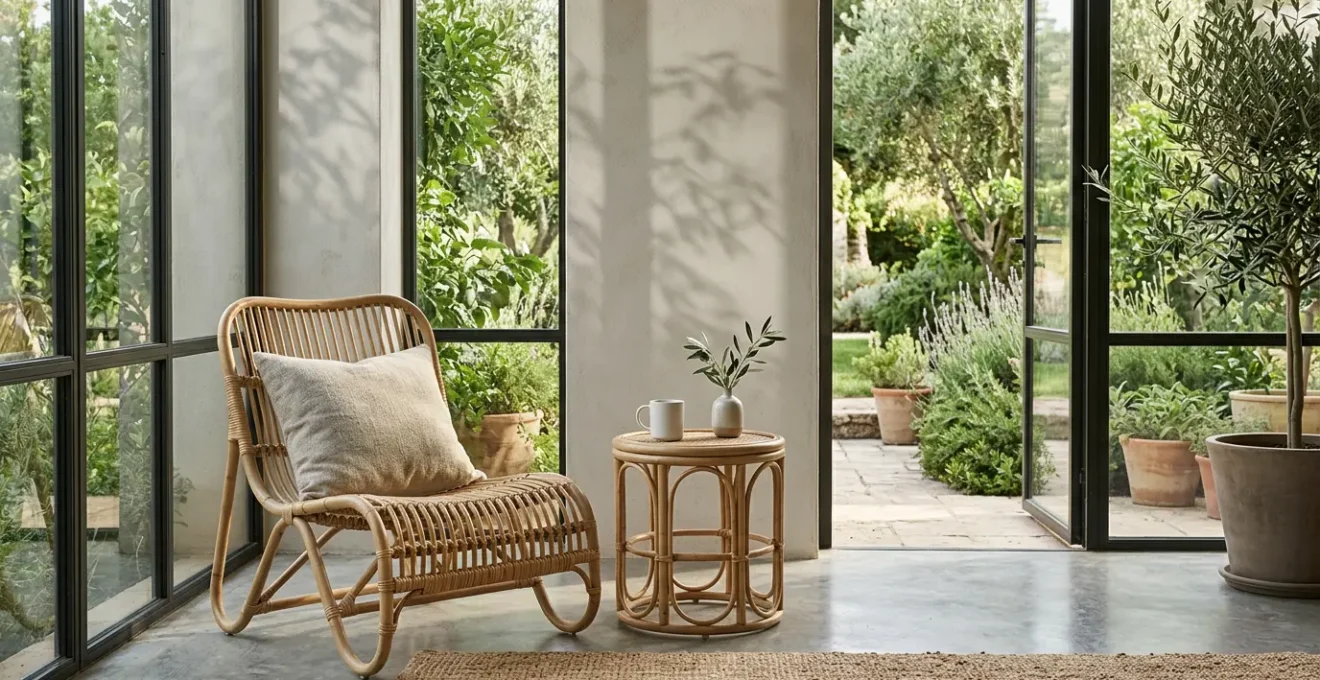
The key to long-lasting rattan furniture isn’t where you place it, but how you understand it as a dynamic natural material.
- True sustainability goes beyond looks: Natural rattan is biodegradable, while synthetic PE wicker creates long-term plastic waste.
- Durability is an active process: Maintaining a 40-60% humidity balance is more critical than simply avoiding all moisture.
Recommendation: Prioritize vintage pieces with hardwood frames and traditional wrapped joinery for superior build quality and lasting investment value.
For homeowners with a sunroom, conservatory, or covered patio, the choice of furniture presents a unique challenge. This transitional space, neither fully indoors nor completely outdoors, demands materials that can withstand fluctuations in light, temperature, and humidity. Rattan often emerges as the aesthetic favorite, celebrated for its ability to bring a natural, airy feel to any setting. But the conversation frequently stops at its looks, leaving a critical question unanswered: is it truly durable enough for the job?
The common advice is often a set of vague warnings: protect it from rain, bring it inside during winter, and watch out for fading. While not incorrect, this surface-level guidance misses the fundamental nature of rattan. It treats the material as a fragile object to be shielded, rather than a resilient, natural fiber to be understood and maintained. The real measure of rattan’s suitability lies not in avoiding the elements, but in mastering its relationship with them.
This guide moves beyond aesthetics to explore the core of rattan’s performance. We will treat it not as static decor, but as a dynamic material with specific needs and remarkable strengths. By understanding its properties, from its cellular response to humidity to the integrity of its bindings, you can transform your rattan pieces from seasonal accents into year-round, sustainable investments. This is about embracing a lifecycle approach—choosing the right type, performing the right maintenance, and ensuring your furniture doesn’t just survive, but thrives.
To navigate this topic effectively, this article breaks down the essential aspects of choosing, maintaining, and understanding rattan furniture. Explore the sections below to become an expert in durable, sustainable indoor-outdoor living.
Summary: A Deeper Look at Rattan’s Durability for Transitional Living
- Natural Rattan vs PE Wicker: How to Tell the Difference Instantly?
- How to Fix Unraveling Rattan Bindings Before the Chair Breaks?
- The Humidity Balance: Preventing Rattan From Cracking or Molding
- Vintage vs New: Which Era of Rattan Offers Better Build Quality?
- How to Choose Cushions That Stop Rattan from Digging Into Your Back?
- Bamboo vs Reclaimed Wood: Which Is Truly More Sustainable?
- Vintage Original vs Modern Reproduction: Which Holds Value Better?
- How to Reduce Your Carbon Footprint Through Recycled Decor Materials?
Natural Rattan vs PE Wicker: How to Tell the Difference Instantly?
Before assessing durability, it’s crucial to understand what you’re buying. Many consumers use “rattan” and “wicker” interchangeably, but they are not the same. Wicker is a style of weave, not a material. Rattan, a natural vine-like palm, is a material often used in wicker weaves. The most common confusion arises between natural rattan and its synthetic counterpart, PE (polyethylene) wicker, which is essentially plastic woven in a wicker style.
While PE wicker is marketed for its weather resistance, its long-term sustainability is questionable. It’s a petroleum-based product that becomes brittle with UV exposure and will persist in landfills for centuries, shedding microplastics. Natural rattan, on the other hand, is a renewable resource that is fully biodegradable. It develops a patina with age rather than degrading, and its feel is warmer and more organic. Tapping on PE wicker often produces a slight, hollow plastic ‘ticking’ sound, whereas natural rattan has a more solid, sound-dampening quality.
Understanding these differences is the first step in making a conscious choice aligned with long-term value and environmental impact, not just short-term weatherproofing.
| Characteristic | Natural Rattan | PE Wicker (Polyethylene) |
|---|---|---|
| Material Origin | Palm vines from tropical regions (biodegradable) | Synthetic plastic (polyethylene polymer) |
| End-of-Life Impact | Biodegradable and compostable, returns to earth | Persists in landfills for centuries, sheds microplastics |
| Durability vs. UV | Ages with patina, weakens with moisture but manageable | UV degradation causes brittleness and cracking over time |
| Tactile & Acoustic | Warmer to touch, sound-dampening qualities | Cool, plastic-y feel, slight ‘ticking’ sound when tapped |
| Typical Lifespan (Indoor) | 10-15 years with proper care | 5-10 years outdoors with minimal care |
How to Fix Unraveling Rattan Bindings Before the Chair Breaks?
The true test of rattan furniture’s longevity lies not in its main canes, but in its joints. The intricate bindings that hold the frame together are the points most susceptible to stress and environmental changes. When these start to unravel, it’s a sign of compromised structural integrity that, if ignored, can lead to catastrophic failure. However, a loose binding is not a death sentence; it’s an opportunity for a simple, effective repair that restores the furniture’s strength.
Many people reach for superglue, but this is a mistake. Superglue is brittle and creates a superficial bond that will quickly fail under tension. The professional approach focuses on restoring flexibility to the fibers and using mechanical tension for a lasting fix. This involves rehydrating the binding material and applying a strong, flexible adhesive like PVA (polyvinyl acetate) wood glue. The following steps turn a potential disaster into a nearly invisible, permanent repair.
As the image above highlights, the weave itself is a structural component. The goal of a good repair is to work with this structure, not just glue over it. By re-engaging the tension of the wrap, you ensure the joint is as strong, or even stronger, than it was originally. According to experts cited on platforms dedicated to garden furniture care, proper maintenance and timely repairs are key to extending lifespan.
The Humidity Balance: Preventing Rattan From Cracking or Molding
Natural rattan is a plant fiber, and like any wood product, it “breathes” by absorbing and releasing moisture from the air. This is the secret to its resilience but also its primary vulnerability. In a transitional space like a sunroom, humidity can swing dramatically. Too little humidity, and the fibers dry out, become brittle, and crack. Too much, and you invite the growth of mold and mildew. The key is not to isolate the furniture, but to manage its environment to achieve a state of humidity equilibrium.
Vague advice to “keep it dry” is unhelpful. The ideal strategy is precise and proactive. Experts recommend using a digital hygrometer to monitor your space. The target is to maintain a relative humidity level between 40% and 60%. This “50% Rule” provides a clear, actionable goal. In dry winter months, this may mean lightly misting the furniture or using a humidifier. In a humid summer, it requires ensuring good air circulation to prevent moisture from settling on the surfaces.
As Posh Living Magazine notes in its guide, “Natural rattan’s lifespan can vary greatly depending on how well it’s made and how you take care of it.” This care extends to a seasonal regimen: nourishing the fibers with boiled linseed or tung oil in the spring to repel surface moisture, and ensuring proper airflow during humid periods. This active management prevents the material from reaching the breaking or molding point.
Vintage vs New: Which Era of Rattan Offers Better Build Quality?
When shopping for rattan, you’ll face a choice between brand-new pieces and vintage finds from the mid-20th century. While new furniture offers immediate availability, vintage rattan often boasts superior build quality. The difference lies in both materials and craftsmanship. As noted by experts at 1stDibs, a leading marketplace for design, “Vintage pieces have hardwood rather than metal frames, and the rattan will be natural rather than resin.”
Mid-century makers like Paul Frankl, McGuire, and Ficks Reed used mature, dense rattan canes and constructed their furniture with robust hardwood frames. Joints were not held by modern staples or screws, which can loosen over time, but by traditional joinery techniques where connections were meticulously wrapped with leather or rattan bindings. This method created a stronger, more flexible structure that has allowed many of these pieces to last for over 50 years.
Case Study: The Investment Value of Designer Rattan
The enduring quality of vintage designer rattan translates directly into investment value. According to an analysis of the antiques market, authentic pieces from reputable designers like McGuire, Palecek, and Paul Frankl can command prices between $1,000-$10,000 depending on their condition and rarity. For instance, a French solitaire chair by Janine Abraham and Dirk Jan Rol was listed at auction for over $1,000. This value is a direct result of the superior materials—dense, mature canes—and the hand-crafted construction that modern, mass-produced furniture cannot replicate.
Choosing vintage is therefore not just an aesthetic decision but a structural one. It’s an investment in a level of craftsmanship and material quality that is increasingly rare in today’s market, ensuring the piece has the foundational strength to last for decades more.
How to Choose Cushions That Stop Rattan from Digging Into Your Back?
Even the most beautifully crafted rattan chair can be uncomfortable without the right support. The rigid frame, while durable, can create pressure points. The solution isn’t just any soft cushion; it’s about creating an ergonomic partnership between the frame and the padding. This means choosing a cushion with the right density and material to provide support without sacrificing the chair’s airy aesthetic or your commitment to sustainability.
Standard polyurethane foam cushions are a common choice, but they tend to compress quickly, losing their supportive qualities and ending up in a landfill. A more durable and sustainable approach involves looking at high-performance, natural fillings. These materials not only provide superior, long-lasting comfort but also align with the eco-friendly nature of the rattan itself. For example, natural latex offers firm, responsive support and can last for over 20 years, while coconut coir provides excellent breathability, making it ideal for hotter climates.
The right cushion becomes an integral part of the furniture system. It protects your body from the rigid frame while also protecting the rattan itself from concentrated stress. By selecting a high-quality, sustainable filling, you elevate the piece from a simple chair to a truly comfortable and long-lasting seating experience.
| Filling Material | Durability | Comfort Level | Sustainability | Best For |
|---|---|---|---|---|
| Natural Latex | High (20+ years) | Firm, responsive | Renewable, biodegradable, hypoallergenic | Lumbar support, long-term use |
| Kapok | Medium (5-7 years) | Soft, silky | Water-resistant, plant-based, renewable | Decorative cushions, light use |
| Coconut Coir | High (10-15 years) | Firm, breathable | Natural fiber, excellent airflow | Hot climates, outdoor use |
| High-Density Foam | Medium (7-10 years) | Variable | Lower density compresses quickly | Budget options, indoor use |
Bamboo vs Reclaimed Wood: Which Is Truly More Sustainable?
When expanding your sustainable decor palette beyond rattan, bamboo and reclaimed wood often emerge as top contenders. Both are excellent alternatives to virgin timber, but they offer different environmental benefits. Reclaimed wood is the ultimate form of recycling, giving a second life to timber from old buildings and preventing it from ending up in a landfill. Its carbon footprint from manufacturing is nearly zero, though sourcing and transportation must be considered.
Bamboo, technically a grass, is a champion of renewability. It is one of the fastest-growing plants in the world and requires no replanting after harvesting. Its most significant advantage, however, is its incredible efficiency at carbon sequestration. Research shows that bamboo can sequester up to 35% more carbon than comparable timber species, actively cleaning the atmosphere as it grows. This makes it a powerful tool in combating climate change.
The choice between them often comes down to project specifics and availability. Reclaimed wood offers unparalleled character and history, while bamboo provides a sleek, modern aesthetic backed by rapid renewability and superior carbon capture. For a truly holistic sustainable strategy, incorporating both materials into your home leverages the best of recycling and renewal.
Key Takeaways
- Rattan’s sustainability depends on its lifecycle: natural rattan biodegrades, while synthetic PE wicker adds to plastic pollution.
- Proactive care is crucial: maintain a 40-60% humidity level using a hygrometer to prevent cracking and mold.
- Superior quality is found in the past: vintage rattan often features more durable hardwood frames and traditional joinery compared to modern counterparts.
Vintage Original vs Modern Reproduction: Which Holds Value Better?
The market for rattan furniture is divided between authentic vintage pieces and modern reproductions designed to mimic their style. While a reproduction can capture the look, it rarely captures the long-term value. An original vintage piece, especially from a noted designer, is not just furniture; it’s a collectible asset that can appreciate over time. As previously noted, authentic pieces can command prices ranging from $1,000 to $10,000.
This value retention is directly tied to the superior materials and construction methods of the past. Modern reproductions often cut corners, using cheaper materials like metal frames instead of hardwood, or synthetic resin instead of natural rattan. They may also use staples and screws for joinery, which lack the durability of traditional wrapped bindings. These compromises affect not only the piece’s lifespan but also its desirability for collectors.
Therefore, being able to authenticate a vintage piece is a critical skill for any serious buyer. Identifying the signs of original craftsmanship—from the type of frame to the joinery method—is the key to ensuring you are investing in an appreciating asset, not just a disposable lookalike. An original holds its value because its quality is tangible and has stood the test of time.
Your 5-Point Checklist for Authenticating Vintage Rattan
- Frame Construction: Check underneath the rattan. Authentic vintage pieces (pre-1980s) almost always feature solid hardwood frames, not modern metal or aluminum.
- Joinery Method: Look closely at the joints. Originals use traditional wrapped bindings (often leather or rattan) to create structural connections. Reproductions typically use visible staples, screws, or other fasteners.
- Material Quality: Feel the surface. Genuine vintage rattan is a natural fiber with slight imperfections, color variations, and an aged patina. Synthetic resin on reproductions looks and feels too uniform and plastic-y.
- Proportions & Design: If you know the designer, compare the piece’s measurements and details to documented examples. Reproductions often alter proportions, which can compromise the ergonomic integrity and aesthetic balance.
- Maker’s Marks & Provenance: Look for labels or marks from renowned brands like Ficks Reed, McGuire, or Paul Frankl. Even without a mark, documented design characteristics can help attribute a piece and confirm its authenticity.
How to Reduce Your Carbon Footprint Through Recycled Decor Materials?
Making sustainable choices for your home goes beyond just one piece of furniture. It’s about adopting a mindset—a lifecycle thinking approach to everything you bring into your space. Reducing your carbon footprint through decor involves a clear hierarchy of choices, prioritizing reuse and recycling over buying new. This framework empowers you to make impactful decisions that are both beautiful and environmentally responsible.
The highest priority is always reuse. Sourcing secondhand or vintage items, such as a well-made rattan chair, completely eliminates the manufacturing emissions and resource consumption associated with a new product. The next best choice is to select materials processed from waste streams, such as reclaimed wood from local demolitions or textiles upcycled from post-consumer materials. These choices actively divert waste from landfills.
If you must buy new, the focus shifts to responsible sourcing. Look for certifications like FSC for wood products and prioritize natural, renewable materials with low-VOC (volatile organic compound) finishes. Finally, always consider “material miles.” A locally sourced item, even if new, can have a lower overall carbon footprint than a “green” product shipped from across the globe. By following this hierarchy, every decor choice becomes a positive contribution to a healthier planet.
By applying this sustainable hierarchy to your next decor project, you transform your role from a mere consumer to a conscious curator of your living space. Each choice becomes an opportunity to champion longevity, reduce waste, and build a home that is not only beautiful but also deeply aligned with your values.