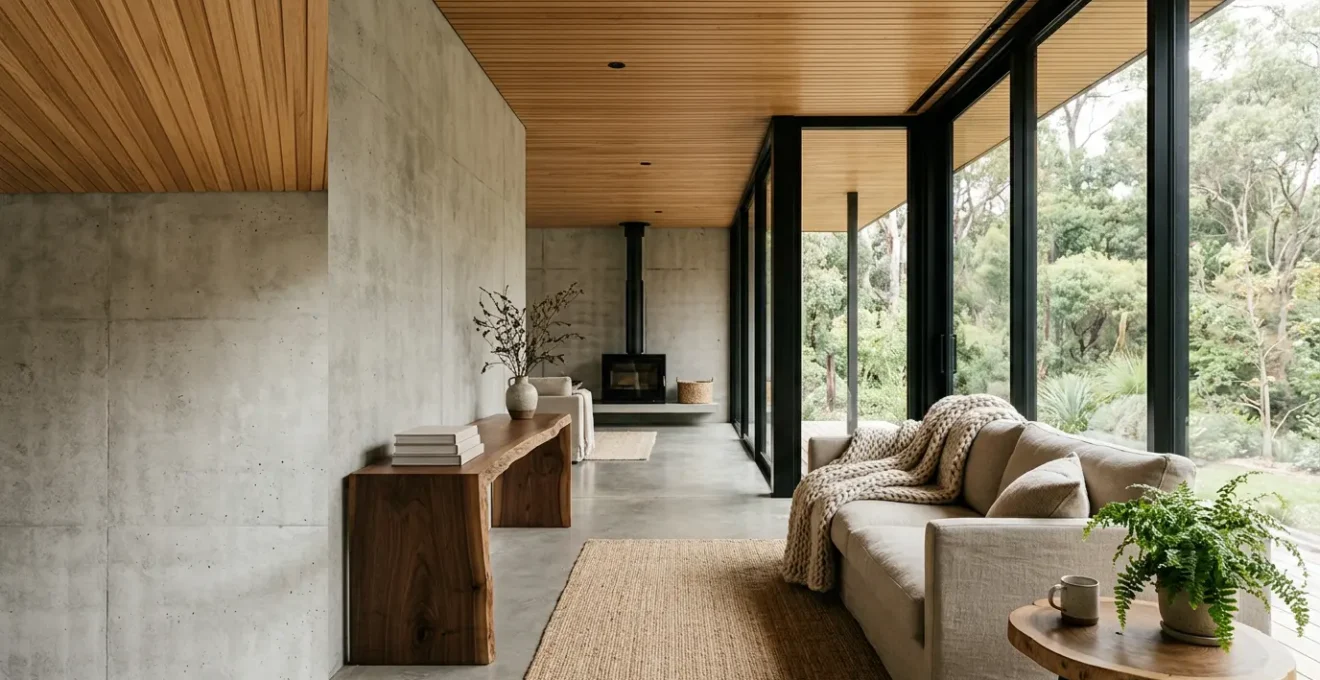
The solution to a cold modern interior isn’t adding more things; it’s strategically correcting the sensory deficits—harsh light, hard surfaces, and sharp echoes—inherent in minimalist architecture.
- Material dialogue is key: The warmth of wood is amplified against concrete, and the softness of velvet is heightened by steel.
- Light quality (CRI) is more important than color temperature (Kelvin) for creating a welcoming, not sterile, atmosphere.
- Acoustic comfort, achieved by dampening echoes with textured surfaces, is the invisible layer of warmth.
Recommendation: Stop thinking about decoration and start conducting a sensory audit of your space to identify and correct where it feels cold, loud, or flat.
You inhabit a space of clean lines and architectural purity—a modern home of glass, concrete, and steel. It’s the very vision of minimalism you desired, yet an undeniable chill pervades. Not a physical cold, but a sensory one. The space feels more like a gallery than a home. The common advice is to add plants, a colorful rug, or a cozy throw blanket. But these feel like superficial fixes, decorative clutter that betrays the very principles of the architecture you love. You fear that in the quest for warmth, you will inevitably sacrifice the clean, uncluttered aesthetic you worked so hard to achieve.
This is the central paradox for the owner of a modern home. The pursuit of warmth seems to be on a collision course with the integrity of minimalism. The solutions often feel like a compromise, adding layers of “stuff” that dilute the home’s strong character. But what if the problem has been framed incorrectly? What if the coldness isn’t a lack of decoration, but a series of correctable sensory deficits? The hardness of the surfaces, the echo in the open-plan spaces, the flat, sterile quality of the light—these are the true culprits. The key isn’t to add clutter, but to introduce strategic, almost architectural, interventions that manipulate material, light, and sound to create a feeling of warmth and comfort from within the design itself.
This guide reframes the approach. We will move beyond decoration and into the realm of sensory design. We will explore how to make hard materials feel soft, how to use light to sculpt intimacy, and how to manage sound for a sense of calm. This is the philosophy of “Warm Minimalism”: achieving residential comfort not by adding, but by correcting and balancing, preserving the soul of your modern home while making it a deeply inviting sanctuary.
This article provides a strategic framework for achieving that balance. Inside, you’ll find a detailed exploration of the principles that allow warmth and minimalism to coexist, turning a cold architectural shell into a sophisticated, comfortable home.
Contents: A Strategic Framework for Sensory Warmth
- How to Introduce Wood Tones into a Concrete Shell?
- The “Granny Chic” Risk: Losing Your Modern Edge With Vintage
- Rugs vs Heated Floors: Which Warms a Modern Living Room Best?
- Why Does 4000K Lighting Make Modern Homes Feel Like Hospitals?
- Why Does Hard Steel Make Velvet Furniture Look Softer?
- How to Layer Textures to Avoid the “Boring Beige” Trap?
- How to Dampen Echoes in Open Plan Spaces Without Curtains?
- How to Soften the Industrial Loft Edge for Family Living?
How to Introduce Wood Tones into a Concrete Shell?
The instinct to add wood to a concrete interior is correct, but its success lies in the application. Dropping a small wooden table into a vast concrete room is like a whisper in a windstorm; it’s easily lost. The goal isn’t just to add a new material, but to create a powerful material dialogue where the wood actively counterbalances the concrete’s austerity. Instead of small decorative pieces, think architecturally. Cladding a structural column in wood, using large-scale wood slat panels on a feature wall, or installing a built-in wooden bench doesn’t add clutter—it redefines the space’s surfaces.
This approach is about transforming the concrete’s industrial feel into a warm, inviting environment. As detailed in a case study on Brazilian apartment renovations, wood provides a crucial alternative to “soften the austere impression of concrete.” It’s not just a visual trick; the natural grain, varied tones, and inherent warmth of wood create a tactile and psychological contrast that makes the entire space feel more human and livable. The concrete’s coolness makes the wood appear warmer, and the wood’s organic nature makes the concrete feel more like a deliberate, grounding choice.
This method has become a hallmark of sophisticated modern design. A curated collection by ArchDaily shows that in over 35 architecture projects, the combination of raw wood and concrete is used to create spaces that are both raw and refined. By treating wood as an integral part of the architecture—a surface, a structural element, a source of texture—you can infuse warmth deeply into the home’s DNA without adding a single piece of clutter.
The “Granny Chic” Risk: Losing Your Modern Edge With Vintage
Introducing vintage or antique pieces is a potent strategy for injecting soul and history into a modern interior. These items tell a story and provide a rich textural contrast to the clean lines of contemporary design. However, there’s a fine line between a curated, sophisticated mix and a space that feels like a disjointed thrift store. This is the “Granny Chic” risk: an over-reliance on vintage can erode the sharp, modern edge you want to maintain, resulting in a look that feels dated and cluttered rather than timeless.
The key to avoiding this pitfall is balance and intention. To maintain a modern aesthetic, interior designers widely recommend the 80/20 rule: your space should be composed of roughly 80% modern pieces and 20% vintage. This ratio ensures the overall character of the room remains contemporary and clean, while the vintage items act as powerful, character-rich accents rather than overwhelming the space. A single, sculptural antique console in a minimalist hallway makes a stronger statement than five smaller, competing pieces.
The modern pieces provide a necessary framework that elevates the vintage selections. As designer Emily Henderson notes, this context is crucial for the mix to succeed.
Without the mix of a few contemporary pieces, it did look more thrift store and adding a few contemporary/modern pieces would elevate everything and give a needed context to the vintage.
– Emily Henderson, How And Why I Mix Vintage + Modern
Think of your modern furniture and architecture as the gallery walls, and the vintage pieces as the carefully chosen art. One beautifully patinated leather armchair or a single ornate mirror doesn’t add clutter; it adds a layer of history and texture that makes the entire modern composition feel warmer and more considered.
Rugs vs Heated Floors: Which Warms a Modern Living Room Best?
When faced with a large, modern living room with polished concrete or wide-plank floors, the question of warmth becomes paramount. The two primary solutions, area rugs and radiant heated floors, are often pitted against each other, but they address fundamentally different types of “coldness.” Understanding this distinction is key to making the right choice for your minimalist space. Radiant flooring provides a literal, ambient physical heat, while a large area rug delivers visual, textural, and acoustic warmth.
Radiant heating is a truly minimalist solution—an invisible luxury that warms the room from the ground up, creating a uniform, comfortable temperature without any visual clutter. However, it doesn’t solve the sensory issues of a modern space: it doesn’t define zones, soften footsteps, or absorb sound. An area rug, on the other hand, excels at these tasks. It visually anchors a seating area, provides a soft texture underfoot, and significantly dampens the echo common in open-plan homes.
For those with radiant heating, a common misconception is that rugs are off-limits. This is not true, provided you choose wisely. The key is to avoid thick, insulating rugs that trap heat and force the system to work harder. In fact, radiant heating specialists recommend limiting rug coverage to a 50% maximum of the floor area and choosing rugs with a low Tog rating (under 2.5) to allow heat to pass through efficiently. The best solution is often a combination of both, as this table illustrates.
| Warmth Attribute | Radiant Heated Floors | Area Rugs |
|---|---|---|
| Type of Warmth | Literal, ambient physical heat | Visual, textural, acoustic warmth |
| Primary Function | Temperature regulation | Zone definition and sensory comfort |
| Heat Conductivity | Direct heat transfer from below | Thin rugs (wool/jute) conduct heat; thick rugs insulate |
| Efficiency Impact | System works harder when covered over 50% | Tog rating under 2.5 recommended for compatibility |
| Best Combined Use | Thin flat-weave rugs (10-15mm pile) on radiant floors for both ambient and sensory warmth | |
Ultimately, the choice isn’t “either/or.” The ideal warm minimalist approach uses radiant heating for physical comfort and a well-chosen, thin flat-weave rug for sensory comfort. This layered strategy provides the best of both worlds, creating a space that is both literally and perceptually warm without compromising clean lines.
Why Does 4000K Lighting Make Modern Homes Feel Like Hospitals?
Lighting is one of the most powerful and misunderstood tools for creating warmth. Many people, aiming for a “clean, modern” look, opt for bulbs in the 4000K range. This color temperature is a cool, neutral white, often marketed as “daylight.” The disastrous result is a home that feels less like a chic modern dwelling and more like a sterile clinic or a corporate office. The reason lies not just in the color temperature (Kelvin), but in a more crucial, often overlooked metric: the Color Rendering Index (CRI).
CRI measures how accurately a light source reveals the true colors of objects, on a scale of 0 to 100. Cheap, low-CRI 4000K bulbs render colors—and especially skin tones—in a flat, lifeless, and often greenish way. This is what creates that “hospital” feeling. It’s an unnatural light that drains the warmth and richness from your carefully chosen wood tones, textiles, and even the people in the room. In contrast, a high-CRI light source makes colors pop with vibrancy and depth. For residential spaces, commercial lighting specialists confirm that a CRI of 90 or above is required to achieve accurate, appealing color rendering.
The professional’s secret is to pair a high CRI (90+) with a warmer, more inviting color temperature. A 3000K bulb with a high CRI is the sweet spot for modern interiors. It’s a clean, crisp white without the yellow cast of 2700K, but it still feels warm and welcoming, not sterile. It allows the whites to feel white and the wood to feel warm. The ultimate strategy, however, is to layer different light temperatures. You might use 3000K for general ambient light, but create intimate pools of much warmer 2200K-2700K light with task lamps or accent lights to define cozy zones within the larger space.
This layered approach, as shown in the composition above, allows for flexibility and mood creation. The space can be bright and functional when needed, but can also become an intimate, warm sanctuary at the flick of a switch. Stop chasing Kelvin numbers and start demanding high CRI. It is the single most effective way to banish the hospital feel and bring true, vibrant warmth into your modern home.
Why Does Hard Steel Make Velvet Furniture Look Softer?
In the quest for warmth, our intuition tells us to add soft things. But in a minimalist context, the effectiveness of that softness is dramatically amplified when placed in direct dialogue with something hard. This is the principle of simultaneous contrast, a phenomenon where two adjacent colors or textures intensify each other’s perceived qualities. This is precisely why a plush velvet sofa looks infinitely more sumptuous and soft when its frame is made of cold, hard steel, or when it’s placed on a polished concrete floor.
The steel doesn’t detract from the velvet’s softness; it provides the stark contrast necessary for our brain to fully register it. The cold, reflective, and rigid nature of the metal serves as a perfect foil to the light-absorbing, plush, and yielding nature of the velvet. Without the hard element, the velvet is just velvet. Next to the steel, it becomes an oasis of tactile comfort. This “material dialogue” is a cornerstone of warm minimalism, creating sensory richness without adding visual clutter.
This principle extends beyond just steel and velvet. It’s the same dynamic that makes raw wood feel so warm against exposed concrete, or a hand-woven linen curtain feel more delicate against a vast pane of glass. The team at Home-Designing eloquently captures this symbiotic relationship:
The warmth and texture of natural wooden elements just sing against the cold hard drama of gray concrete in a home decor scheme, allowing each element a moment in the spotlight.
– Home-Designing, 4 Interiors Where Wood And Concrete Meet
To warm up a modern interior, don’t just add soft textures. Intentionally place them against their opposites. Pair a chunky knit throw with a sleek leather chair. Place a rough-hewn wooden bowl on a smooth quartz countertop. By embracing this contrast, you make each material work harder, creating a space that is both minimalist in its composition and profoundly rich in its sensory experience.
How to Layer Textures to Avoid the “Boring Beige” Trap?
A monochromatic neutral palette is a hallmark of modern, minimalist design. But it’s also a high-wire act. Without careful attention to texture, a room of beige, cream, and grey can quickly devolve into the “boring beige” trap—a space that is flat, lifeless, and utterly devoid of interest. The antidote is not to inject random pops of color, which can feel jarring and disrupt the calm, but to become a master of textural layering. This means composing with a variety of surfaces that engage the senses of sight and touch, even within a single color family.
Effective textural layering operates on multiple scales. Think of it vertically: the large-scale texture of the floor, the medium-scale texture of the walls, and the small-scale textures of objects and textiles. For example, a wide-plank oak floor with a visible grain provides a grounding, large-scale texture. This might be paired with a wall treated with a matte, slightly uneven limewash or plaster finish, which offers a subtle, medium-scale texture that catches the light in interesting ways. Finally, the small-scale textures come from objects: a plush bouclé armchair, a sleek ceramic vase with a high-gloss sheen, a tightly-woven linen cushion, and a chunky knit throw.
The key is the variation in both feel (rough vs. smooth, nubby vs. sleek) and sheen (matte vs. satin vs. gloss). A matte wall makes a silk cushion appear more lustrous. A smooth leather sofa highlights the coarseness of a jute rug. This interplay creates a visual and tactile depth that is far more sophisticated and satisfying than a simple color palette. It’s a quiet richness, a warmth that is felt rather than shouted. By focusing on a rich tapestry of textures, you can create a neutral space that is anything but boring—it becomes a serene, complex, and deeply inviting environment.
Action Plan: Auditing Your Room’s Textural Layers
- Identify Surfaces: List all major surfaces in the room (floor, walls, large furniture like sofas and tables).
- Categorize Textures: For each surface, describe its texture in one word (e.g., smooth, rough, polished, woven, plush, matte).
- Assess Variety: Look at your list. How many “smooth” or “matte” items do you have? If more than 70% of surfaces share the same texture, you’ve identified a lack of textural diversity.
- Spot Contrast Opportunities: Identify a large, smooth surface (like a leather sofa or a glass table). This is your opportunity to introduce a contrasting texture, like a chunky wool throw or a rough linen placemat.
- Introduce a Counterpoint: Based on your audit, select one new element with a contrasting texture (e.g., a nubby bouclé pillow for a sleek sofa, a live-edge wood tray for a polished marble coffee table) to start building depth.
How to Dampen Echoes in Open Plan Spaces Without Curtains?
One of the most significant “sensory deficits” of a modern, open-plan home is acoustic. Large expanses of glass, polished concrete floors, and high ceilings are a recipe for harsh echoes and reverberation, creating a space that feels loud, cavernous, and unsettling. While thick, heavy curtains are a traditional solution, they often conflict with a minimalist aesthetic that prizes natural light and clean lines. The warm minimalist approach seeks solutions that are integrated into the architecture and decor, providing acoustic comfort without visual clutter.
The strategy is to introduce soft, irregular, or porous surfaces that absorb or diffuse sound waves instead of letting them bounce around. This doesn’t have to mean bulky acoustic panels. A large, well-stocked bookshelf is one of the most effective and elegant solutions. The varied shapes and soft paper of the books act as natural sound diffusers, breaking up sound waves and preventing echo. The books themselves add a layer of texture, color, and personality, contributing to the room’s overall warmth.
Other integrated solutions include large-scale textile art, which functions like a beautiful, decorative acoustic panel, or a large, flat-weave wool or jute rug, which absorbs a significant amount of sound from the floor. Architecturally, slatted wood ceilings or wall panels are a brilliant dual-purpose element. As demonstrated in numerous raw interior projects featuring wood and concrete, these slatted structures not only add immense visual warmth and linear interest but are also highly effective at trapping sound and reducing reverberation. By thinking of sound absorption as a design opportunity, you can solve the problem of echoes while simultaneously enhancing the beauty and warmth of your modern space.
Key Takeaways
- Warmth in modern design is achieved by correcting sensory deficits (light, sound, texture), not by adding decorative clutter.
- Create a “material dialogue” where hard surfaces like concrete and steel amplify the perceived softness of wood and textiles.
- Prioritize high-CRI (90+) lighting in a 3000K temperature to ensure colors and skin tones look natural and vibrant, not sterile.
How to Soften the Industrial Loft Edge for Family Living?
The industrial loft, with its exposed brick, concrete floors, and steel beams, offers a dramatic and spacious canvas. But for a family, its raw edges can feel too hard and impersonal. The challenge is to soften this industrial character for comfortable family living without erasing the very features that make it unique. This is where the principles of warm minimalism converge to create a space that is both kid-friendly and design-forward.
The solution lies in creating “soft zones” within the larger open space. This can be achieved by using large, plush rugs to define a cozy play area or a comfortable seating arrangement. These rugs absorb sound, provide a soft landing for little ones, and visually signal a shift from the hard, industrial shell to a zone of comfort. Another powerful strategy involves using wood as a visual and tactile bridge. As seen in a case study of a 420-square-meter loft transformation, thick wood slabs over concrete countertops and expansive wood entertainment walls provide significant visual warmth and create a focal point for family gatherings.
This strategic blend of raw industrial materials with refined, natural elements is not just a passing fancy; industry analysis confirms that this combination is a 2024 sustainable architecture megatrend. It represents a mature design approach that values both authenticity and livability. By layering in durable but soft-textured furniture (like a leather sofa that gains character with age), using rounded forms in coffee tables or chairs to break up the harsh lines, and introducing ample, easily accessible storage to manage family clutter, you can successfully tame the industrial edge. The loft’s character isn’t lost; it’s given a new depth, becoming a warm, inviting backdrop for family life.
By adopting this strategic mindset, you can transform your modern space. The next step is to begin your own sensory audit, identifying the areas where you can replace coldness with comfort, harshness with softness, and noise with tranquility, all while preserving the clean, modern lines you love.