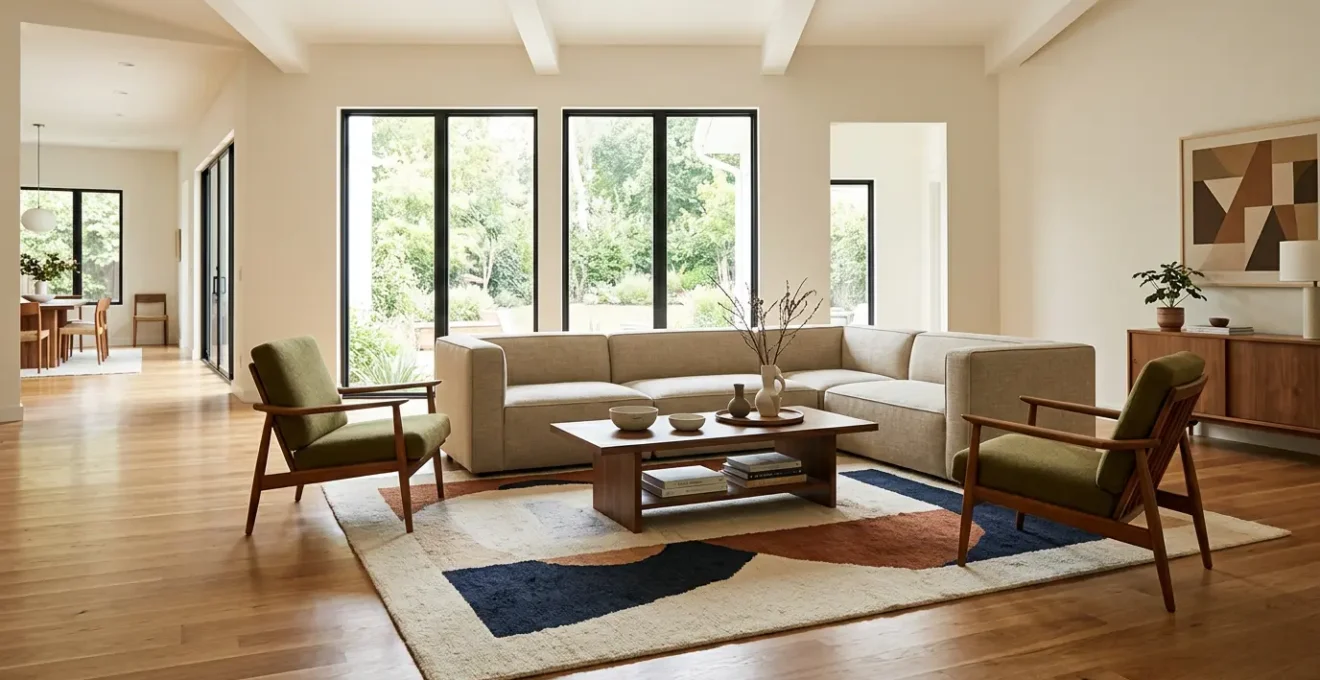
The secret to anchoring floating furniture isn’t just a rug’s size, but its ‘Visual Gravity’—the combination of color, texture, and pattern that locks an arrangement in place.
- A rug’s pile height and color density are as critical as its dimensions for creating a stable visual anchor.
- A small, poorly chosen rug (a “postage stamp”) can make a room feel disjointed and up to 30% smaller.
Recommendation: Always select the rug as the foundational element of the room, before paint or other decor, to ensure a cohesive and well-grounded space.
In the vast expanse of an open-plan room, furniture can often feel unmoored, as if it’s drifting in a sea of empty floor space. The common advice is to “get a big rug” to corral the pieces, but this simplistic rule often fails. Homeowners follow the guideline, purchase a large, expensive textile, and find their living area still feels disjointed and incomplete. This floating sensation isn’t just a matter of poor layout; it’s a problem of weak visual physics.
The solution lies beyond mere dimensions. True anchoring is not about just covering the floor; it’s about strategically deploying a rug’s inherent properties to create a strong center of gravity. Most guides focus on the what—the rules of placement—but neglect the why. They tell you to place furniture legs on the rug but don’t explain how the rug’s texture and pattern contribute to the stability of the entire composition.
But what if the key wasn’t simply a bigger rug, but a smarter one? This guide breaks down the specialist principles of anchoring. We will move beyond generic advice to explore the concepts of Visual Gravity and Perceptual Fencing. You will learn not just how to size a rug, but how to select its material, pile, and pattern to create an unshakeable foundation that stops “anchor drift” for good. By treating the rug as the room’s primary anchor, you can transform a floating, undefined area into a purposeful and grounded sanctuary.
This article provides a complete framework, from fundamental sizing rules to advanced concepts of spatial perception, to help you master the art of anchoring your furniture. Explore the sections below to build your expertise from the ground up.
Summary: A Guide to Grounding Your Space
- How to Size a Rug so All Legs Fit Comfortably?
- The “Postage Stamp” Effect: Why Small Rugs Cheapen Large Rooms
- High Pile vs Flat Weave: Which Suits a Dining Room?
- How to Use Rug Pads to Extend Fiber Life by 5 Years?
- Rugs vs Heated Floors: Which Warms a Modern Living Room Best?
- The Furniture Placement Error That Wastes 20% of Your Floor Space
- Why Should You Pick the Rug Before the Paint Color?
- Why Are Flatweave Kilim Rugs the Best Choice for High-Traffic Homes?
How to Size a Rug so All Legs Fit Comfortably?
The foundational rule of anchoring a floating furniture arrangement is correct sizing. An improperly scaled rug fails to create a cohesive “island,” leaving furniture pieces feeling disconnected. The primary goal is to select a rug large enough to unify the entire seating group. As a baseline, the rug must be substantial enough to have at least the front legs of all sofas and chairs resting comfortably on its surface. This single act connects each piece to a shared foundation, instantly stopping the drift.
For a truly grounded feel, however, the ideal scenario is a rug that accommodates all four legs of every major furniture piece within the arrangement. This creates a definitive zone. To achieve this without the rug appearing like wall-to-wall carpeting, you must maintain a perimeter of exposed flooring. Professional guidelines suggest leaving a border of at least 18 to 24 inches of bare floor between the edge of the rug and the walls of the room. This negative space is crucial; it frames the furniture grouping and allows the room to breathe, preventing a cramped feeling.
Sizing isn’t just about measurements; it’s also about perception. The rug’s visual weight—determined by its color and pile—influences how large it needs to be. A dark, high-pile rug has more Visual Gravity and can feel like a solid anchor even at a slightly smaller size (e.g., 8’x10′). Conversely, a light-colored, low-profile rug may need to be larger (e.g., 9’x12′ or more) to achieve the same grounding effect in the same space. Always consider the rug’s character, not just its dimensions.
Action Plan: Your Rug Sizing Checklist
- Measure the Grouping: Arrange your furniture as desired, then measure the total length and width of the occupied space. The rug should be large enough to fit all furniture legs, or at minimum, the front legs of every piece.
- Apply the Bare Floor Rule: Subtract the recommended 18-24 inch border from your room’s dimensions. This gives you the maximum size for your rug, ensuring it doesn’t overwhelm the space.
- Assess Visual Weight: For the same furniture group, a dark or high-pile rug can be on the smaller end of your acceptable range, while a light or flatweave rug should be on the larger end to provide sufficient grounding.
- Check for Symmetry: If anchoring a floating sectional, center the rug underneath the entire configuration. The goal is to have an equal border of rug visible on all sides of the sectional for a balanced, intentional look.
- Confirm Clearance: Ensure the chosen size does not interfere with door swings or cover floor vents. The rug must define the space without disrupting the room’s core functions.
By following these steps, you move from guessing to a strategic, rule-based approach that guarantees your rug will serve as a powerful and effective anchor.
The “Postage Stamp” Effect: Why Small Rugs Cheapen Large Rooms
One of the most common and detrimental errors in an open-plan space is using a rug that is too small for the furniture grouping. This creates the “postage stamp” effect—a tiny island of textile floating under a coffee table, completely disconnected from the surrounding seating. Rather than anchoring the room, this visually fragments the floor, making the entire space feel smaller and less cohesive. It is a design choice that actively works against the goal of creating a unified, grounded area.
This mistake cheapens a room’s appearance because it breaks the visual flow. As the Amer Rugs Design Team notes, this disjointedness is a critical psychological barrier to comfort. In their guide, “The Psychology of Rug Placement for a Cozy Living Room,” they state:
A rug that is too small for the room can make the space feel disjointed and incomplete.
– Amer Rugs Design Team, The Psychology of Rug Placement for a Cozy Living Room
Design research confirms this perceptual impact. Studies show that positioning a small rug only under a coffee table can make a space feel up to 30% smaller than its actual dimensions. The eye is drawn to the small, isolated shape, which contracts the perceived scale of the room. The solution is to use an appropriately sized rug that creates visual continuity, drawing the eye outward and generating an illusion of expanded floor space.
However, what if a single, massive rug is outside your budget? A sophisticated and cost-effective solution is strategic layering. By placing a larger, inexpensive natural fiber rug (like jute or sisal) as a base, you can establish the necessary scale. Then, a smaller, more vibrant or patterned rug can be layered on top to add color, texture, and personality. This technique achieves the anchoring effect of a large rug while allowing for more creative expression.
This layering approach correctly anchors the furniture, with the front legs of the sofa resting on the layered combination. It solves the “postage stamp” problem by creating a sufficiently large foundation, proving that intelligent design can overcome budgetary constraints.
Ultimately, the size of your rug’s footprint must be proportional to your furniture’s footprint. Anything less will shrink your room and leave your design feeling unresolved.
High Pile vs Flat Weave: Which Suits a Dining Room?
Once sizing is determined, the next critical decision is the rug’s construction, specifically its pile height. The choice between a plush, high-pile rug and a dense, flatweave rug fundamentally alters the Visual Gravity of your floating arrangement. This is especially crucial in a functional space like a dining room, where practicality must meet aesthetics. A high-pile or shag rug has immense visual weight; its texture absorbs light and sound, creating a deep, cozy anchor ideal for a lounge or bedroom. However, this same quality makes it impractical for a dining area, as chair legs will sink and snag, and cleaning up spills becomes a nightmare.
A flatweave rug, such as a Kilim or a Dhurrie, offers the opposite properties. It has a low visual gravity, presenting a crisp, graphic plane on the floor. Its lack of pile means chairs can slide easily, making it the superior functional choice for a dining room. Furthermore, the tight weave showcases intricate patterns with clarity, allowing the rug to create a strong “Perceptual Fence” that defines the dining zone without adding physical bulk.
The interaction between the rug and furniture legs is a key consideration. A high-pile rug can obscure delicate or slender furniture legs, adding a sense of heaviness to the entire arrangement. A flatweave rug, in contrast, allows the design of the chair and table legs to remain visible, maintaining the lightness and airiness of the furniture design. The following comparison breaks down these anchoring properties.
This table, based on an analysis of rug construction properties, clarifies the distinct roles each type plays in grounding a space.
| Property | High-Pile Rugs | Flatweave Rugs |
|---|---|---|
| Visual Gravity | High—absorbs light and sound, creates strong cozy anchor ideal for lounge areas | Low—offers graphic, defined plane, maintains visual crispness |
| Furniture Leg Interaction | Obscures delicate or intricate furniture legs (e.g., Mid-Century Modern), adds visual heaviness | Showcases furniture legs, maintains overall lightness of arrangement |
| Pattern Perception | Blended colors anchor through block of color and softness | Crisp geometric patterns create strong lines, excellent for ‘fencing in’ floating arrangements |
| Best Use for Floating Furniture | Intimate conversation areas, bedrooms, low-traffic lounges | Dining rooms, high-traffic areas, spaces requiring chair mobility |
| Pile Height | Over 1/4 inch—soft, bouncy, luxurious feel | No pile—flat, durable, easy furniture movement |
For a floating dining arrangement, the verdict is clear: a flatweave rug provides the necessary visual boundary and durability without sacrificing the mobility essential to the space.
How to Use Rug Pads to Extend Fiber Life by 5 Years?
The rug itself is only half of the anchoring equation. The unseen element—the rug pad—is the true workhorse that locks the foundation in place, prevents “anchor drift,” and can significantly extend the life of your textile. A rug placed directly on a hard surface like wood or tile will inevitably shift and slide, no matter how heavy the furniture on top. This constant, subtle movement creates friction that wears down the rug’s fibers from below. A quality rug pad provides a gripping layer that stops this movement, protecting the rug’s structure and potentially adding five or more years to its lifespan.
Beyond preservation, the pad plays a vital role in enhancing a rug’s anchoring power. It adds a layer of cushioning and heft, increasing the rug’s overall perceptual weight. This makes the entire furniture island feel more substantial and permanently fixed. The choice of pad must be tailored to the rug type to be effective. For a flatweave rug, a thin, grippy rubber pad is essential. It secures the rug without adding unnecessary bulk, maintaining the sharp lines needed for a strong “Perceptual Fence.” This combination is crucial for keeping a floating arrangement visually crisp and secure.
For low-to-medium pile rugs, a thicker, felted pad is a better choice. It adds a luxurious, cushioned feel underfoot and provides more substantial sound dampening, enhancing the rug’s contribution to the room’s “Sensory Warmth.” For very high-pile or shag rugs, a medium-density pad offers the best of both worlds, providing grip and cushioning without being so thick that it compresses and flattens the plush fibers. Proper installation is the final step: the pad should always be cut about one inch smaller than the rug on all sides. This ensures the pad remains completely hidden while allowing the rug’s edges to taper down to the floor, creating a clean, professional finish.
Ultimately, a rug without a pad is an incomplete anchor. It is an investment that protects your primary investment while perfecting its function.
Rugs vs Heated Floors: Which Warms a Modern Living Room Best?
In modern design, which often features hard surfaces like concrete, tile, or polished wood, the question of warmth is paramount. While radiant-heated floors provide literal, thermal warmth, they fail to deliver the complete comfort that a well-chosen rug offers. The warmth a rug provides is not just about temperature; it’s about a broader, more psychological concept of Sensory Warmth. This encompasses acoustic comfort, textural softness, and visual stability—qualities that heated floors alone cannot replicate.
The most significant contribution a rug makes in a modern living room is acoustic dampening. Hard surfaces create an environment where sound waves bounce and reverberate, resulting in echo and a cold, sterile feeling. A thick rug acts as a powerful sound absorber. Research on spatial perception shows that rugs can reduce sound reverberation by up to 30%, creating an auditory calm and sense of intimacy. This acoustic buffering is especially critical in a floating furniture arrangement, where a large central expanse of exposed, hard flooring would otherwise amplify every sound. The resulting quietness is a key component of a room’s perceived warmth and comfort.
Furthermore, a rug provides textural warmth. The softness underfoot offers a tactile contrast to the unyielding nature of hard flooring, a sensory cue that signals comfort and relaxation. This physical softness also translates into visual softness, breaking up the monolithic plane of the floor and adding a layer of visual interest and depth. Even with heated floors, a room can still feel stark and unwelcoming without the textural and acoustic benefits of a textile anchor. The rug’s role as an “unsung hero” is to ground the space not just visually, but sensorially.
For a truly warm and inviting modern living room, a rug is not redundant on top of heated floors; it is an essential partner that provides the sensory layers of comfort that technology alone cannot.
The Furniture Placement Error That Wastes 20% of Your Floor Space
Before even considering a rug, it’s crucial to address the most common layout mistake in large or open-plan rooms: “wall-hugging.” This is the instinctive tendency to push all furniture—sofas, chairs, consoles—up against the walls. While it seems logical to maximize the open area in the middle, this practice is counter-productive. It creates a vast, unused “dead zone” in the center of the room, disrupts functional traffic flow, and paradoxically makes the room feel awkward and smaller than its actual dimensions. Design analysis reveals this wasted central area can account for over 20% of the total floor space.
The solution to wall-hugging is the “Floating Anchor” technique. This involves pulling the furniture away from the walls to create a functional island in a more central location. This is where the rug becomes the critical tool. By placing a correctly sized rug away from the walls, you create a definitive platform—an anchor—upon which to build your furniture arrangement. This approach reclaims the dead zone, transforming it into a purposeful conversation area. More importantly, it establishes clear and logical circulation paths around the perimeter of the furniture grouping.
As the floor plan above demonstrates, the floating arrangement on the right creates a much more dynamic and usable space than the static, wall-hugging layout on the left. To ensure this floating island remains functional, you must maintain adequate clearance for walkways. Ergonomic design standards require a minimum of 18 to 24 inches of clear space for minor traffic paths, with major thoroughfares needing up to 36 inches. The edge of your anchor rug helps to visually enforce these pathways, guiding movement through the space naturally.
Embrace the float. By pulling your furniture off the walls and onto a well-defined rug anchor, you create a space that is more intimate, functional, and visually expansive.
Why Should You Pick the Rug Before the Paint Color?
Many interior design projects start with a paint swatch, but this is a strategic error. A “ground-up” design methodology, which prioritizes the rug as the first selection, is a far more effective approach to creating a cohesive and anchored space. As Alinta, Senior Designer at King Living, emphasizes, the floor is the room’s true foundation. In their “Rug Placement: A Designer’s Guide,” the point is made clearly:
The floor sets the tone of a room. It’s a such large surface area yet often overlooked in its ability to shape how we respond to a space.
– Alinta (King Living Senior Designer), Rug Placement: A Designer’s Guide to Layout and Size
A rug is a piece of art for the floor, often containing complex patterns and multiple hues. It is infinitely easier to pull one of these many colors from a rug to use for the walls than it is to find a complex textile that perfectly matches a pre-selected, single-color paint chip. There are thousands of paint colors available, but the perfect rug is a far more limited and defining element. By choosing the rug first, you are establishing the entire room’s color palette from the outset. Walls, pillows, throws, and artwork can then be selected to complement the foundational colors and patterns established by the rug.
Case Study: The Ground-Up Design Methodology
Interior design experts at Apartment Therapy champion a “ground-up” approach for both aesthetic and practical reasons. They recommend prioritizing the rug purchase even before acquiring furniture. This prevents the significant logistical challenge of maneuvering heavy sofas and tables to lay a rug later. From a design perspective, the rug serves as the foundational color palette and pattern source. Designers pull accent colors directly from the rug’s weave for walls, pillows, and art. This ensures a deeply cohesive, anchored result, in contrast to the often-frustrating process of trying to retrofit a rug into a pre-existing, and potentially disconnected, color scheme.
This methodology ensures that the rug doesn’t become an afterthought. Instead, it becomes the central, unifying element from which all other design choices radiate. It’s the difference between forcing a piece to fit and building a harmonious composition around a strong focal point.
Treating the rug as the cornerstone of your design guarantees a level of cohesion that is difficult to achieve when it is one of the last items chosen.
Key Takeaways
- Size for Unity: A rug must be large enough to have at least the front legs of all furniture pieces on it to create a unified anchor.
- Respect the Border: Always leave 18-24 inches of bare floor between the rug and the walls to frame the space and prevent a cramped look.
- Master Visual Gravity: A rug’s anchoring power comes from its color, pattern, and pile height, not just its dimensions. Darker, plusher rugs have more visual weight.
Why Are Flatweave Kilim Rugs the Best Choice for High-Traffic Homes?
When all the principles of anchoring are considered—durability, clear pattern, and functional surface—one style of rug consistently emerges as a superior choice, especially for high-traffic areas: the flatweave Kilim. Kilims are not just decorative; they are engineered with properties that make them exceptional tools for creating Perceptual Fencing and a strong center of gravity. Their no-pile construction makes them incredibly durable and easy to clean, a non-negotiable trait for areas like entryways, dining spaces, or main living room thoroughfares.
The true genius of a Kilim as an anchor lies in its signature patterns. These rugs often feature strong geometric borders and prominent central medallions, which are powerful visual cues for furniture placement and spatial definition. These features provide a clear blueprint for creating a grounded arrangement:
- Geometric Borders as a ‘Visual Fence’: The strong, crisp lines of Kilim borders create an unambiguous boundary. This visual fence is exceptionally effective at defining the zone for floating furniture and clearly delineating it from essential walkways.
- Central Medallion as a ‘Center of Gravity’: Many Kilims have a bold central medallion that acts as a natural focal point. This provides an intuitive center around which to arrange a sofa and chairs, reinforcing the anchor effect and creating a balanced composition.
- Reversible for Longevity: A unique advantage is that most Kilims are reversible, often with slight color or pattern variations between the two sides. This allows you to refresh the look of your anchored space seasonally without changing the core layout, adding incredible long-term value.
- Flatness for Mobility: The complete lack of pile means dining chairs and office chairs slide smoothly without catching. This makes Kilims the ideal choice for any high-use floating furniture arrangement that requires frequent movement.
The Kilim is the embodiment of form meeting function. It solves the practical demands of a high-traffic home while providing the exact visual tools needed to create a perfectly defined and powerfully anchored floating furniture arrangement.
By selecting a Kilim that is correctly sized for your space, you are not just choosing a rug; you are deploying a sophisticated design tool engineered for anchoring.