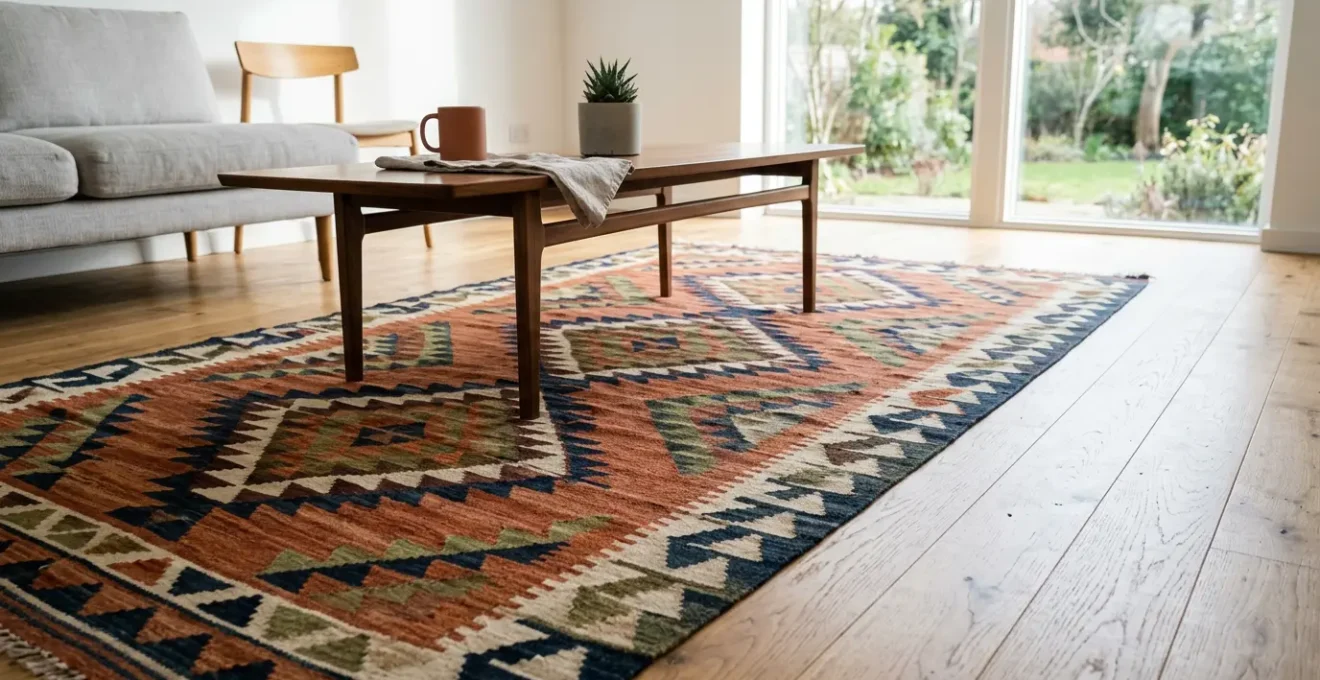
The ideal rug for a busy home with pets and children isn’t a thick, plush carpet, but a thin, ancient flatweave kilim.
- Its tight, no-pile construction means dirt and spills sit on the surface, making it exceptionally easy to clean.
- The dense weave is engineered for extreme durability, resisting the crushing and matting that ruins high-pile rugs under furniture and foot traffic.
Recommendation: Choose a kilim not just for its beauty, but as a piece of practical textile technology designed to withstand the realities of modern family life.
For homeowners with children, pets, and a constant flow of foot traffic, the search for the perfect rug often feels like a frustrating compromise. You crave the warmth, color, and style that a rug brings to a room, but you live in fear of the inevitable spills, stains, and wear that will quickly destroy a precious investment. The conventional wisdom often points toward disposable, low-cost synthetic rugs or dark, busy patterns designed to hide a multitude of sins. We accept that beauty and durability are mutually exclusive.
But what if this entire premise is wrong? What if the most practical, resilient, and forgiving rug for a chaotic modern home is not a product of modern manufacturing, but an ancient textile technology perfected over centuries? The flatweave kilim, often admired for its bold geometric patterns and rich history, is frequently overlooked in the durability conversation. Many assume its thinness equates to fragility. In reality, the opposite is true.
This guide will deconstruct the kilim, moving beyond its aesthetic appeal to reveal its structural genius. We will explore it not as a mere decorative object, but as a piece of functional art, where every element of its design—from the weave structure to the symbolic motifs—contributes to a level of resilience that high-pile rugs simply cannot match. You will learn why a kilim is not a compromise but is, in fact, the most logical and elegant choice for a home that is truly lived in.
This article explores the practical and cultural reasons that make flatweave kilims a superior choice for busy households. The following sections will guide you through everything from maintenance and identification to advanced styling techniques.
Summary: Why a Flatweave Kilim Is the Ultimate Rug for a High-Traffic Home
- How to Remove Red Wine Stains From Wool Kilims?
- The Slip Risk: Which Rug Pad Actually Holds a Flatweave in Place?
- Anatolian vs Persian: How to Identify the Origin by Geometric Motifs?
- How to Fix a Hole in a Kilim Weave Before It Unravels?
- How to Layer a Kilim Over Sisal for a Boho Luxe Look?
- High Pile vs Flat Weave: Which Suits a Dining Room?
- French vs Baltic Linen: Is There a Tangible Difference in Quality?
- Which Rug Designs Best Anchor Floating Furniture Arrangements?
How to Remove Red Wine Stains From Wool Kilims?
The moment a glass of red wine topples onto a rug is a universal moment of panic. With most rugs, this is a near-certain disaster. Yet, this is where the material science of a wool kilim reveals its first advantage. Wool fibers contain natural lanolin, a waxy substance that provides a temporary barrier against liquids. However, research on wool fiber structure reveals that this natural liquid-repellent effect is short-lived; you must act quickly before the wine penetrates the fiber’s core. Unlike a plush rug that absorbs the spill instantly and traps it deep within its pile, a flatweave kilim keeps the spill on the surface for a crucial few moments.
The key is immediate, correct action. Never rub the stain, as this grinds the pigment into the wool. Instead, a combination of blotting and absorption is the historically proven method. The following steps use common household items to counteract the stain before it sets.
- Blot Immediately: Use a clean, white cotton or paper towel. Press down firmly on the spill to absorb as much liquid as possible. Lift, and repeat with a clean section of the towel. Do not scrub.
- Apply Salt: Generously cover the entire stain with a mound of regular table salt. Salt is hygroscopic, meaning it naturally draws moisture out of the wool fibers. You will see the salt turn pink as it works.
- Wait and Vacuum: Let the salt sit for at least 30-60 minutes. Once it has done its work, vacuum it up using a suction-only attachment. Never use a beater bar or rotating brush on a kilim, as it can snag the weave.
- Blot with Solution: If a faint stain remains, mix one cup of lukewarm water with one tablespoon of white vinegar and a few drops of clear dish soap. Dampen a white cloth with this solution and gently blot the area. Do not pour the liquid directly onto the rug.
- Rinse and Dry: Finally, blot the area with a separate cloth dampened with plain cold water to rinse. Dry the spot thoroughly by pressing down with a dry towel, then allow it to air dry completely, away from direct sunlight.
The Slip Risk: Which Rug Pad Actually Holds a Flatweave in Place?
The most significant practical downside of a lightweight flatweave kilim is its tendency to shift, bunch, and slide on a hard floor. This isn’t just an annoyance; it’s a slipping hazard, especially in high-traffic areas. The solution is a rug pad, but not all pads are created equal. Choosing the wrong one can be ineffective at best and damaging to your floors at worst. The most common mistake is opting for a cheap, grid-like PVC pad. While they offer some grip, flooring safety analysis shows that PVC pads contain plasticizers that can leach out over time, chemically reacting with floor finishes like polyurethane and vinyl, causing permanent yellowing and discoloration.
A high-quality rug pad is an investment in safety, floor protection, and comfort. The ideal pad for a kilim is a dual-surface model that combines two distinct materials: a dense felt layer and a natural rubber backing. Each side serves a specific, engineered purpose.
As the image above illustrates, the upper surface is a dense, heat-pressed felt. This material is designed to grip the textile fibers of the kilim itself, almost like Velcro, holding it firmly in place and preventing it from wrinkling. The bottom layer is made of solid natural rubber, not PVC or plastic. This rubber provides a strong, non-slip grip on the hard floor without relying on sticky adhesives or damaging chemicals. This two-part system provides stability, adds a subtle layer of cushioning underfoot, and protects both your rug and your floors for the long term.
Anatolian vs Persian: How to Identify the Origin by Geometric Motifs?
While often grouped together, Anatolian (Turkish) and Persian (Iranian) kilims represent distinct weaving traditions with unique visual languages. For the textile historian, identifying a kilim’s origin is a matter of reading its patterns, colors, and weaving techniques. Persian kilims, influenced by sophisticated court workshops, often feature more curvilinear, intricate floral patterns and central medallions. Their designs can feel more narrative and flowing.
Anatolian kilims, by contrast, are born from tribal and village traditions. Their designs are bolder, more geometric, and deeply symbolic. The patterns are not merely decorative; they are ancient talismans and expressions of the weaver’s life, beliefs, and heritage. These motifs are passed down through generations, often woven from memory.
Case Study: The Elibelinde Motif of Anatolia
One of the clearest identifiers of an Anatolian kilim is the Elibelinde (hands on hips) motif. As detailed in ethnographic studies of kilim symbolism, this powerful, stylized female figure represents the mother goddess, a universal symbol of fertility, birth, and abundance. Its presence is a direct link to the Neolithic mother goddess cults of ancient Anatolia. Finding this strong, angular symbol is a near-certain sign that you are looking at a Turkish kilim, as it is not part of the traditional Persian design lexicon. It transforms the rug from a floor covering into a piece of cultural history.
The following table breaks down the core differences, helping you to identify the heritage of a flatweave rug.
| Characteristic | Anatolian (Turkish) Kilims | Persian Kilims |
|---|---|---|
| Motif Style | Bold geometric patterns, symbolic and talismanic (e.g., Elibelinde, ram’s horn) | Intricate floral designs, medallions, narrative and court-influenced |
| Weaving Tradition | Tribal/village weaving, patterns passed from memory, intentional imperfections as weaver’s signature | Mix of tribal and workshop pieces, more structured designs, higher refinement in some types |
| Color Palette | Rich reds from madder root, deep blues from indigo—reflecting Anatolian botanical resources | Pomegranate and weld yellows, broader palette reflecting Persian regional diversity |
| Weaving Technique | Slit-weave technique with visible vertical gaps between color blocks—prized for sharp patterns | Often uses dovetailing or interlocking techniques to avoid slits, resulting in smoother color transitions |
| Texture | Crisp, sharp-edged designs due to slit-weave | Smoother, more uniform texture with high-quality wool |
How to Fix a Hole in a Kilim Weave Before It Unravels?
A kilim’s flatweave structure is incredibly durable, but not indestructible. A sharp object, a pet’s claw, or simple age can sometimes break the threads, creating a hole. The primary danger isn’t the hole itself, but the potential for it to unravel. A kilim is constructed of vertical “warp” threads that form the foundation and horizontal “weft” threads that create the color and pattern. If the weft threads are severed, they can create a “zipper effect,” causing the weave to rapidly come undone along the stable warp threads.
Immediate stabilization is critical. While a professional re-weaving is the best solution for a valuable or heavily damaged rug, you can perform an emergency intervention to prevent further damage. The goal is not to perfectly repair the pattern, but to secure the edges of the hole and stop the unraveling. Crucially, never use a sewing machine, as its mechanical stitching will perforate and destroy the surrounding warp threads, causing irreparable harm.
Instead, use a strong upholstery thread and a needle to perform a manual tacking stitch. This temporary fix, outlined in guides for antique rug preservation, stabilizes the structure.
- Assess the Damage: First, look closely. Is it just the colorful weft threads that are broken, or are the foundational warp threads also torn? If the warp is compromised, professional help is essential.
- Secure the Perimeter: Using a strong upholstery thread (not regular sewing thread), begin stitching around the edge of the hole.
- Follow the Weave: Pass the needle by hand, following the path of the existing weft threads, going over and under the intact warp threads surrounding the hole.
- Tack it Down: Create small, secure tacking stitches that anchor the loose weft threads to the stable warp, effectively creating a barrier that stops the “zipper effect”.
- Tie Off Securely: Continue this process around the entire perimeter of the hole and tie off the thread securely on the back of the rug. This buys you time to schedule a proper, professional repair without the risk of the damage spreading.
How to Layer a Kilim Over Sisal for a Boho Luxe Look?
One of the most sophisticated ways to style a kilim is by layering it over a larger, neutral rug. This technique adds depth, texture, and a deliberate, designer feel to a room. The most effective combination is layering a vibrant, geometric kilim over a natural fiber base rug, such as sisal, jute, or seagrass. This pairing creates a powerful textural contrast: the soft, colorful wool of the kilim against the rustic, woven texture of the sisal.
The key to a successful layered look is proportion. The kilim should not look like a random afterthought. It must be positioned with intention to create a cohesive whole. The base rug (the sisal) should be large enough to define the entire seating or dining area, with a substantial border visible around the smaller kilim. A general rule of thumb is to maintain an 18-to-24-inch border of the base rug on all sides of the top rug. This creates a “frame” effect that makes the layering feel purposeful and anchors the entire arrangement.
This approach offers several practical benefits beyond aesthetics. The large sisal rug protects a wider area of your flooring, while the kilim adds a splash of color, pattern, and comfort exactly where it’s needed most—underfoot in a seating area or beneath a coffee table. It also solves the problem of a beloved kilim being too small to anchor a large room on its own. By layering, you give it the scale and presence it needs to make a powerful design statement.
High Pile vs Flat Weave: Which Suits a Dining Room?
The dining room is one of the most challenging environments for a rug. It combines high foot traffic with the constant scraping of chair legs and the high probability of food spills. Many people default to a high-pile rug for a sense of luxury, but this is a significant functional mistake. A plush rug in a dining room quickly becomes a source of frustration and a hygiene concern. The pile creates resistance, making it difficult to slide chairs in and out, and the pressure from chair legs creates permanent, unsightly crushed dents in the fibers.
Even more concerning is cleanliness. Crumbs, spills, and dust become embedded deep in the base of a high-pile rug, making them nearly impossible to vacuum out completely. This creates a trap for allergens and bacteria. A flatweave kilim, on the other hand, is structurally engineered to solve every one of these problems. Its no-pile surface allows chairs to glide smoothly, and its dense weave is incredibly resistant to crushing or matting. Most importantly, debris sits on top of the flat surface, where it can be easily swept or vacuumed away.
The table below provides a direct comparison of how each rug type performs under the specific pressures of a dining room environment.
| Performance Factor | High-Pile Rugs | Flatweave Kilim Rugs |
|---|---|---|
| Chair Mobility | Chair legs catch and drag on pile, causing frustration and resistance when pulling out chairs | Chairs slide smoothly back and forth with no resistance—ideal for frequent in-and-out movement |
| Pile Compression | Chair leg pressure permanently crushes and mats the pile, creating unsightly dents that are difficult to restore | Flat weave structure resists compression entirely—no matting or denting occurs |
| Cleaning & Maintenance | Food crumbs and debris become embedded deep in pile base, difficult to vacuum completely, creating hygiene issues | Debris sits on flat surface, easy to sweep or vacuum with suction-only setting |
| Durability in High-Traffic | Pile shows wear patterns and crushing in main traffic paths | Excellent for high-traffic areas, often reversible to extend lifespan |
| Acoustic Properties | Can over-deaden room sound, making conversation feel muffled | Absorbs harsh echoes while maintaining natural conversation clarity |
French vs Baltic Linen: Is There a Tangible Difference in Quality?
While our focus is on the robust world of wool kilims, a brief aside into the world of linen offers a valuable lesson in textile appreciation. As a textile historian, I’m often asked if the origin of a fiber—like French versus Baltic linen—truly matters. The answer is yes, and the principles behind it apply directly to how we should evaluate the quality of a kilim.
The quality of any natural fiber is determined by its “terroir”—the soil, climate, and agricultural traditions of the region where it was grown. French linen, particularly from Normandy, is prized because the region’s unique oceanic climate, rich soil, and generations of farming expertise produce exceptionally long, strong flax fibers. This results in a fabric that is both more durable and becomes softer with each wash. Baltic linen is also of high quality, but the different growing conditions can result in slightly different fiber characteristics.
This concept of provenance and terroir is just as critical in the world of kilims. An Anatolian kilim’s quality is a direct result of its environment. The hardiness of the wool comes from sheep grazing on rugged mountain pastures. The richness of its colors comes from dyes derived from local botanical resources, like madder root for deep reds and indigo for vibrant blues. The patterns themselves are a form of cultural terroir. Therefore, just as a connoisseur can distinguish between types of linen, an informed eye can see the history and environment of a region woven directly into the fibers of a kilim.
Key Takeaways
- A kilim’s flatweave structure is a feature, not a flaw, making it inherently more durable and easier to clean than high-pile rugs.
- The right rug pad (felt + natural rubber) is non-negotiable for preventing slips and protecting floors.
- Anatolian and Persian kilims have distinct design languages; recognizing their motifs tells a story of their origin.
Which Rug Designs Best Anchor Floating Furniture Arrangements?
One of the most common interior design challenges is the “floating” furniture arrangement, where a sofa and chairs are placed in the middle of a large room rather than against the walls. Without a proper anchor, the furniture can look lost and the space can feel disjointed. A well-chosen rug is the single most effective tool for solving this problem, creating a defined “zone” that unifies the grouping. A kilim, with its strong geometric patterns, is exceptionally well-suited for this task.
The key is to select a pattern that actively helps create a sense of order and gravity. Random or abstract patterns can sometimes add to the visual chaos. In contrast, traditional kilim motifs offer a time-tested toolkit for creating structure. For instance, a kilim with a strong central medallion provides an undeniable focal point. By placing your coffee table directly over the medallion, you create a visual center of gravity that the rest of the furniture can orient around.
Similarly, kilims with powerful, high-contrast borders act as a “frame” on the floor. The rule is simple: ensure at least the front legs of all furniture pieces in the grouping are placed inside this frame. This visually contains the arrangement and makes it feel intentional and cohesive. The pattern of the rug is no longer just decoration; it becomes a functional tool for architectural definition.
Action Plan: Auditing Your Rug’s Anchoring Potential
- Identify the Focal Point: Does your kilim have a central medallion or a dominant, repeating motif? This is your natural center of gravity. Position your main element (like a coffee table) on it.
- Assess the Border: Examine your kilim’s border. Is it strong and distinct? Use it as a visual container, ensuring all primary furniture pieces have their front legs on the rug, inside the border.
- Analyze Directionality: Does the pattern have clear stripes or a linear flow? Orient these lines to your advantage—perpendicular to a room’s short walls to create an illusion of width, or parallel to long walls to enhance length.
- Evaluate Pattern Density: If you have an asymmetrical furniture layout, a kilim with a dense, all-over pattern (like a Herati design) can be ideal. It creates a unified visual field that ties disparate elements together without demanding a single, rigid focal point.
- Check for Cohesion: Step back. Does the rug successfully unify the furniture into a single, cohesive conversation area? If not, adjust the furniture placement to better align with the rug’s inherent geometric structure.
Ultimately, a kilim rug is more than just a durable, practical choice for a high-traffic home. It is a piece of living history, a testament to a textile technology perfected to be both beautiful and resilient. By understanding its structure, its language, and its proper care, you are not just decorating your home—you are becoming a custodian of a timeless art form. To start your journey, the first step is to assess your space and needs to select a kilim that will serve you for years to come.