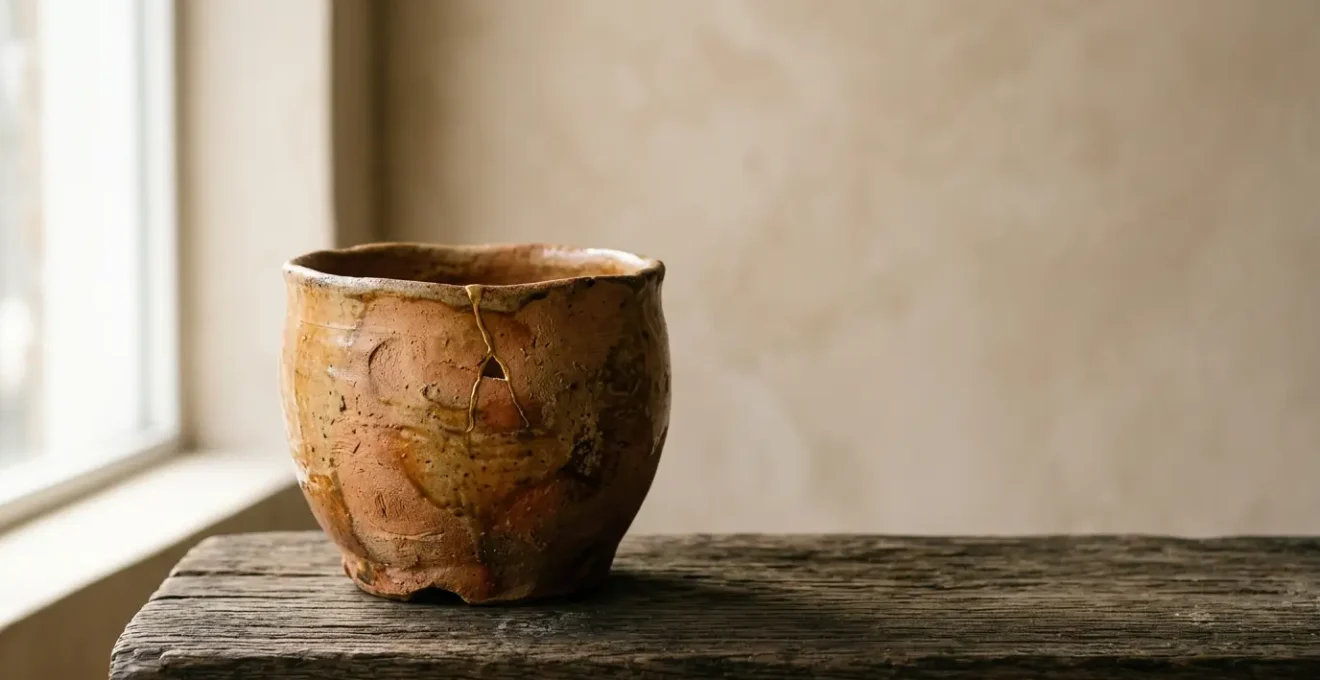
Contrary to belief, the higher price of a ‘flawed’ handcrafted item isn’t for a mistake; it’s a premium for a verifiable story and a human connection that mass-production cannot fake.
- Imperfections are not defects but the “Signature of the Hand,” a tangible proof of authenticity and the artisan’s unique process.
- The cost includes a “Narrative Premium”—you’re buying the artist’s time, skill, failures, and the philosophy embedded in the object.
Recommendation: Shift your perspective from viewing wabi-sabi objects as merely functional items to seeing them as investments in art, ethics, and a tangible piece of human history.
You see it on a shelf: a ceramic mug, slightly asymmetrical, its glaze uneven. It’s beautiful, but undeniably imperfect. Then you see the price tag: $50. The immediate reaction for many is confusion. Why would a “flawed” object cost significantly more than a perfectly uniform, mass-produced equivalent? The common answers—citing labor hours and material costs—only tell part of the story. They address the “how” but miss the philosophical “why” that truly justifies the value. We’re conditioned to see perfection as the standard of quality, making the premium on imperfection seem illogical.
This article moves beyond the surface-level economics of handmade goods. We will not just repeat that “it takes time.” Instead, we will explore the deeper value system at play, rooted in concepts like wabi-sabi and the growing demand for authenticity in an increasingly automated world. The core idea is a radical shift in perspective: the flaw is not a bug; it’s a feature. It is the Signature of the Hand, a non-forgeable token of human creation. The extra cost is a “Narrative Premium” for the story, the process, and the irreplaceable human touch embedded within the object.
Through this lens, we’ll deconstruct the real value proposition of handcrafted items. We will explore how to verify genuine artisanship, how to care for materials that are designed to age, and why celebrating imperfection through practices like Kintsugi turns damage into a beautiful history. We will also analyze the tangible economic and environmental benefits of supporting this ecosystem, ultimately demonstrating that when you buy a wabi-sabi object, you’re acquiring far more than just a thing—you’re participating in a philosophy.
This guide breaks down the essential aspects of understanding and appreciating the value of handcrafted goods. Each section addresses a key question, helping you become a more informed and appreciative collector.
Summary: Why Do Handcrafted Objects with “Wabi-Sabi” Flaws Cost More?
- How to Verify if “Handmade” Actually Means Ethically Produced?
- How to Care for Unsealed Terracotta Without Staining It?
- The “Power of One”: When to Display a Single Object in Isolation
- Kintsugi Repair: Is Gold Repair Suitable for Daily Use Ceramics?
- Why Buying Direct From Artisans Supports Local Economies Better Than Retail?
- Why Does Local Sourcing Beat Organic Import on Carbon Impact?
- DIY vs Commission: Is It Cheaper to Knot Your Own Wall Hanging?
- How to Use Macramé Installations to Soften Acoustics in Echoey Rooms?
How to Verify if “Handmade” Actually Means Ethically Produced?
In a market where “handmade” is a powerful buzzword, discerning genuine craft from clever marketing is the first step to understanding its value. An object’s premium price is tied to its story of creation, and that story must be authentic. The term “handmade” should signify not just that a person was involved, but that the process was defined by skill, intention, and ethical practices. True artisanship leaves a “Signature of the Hand”—unique irregularities that a machine cannot replicate. These are not defects but markers of authenticity.
Verifying these claims involves moving from passive consumer to active investigator. It means looking beyond the surface and asking the right questions. While authentication experts note that technologies like blockchain and QR codes are emerging for traceability, the most reliable tools are still your own senses and curiosity. An artisan with nothing to hide will welcome questions about their process, their material sources, and even their failures, as each is part of the object’s unique history. A suspiciously low price or vague answers are often red flags for mass production disguised as craft.
Ultimately, ethical production and handmade authenticity are two sides of the same coin. An ethically produced item is one where the artisan was paid fairly for their skill and time—a cost that is honestly reflected in the final price. By learning to spot the signs of true craftsmanship, you not only ensure you’re getting what you paid for but also support a system of transparent and sustainable creation.
Action Plan: Verifying Handmade Authenticity
- Examine for Irregularities: Look for unique variations in size, color, and shape in each piece. Authentic handmade items are never perfectly identical.
- Ask Probing Questions: Inquire about the process, such as “What part takes the longest and why?” or “Can you describe the failure rate?” Genuine artisans provide rich, detailed stories.
- Trace Material Sourcing: Request information on where and how materials were obtained. Authentic makers can trace their supply chain and explain their choices.
- Look for Maker’s Marks: Check for artisan signatures, stamps, or marks. These small details transform an object from generic to accountable and collectible.
- Assess the Price-to-Effort Ratio: If a ‘handmade’ item seems too cheap for the materials and apparent labor, it’s likely mass-produced or unethically sourced.
How to Care for Unsealed Terracotta Without Staining It?
The question itself reveals a common misunderstanding. With materials like unsealed terracotta, the goal isn’t to prevent “stains” but to embrace patina. The very characteristics that make unsealed terracotta beautiful—its porosity, its warmth, its connection to the earth—also mean it will change over time. Water, oils, and minerals will leave their marks, but these aren’t signs of damage. They are chapters in the object’s evolving story. Trying to keep it in a pristine, just-made state is to fight against its fundamental nature.
Caring for unsealed terracotta is therefore an exercise in curation, not preservation. For items like planters or decorative tiles, this means allowing the natural aging process to unfold. The white, chalky efflorescence that appears is simply mineral salts wicking to the surface—a beautiful, organic process. For surfaces that may come into contact with oils, a deep-penetrating sealer can be used, but this permanently alters the material’s appearance and breathability. A more wabi-sabi approach is to accept the marks as part of its character, a record of its use and life within your home. As design experts from Clé Tile note:
unsealed terracotta develops an organic, evolving patina — the very quality that draws many people to the material in the first place
– Clé Tile Design Experts, Terracotta Tile Sealer Guide
To clean, use only water and a soft brush. Avoid harsh chemicals, which can be absorbed and cause permanent discoloration. For grease spots, a poultice of baking soda and water can help draw out the oil. But the most important tool is a shift in mindset: you are not a restorer fighting decay, but a guardian of a living finish. You are cultivating a tangible philosophy of acceptance, where the object’s value increases as it reflects the passage of time.
As this surface shows, the accumulation of mineral deposits and water rings creates a unique, unrepeatable texture. Each mark tells a story, turning a simple clay object into a personal artifact. This process is the physical embodiment of wabi-sabi: beauty that is imperfect, impermanent, and deeply connected to nature.
The “Power of One”: When to Display a Single Object in Isolation
In a world of cluttered shelves and maximalist displays, placing a single object in isolation is a powerful statement. This technique, known as the “Power of One,” is reserved for items that have enough narrative weight, sculptural integrity, and philosophical depth to command a space on their own. A slightly misshapen, handcrafted bowl is a perfect candidate. Its value doesn’t come from being part of a set, but from its standalone story. Displaying it alone invites contemplation and elevates it from a mere utility item to a piece of sculpture.
This approach is deeply rooted in the Japanese aesthetic of wabi-sabi. It is not just about minimalism; it is about creating a “void” of space around an object to give it room to breathe and be seen. The empty space, or “ma,” is just as important as the object itself. It focuses the viewer’s attention on the subtle details: the texture of the clay, the unique way the glaze settled, the slight asymmetry of the rim. These are the “Signature of the Hand” that would be lost in a crowd. By isolating the object, you are asking the viewer to appreciate it for its inherent, imperfect beauty.
The decision to display a single object should be intentional. It works best when:
- The object has a strong, sculptural form.
- The surface has a rich, complex texture or patina.
- The object embodies a story or philosophy you want to highlight.
- The surrounding space is uncluttered, allowing the eye to rest on the piece.
This principle is a direct contradiction to the logic of mass consumption, which encourages accumulation. As the Stanford Encyclopedia of Philosophy entry on wabi-sabi highlights, the concept centers on appreciating what is transient and incomplete. Isolating a single, imperfect piece is a quiet rebellion, a declaration that value lies in character, not quantity.
Kintsugi Repair: Is Gold Repair Suitable for Daily Use Ceramics?
Kintsugi, the Japanese art of repairing broken pottery with lacquer dusted with powdered gold, is perhaps the ultimate expression of wabi-sabi philosophy. Instead of hiding the damage, it illuminates it, suggesting that the object’s history of breakage and repair makes it more, not less, beautiful. However, a crucial distinction exists between authentic Kintsugi and modern, decorative imitations, especially concerning daily use. The answer to whether a gold-repaired item is food-safe depends entirely on the materials used in the repair.
Traditional Kintsugi is a painstaking process that relies on urushi lacquer, a natural sap from the lacquer tree. When fully cured over weeks or months, urushi forms a waterproof, chemical-free bond that is exceptionally strong and completely food-safe. The gold is purely for aesthetic celebration. As professional kintsugi artisans confirm, once urushi has completely hardened, it is not only safe for contact with food but also highly durable and resistant to heat and acids. An object repaired with traditional urushi Kintsugi can be returned to daily use with confidence, its golden seams a testament to its resilience.
This stands in stark contrast to the wave of “Kintsugi-style” DIY kits and repairs that have become popular. These almost universally use modern industrial adhesives like epoxy or super glue, combined with metallic mica powder to mimic the look of gold. These materials are purely decorative and, in most cases, are not food-safe. They can leach chemicals into food, especially when exposed to heat or acidic liquids. The distinction is critical and is a perfect example of the article’s central theme: true value lies in authentic process, not just appearance.
Case Study: Traditional Urushi Kintsugi vs. Modern Epoxy Kits
An analysis of Kintsugi methods reveals a clear divide in safety and durability. A piece repaired with traditional, fully-cured urushi lacquer and pure gold is completely food-safe, durable, and even possesses antibacterial properties. The urushi chemically bonds with the ceramic, creating a join that can be stronger than the original material. In contrast, DIY kits using epoxy or super glue with mica powder are not designed for food contact. These industrial adhesives are not rated for the temperatures or acidity of many foods and drinks, making them suitable only for decorative objects. The “gold” line is a cosmetic effect, whereas in true Kintsugi, it is the celebration of a structural, food-safe repair.
Why Buying Direct From Artisans Supports Local Economies Better Than Retail?
When you purchase a handcrafted object directly from its maker, you are participating in a fundamentally different economic model than traditional retail. The price you pay is not just for a product; it is a direct investment in a person, a skill, and a local community. While retail plays a role in distribution, it introduces multiple layers of intermediaries—distributors, wholesalers, and the retailer itself—all of whom take a significant cut of the final sale price. This dramatically dilutes the financial benefit that reaches the original artisan.
The “Economic of Authenticity” becomes clear when you bypass these layers. By buying direct, a much larger percentage of the money you spend goes straight into the pocket of the person whose hands and creativity brought the object to life. This enables them to sustain their craft, purchase materials from other local suppliers, and spend their earnings within their own community, creating a powerful ripple effect. This is not just a feel-good theory; it is a measurable economic impact. Research shows that the artisan sector is the second largest area of employment in many developing parts of the world, making direct support a crucial driver of stability and growth.
This table illustrates the stark difference in how your money is distributed. A lower price direct from the artisan can often result in them earning more than double what they would through a traditional retail channel.
This comparative analysis breaks down where the money goes when you purchase a product through different channels, showing the direct economic impact of your choice.
| Purchase Channel | Product Price | Artisan Receives | Stays in Local Economy | Corporate Profits |
|---|---|---|---|---|
| Traditional Retail | $100 | $25-30 | ~$30-35 | $65-70 |
| Direct from Artisan | $80 | $70-75 | $75-80 | $0 |
Choosing to buy direct is an economic vote for a more equitable and sustainable system of commerce. It ensures that the value you place on a handcrafted object is directly translated into a living wage for the maker, reinforcing the integrity and vitality of their craft for the future. The higher price of a handmade good suddenly seems far more reasonable when you realize it’s not feeding a corporate machine, but sustaining a human-scaled creative economy.
Why Does Local Sourcing Beat Organic Import on Carbon Impact?
In the hierarchy of conscious consumption, “organic” and “local” are often seen as equally virtuous. However, when it comes to the carbon impact of physical goods—especially heavy items like ceramics, wood, or textiles—”local” almost always wins. The environmental cost of transportation, or “food miles,” is a major, often hidden, factor in an object’s lifecycle. An organically grown cotton throw that has been shipped halfway across the world carries a much heavier carbon footprint than a conventionally grown cotton throw made by an artisan in your own region.
The logic is simple: transportation is one of the largest contributors to greenhouse gas emissions. Air freight is the worst offender, followed by sea, rail, and road. Every mile an object travels adds to its embedded carbon cost. While choosing organic materials is a positive step for reducing pesticide use and promoting soil health at the point of origin, these benefits can be negated by the fuel burned to bring that product to you. Local sourcing shortens the supply chain dramatically, slashing transportation emissions and reducing the need for excessive packaging designed for long-haul transit.
Furthermore, supporting local artisans strengthens the entire creative economy, a sector with significant global weight. A 2021 UNCTAD report reveals that the creative economy, which includes artisanal industries, accounts for 3% of global GDP. By investing in local makers, you are not only making a choice with a lower carbon footprint but also contributing to a resilient, decentralized economic system. This model fosters local skills, reduces dependency on global supply chains, and creates a more sustainable and accountable form of commerce. When faced with the choice, prioritizing proximity is one of the most impactful environmental decisions a consumer can make.
DIY vs Commission: Is It Cheaper to Knot Your Own Wall Hanging?
The allure of DIY is strong. Faced with a $300 price tag for a large macramé wall hanging, it’s natural to think, “I could make that for less.” On the surface, a quick search for materials might seem to confirm this. But this simple calculation ignores the most valuable and often most expensive components of a commissioned piece: the artisan’s time, skill, and the cost of their learning curve. A true cost comparison requires calculating the Total Cost of Ownership for your DIY project, not just the price of a few bundles of cord.
First, consider the material costs accurately. This includes not just the primary cord but also the dowel or branch, mounting hardware, any beads or accents, and shipping. Then, factor in the “failure cost”: first-time projects almost always involve mistakes, wasted materials, and re-dos. A conservative estimate is to budget 20-30% extra for these learning errors. Most importantly, you must assign a value to your time. If it takes you 20 hours to complete the project, what is the opportunity cost of that time? Even at a modest hourly rate, this “labor” cost adds up quickly.
When you commission a piece from an experienced macramé artist, you are not just buying cord and a stick. You are paying for mastery. You are buying the hundreds of hours they have already invested in perfecting their knots, mastering tension, and understanding design principles. You are paying for their efficiency, their access to high-quality or unique materials, and a guaranteed professional result. The image below captures this essence—the practiced, precise movement of hands that have tied thousands of knots.
Often, once you honestly calculate the full cost of materials, tools, your time, and the risk of a subpar result, commissioning the piece from an expert is not only less stressful but can be the better financial value. You are paying a premium to bypass the frustration of the learning curve and receive a flawless, heirloom-quality piece of art.
Key Takeaways
- The premium price of handcrafted items reflects a “Narrative Premium”—the value of the story, skill, and authentic process embedded in the object.
- Imperfections are not defects but the “Signature of the Hand,” a valuable guarantee of human origin that cannot be faked by machines.
- Buying directly from artisans is a powerful economic and ethical act that injects capital into local communities and supports a more sustainable model of commerce.
How to Use Macramé Installations to Soften Acoustics in Echoey Rooms?
Beyond their aesthetic appeal, large-scale handcrafted textiles like macramé wall hangings serve a powerful and often overlooked functional purpose: sound absorption. In modern interiors dominated by hard surfaces—glass, concrete, hardwood floors—sound waves bounce freely, creating harsh echoes and a cold, uninviting atmosphere. A large, richly textured macramé installation acts as a beautiful acoustic baffle, fundamentally changing the feel of a room.
The science behind this is straightforward. Hard, flat surfaces reflect sound energy, while soft, porous, and uneven surfaces absorb it. The effectiveness of a material as a sound absorber is directly related to its ability to “trap” sound waves and convert their energy into an imperceptible amount of heat. Macramé is exceptionally well-suited for this task for several reasons:
- Porous Material: Natural fibers like thick cotton, wool, or jute are inherently porous, with thousands of microscopic air pockets that trap sound.
- Complex Texture: The intricate system of knots, twists, and loops creates a highly irregular, multi-layered surface that diffuses and dampens sound waves far more effectively than a flat fabric panel.
- Air Gap: When hung with a slight gap between the piece and the wall, the installation can also trap sound energy in the space behind it, further enhancing its acoustic performance.
As explained by principles of acoustic design, this is a matter of material physics. The value of a large macramé piece is therefore twofold: it is a piece of visual art and a piece of functional acoustic equipment.
The porous, multi-layered texture of macramé—especially with natural fibers like wool or thick cotton—traps and dampens sound waves, converting sound energy into imperceptible heat
– Acoustic Design Principles, Material Sound Absorption Properties
This functional benefit adds another layer to the object’s value proposition. You are not just decorating a wall; you are engineering a more comfortable and serene environment. The price of the piece reflects not only the artisan’s labor but also this tangible improvement to your living space’s quality of life.
Ultimately, the price of an imperfect, handcrafted object is a reflection of a more holistic definition of value. It accounts for the artist’s story, the guarantee of authenticity, the support of a local economy, and often, a tangible functional benefit. To truly understand the cost, one must look past the object itself and see the entire ecosystem of skill, philosophy, and humanity it represents. The next step is to apply this lens to the objects in your own life, seeking out the stories that resonate most with you.